Confucius
孔子
State of Lu · 鲁国
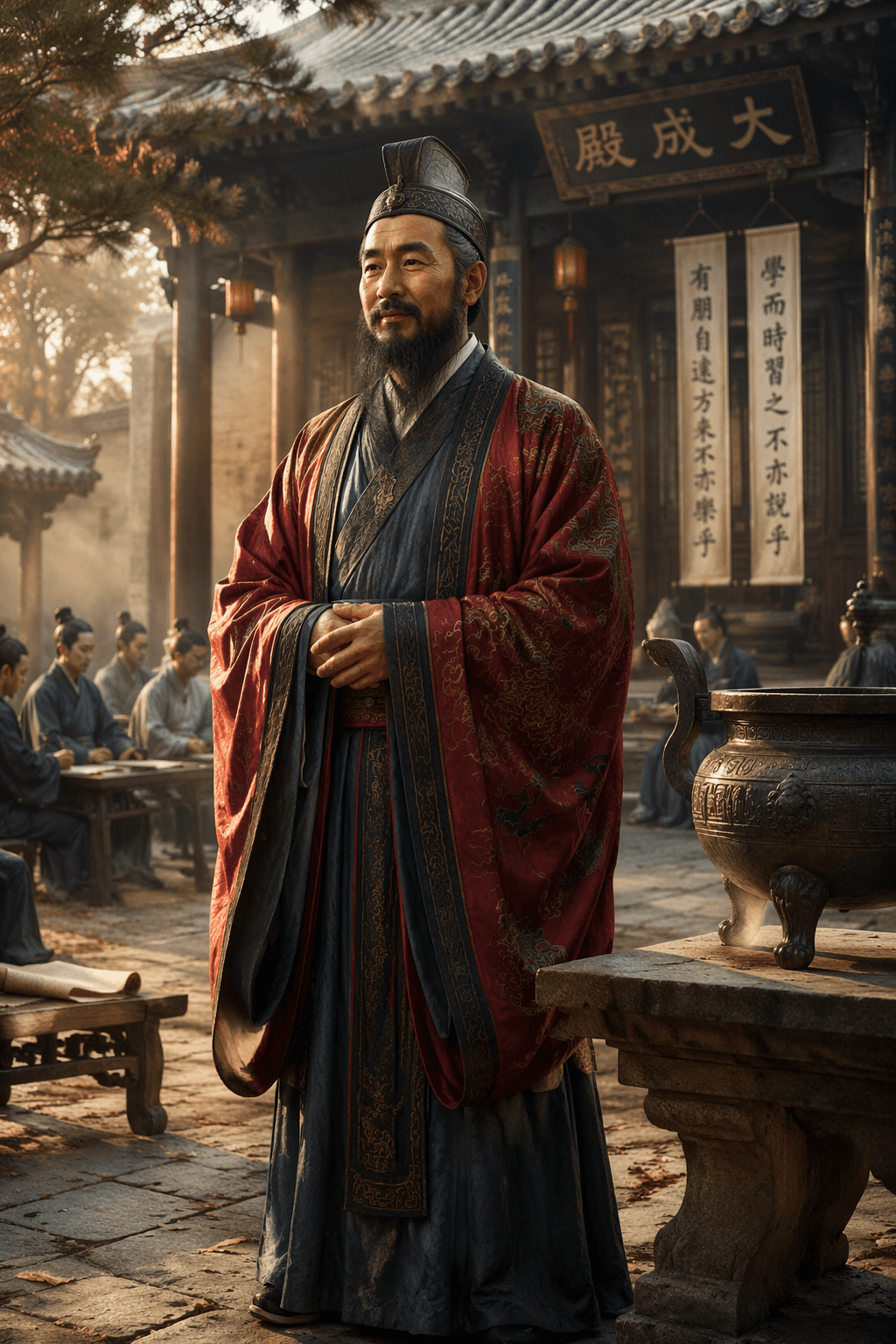
Confucius from State of Lu (551–479 BCE) was a foundational figure in Confucianism. Known for teachings on ren (humaneness), li (ritual propriety), junzi (the exemplary person), Confucius shaped Chinese civilization for millennia.
Biography
The Teacher Who Wandered
Confucius — Kong Qiu, styled Zhongni — was born in 551 BCE in Qufu, a small town in the state of Lu. His father, a military officer, died when Confucius was three, leaving his mother to raise him in modest circumstances. The young Kong Qiu displayed an obsessive interest in ritual: he spent his childhood arranging sacrificial vessels and practicing ceremonial postures, as though the grammar of social forms were a language he was determined to learn before any other. By fifteen, he had "set his heart on learning"; by thirty, he had "stood firm" — meaning he had established a coherent philosophical position and a reputation as a teacher.
His career in government was brief. He served as minister of justice in Lu and reportedly achieved such effectiveness that crime disappeared and neighboring states grew anxious. But political intrigue forced him out, and from age fifty-five to sixty-eight he wandered through the states of eastern China, seeking a ruler who would implement his vision of benevolent governance. No one did. The rulers he met were interested in power, not virtue; in military expansion, not moral cultivation; in short-term advantage, not long-term harmony. Confucius returned to Lu having failed in his political mission but having gathered, along the dusty roads between states, the disciples who would transmit his teachings across millennia.
The Academy at Lu
Back in Qufu, Confucius transformed failure into the most consequential educational project in human history. He accepted any student who could afford the minimal tuition — a bundle of dried meat — regardless of social class. He taught not through lectures but through dialogue, tailoring his instruction to each student's character. To the rash student, he emphasized caution; to the timid student, he emphasized courage. His curriculum covered history, poetry, music, ritual, and politics, but the underlying goal was always moral: to cultivate ren — humaneness — until it became spontaneous rather than deliberate.
The result was a community of practice rather than a school of theory. His disciples did not memorize doctrines; they learned ways of being. Zilu, his most impulsive follower, learned to pause before acting. Yan Hui, his most gifted student, learned to find joy in poverty. Zigong, his most eloquent disciple, learned that brilliance without virtue is mere display. Confucius shaped seventy-two students of exceptional character from three thousand who studied with him — and through their subsequent careers as teachers, officials, and advisors, his influence spread across every state in China.
The Architecture of Virtue
Confucius's philosophy rests on two pillars: ren and li. Ren — humaneness, goodness, the seed of empathy in every heart — is the content of moral life. Li — ritual, propriety, the proper form for every interaction — is the container that makes ren visible and effective. Without ren, li is empty ceremony; without li, ren is vague goodwill. Together, they create what Confucius called the junzi — the exemplary person whose moral character has become so consistent that right action flows naturally.
This architecture extends outward in concentric circles. The person who cultivates ren and li in themselves can manage their family well (qi jia). The person who manages their family can govern their community (zhi guo). The person who governs their community can bring peace to the world (ping tianxia). This is not a utopian fantasy but a logical progression: moral capacity at each scale depends on the same fundamental virtues, applied to increasingly complex relationships. The family is the training ground for society; society is the training ground for civilization.
The Rectification of Names
One of Confucius's most distinctive insights is that social disorder begins with linguistic disorder. When a ruler does not act as a ruler should, the word "ruler" becomes a hollow title, and people stop believing in the obligations it carries. When a father does not fulfill the duties of fatherhood, the word "father" loses its moral weight. Confucius called for zhengming — rectification of names — the practice of ensuring that words and reality remain aligned. This is not pedantry; it is the recognition that language is the operating system of society, and when the operating system corrupts, every program run on it corrupts as well.
The Legacy of Joy
Confucius is often misrepresented as a stern disciplinarian obsessed with hierarchy and ritual. The Analects reveal a different figure: a man who found deep pleasure in learning, in friendship, in music, in the company of his students. His last words were not a doctrinal pronouncement but a song. He laughed frequently, wept at the death of his favorite student, and admitted that he was not yet worthy of the title "junzi." This combination of moral seriousness and human warmth — the insistence that the highest virtue is not sacrifice but cultivated joy — is what makes Confucius relevant to every generation that rediscovers him. He did not offer a system of rules but a way of becoming fully human, and that way begins, as the Analects opens, with the simple delight of learning something new.
Core Concepts
Ren (Humaneness) (仁)
Ren is the central concept of Confucian ethics — a quality that combines empathy, generosity, and moral integrity. It is not merely kindness but a comprehensive virtue: the commitment to treat every person as a full human being, deserving of dignity and respect. Confucius said ren is "to love others," but its full meaning encompasses the entire way of being human well.
仁是儒家伦理的核心概念——结合了同理心、慷慨与道德整全的品质。不仅是善意,而是综合性美德:致力于将每个人都当作完整的人来对待,赋予其尊严与尊重。孔子说仁是"爱人",但其完整含义涵盖了作为一个完整的人的全部方式。
Li (Ritual Propriety) (礼)
Li is the external form that gives ren its shape — the rituals, manners, and social conventions that encode respect and obligation. Without li, ren is an abstract feeling; with li, ren becomes concrete action. Confucius insisted that every human interaction — from greeting a guest to governing a state — has a proper form that makes the virtue within it visible and effective.
礼是赋予仁以形状的外在形式——编码尊重与义务的仪式、礼仪与社会惯例。无礼,仁只是抽象情感;有礼,仁成为具体行动。孔子坚持认为每一次人际互动——从迎接宾客到治理国家——都有使其内在德行可见且有效的恰当形式。
Junzi (The Exemplary Person) (君子)
The junzi is Confucius's model of human excellence — a person who cultivates ren through li, seeks wisdom through study, and maintains moral integrity regardless of circumstances. Unlike the Western hero who achieves greatness through exceptional deeds, the junzi achieves greatness through consistent character. The goal is not to be extraordinary but to be reliably good.
君子是孔子的人格典范——通过礼培养仁、通过学习寻求智慧、无论境遇如何都保持道德整全的人。不同于西方英雄以非凡之举成就伟大,君子以一贯品格成就伟大。目标不是成为非凡之人,而是成为可靠的好人。
Filial Piety (Xiao) (孝)
Xiao — respect and care for parents and ancestors — is the root of Confucian morality. Confucius taught that the virtues that make a good citizen begin in the family: the child who learns to honor parents learns to honor teachers, officials, and ultimately the moral order itself. Xiao is not blind obedience but reciprocal care across generations.
孝——对父母与祖先的尊重与关怀——是儒家道德的根基。孔子教导使一个人成为好公民的德行始于家庭:学会敬父母的孩子会学会敬师长、官员,终至敬道德秩序本身。孝不是盲目服从,而是跨代的互惠关怀。
Rectification of Names (Zhengming) (正名)
Confucius insisted that social disorder begins with linguistic disorder — when words no longer match reality. If a "ruler" does not rule, if a "father" does not father, if a "friend" does not act as a friend, the names become hollow and the social fabric unravels. Rectifying names means ensuring that titles carry their proper obligations and that language remains tethered to reality.
孔子坚持认为社会混乱始于语言混乱——当词语不再匹配现实。"君"不君、"父"不父、"友"不友,名称便成空洞,社会织物便开始散裂。正名意味着确保称号承载其应尽的义务,使语言与现实保持联结。
Notable Quotes
“Is it not a joy to learn and to practice what you have learned? Is it not a delight to have friends come from afar?”
学而时习之,不亦说乎?有朋自远方来,不亦乐乎?
The opening line of the Analects sets Confucius's entire project in motion: learning is not duty but joy; friendship is not convenience but delight. Philosophy begins with pleasure, not with suffering.
“Do not impose on others what you yourself do not desire.”
己所不欲,勿施于人。
This is the Confucian golden rule — the negative formulation that is more cautious and more powerful than its positive counterpart. Rather than assuming you know what others want, it asks only that you refrain from doing what you yourself find harmful. It is a principle of restraint, not presumption.
“At fifteen, I set my heart on learning. At thirty, I stood firm. At forty, I had no doubts. At fifty, I knew the mandate of heaven. At sixty, my ear was attuned. At seventy, I could follow my heart's desire without transgressing what was right.”
吾十有五而志于学,三十而立,四十而不惑,五十而知天命,六十而耳顺,七十而从心所欲,不逾矩。
Confucius's autobiography compressed into six stages — not achievements but states of inner freedom. The trajectory moves from aspiration through stability, clarity, and cosmic understanding, ending in the paradox of total spontaneity within total moral alignment. The ultimate freedom is not freedom from morality but freedom within it.
“The superior man is universal in his outlook, not partisan; the inferior man is partisan, not universal.”
君子周而不比,小人比而不周。
The junzi takes the whole picture into account, weighing multiple perspectives before acting; the petty person aligns with factional interests. Partisanship is not merely a political vice — it is a failure of moral imagination, the inability to see beyond one's own group.
“By nature, people are alike; by practice, they grow far apart.”
性相近也,习相远也。
Confucius affirms a common human nature but insists that what differentiates people is habit and cultivation. This is the philosophical foundation for education — if character is formed by practice, then practice can be guided, and moral development becomes a teachable skill rather than an inherited fate.
“Learning without thought is labor lost; thought without learning is perilous.”
学而不思则罔,思而不学则殆。
Confucius warns against two symmetrical errors: accumulating information without reflecting on it (you become a walking encyclopedia with no understanding), and reflecting without grounding your thoughts in study (you become an armchair theorist disconnected from reality). True understanding requires both input and digestion.
“When you see a worthy person, think of equaling them; when you see an unworthy person, reflect on your own character.”
见贤思齐焉,见不贤而内自省也。
Every encounter becomes material for self-improvement. The worthy person shows what is possible; the unworthy person reveals what to guard against in yourself. Confucius transforms the entire social world into a mirror for moral development.
“The people are the most important element in a state; the spirits of the land and grain are next; the sovereign is the least.”
民为贵,社稷次之,君为轻。
This ranking — people above rulers — is one of the most radical statements in ancient political thought. It places the welfare of the common population above both the territorial state and the sovereign, establishing a proto-democratic principle of governance that prioritizes the people's interests.
Modern Influence
Confucian Values in East Asian Business
Confucius's emphasis on hierarchy, mutual obligation, and long-term relationships remains visible in East Asian business culture. The Korean chaebol, the Japanese keiretsu, and Chinese family enterprises all operate on Confucian assumptions: loyalty flows upward, protection flows downward, and relationships are built over decades rather than quarters. Western analysts often misread these as corruption; they are, in fact, the ren and li of economic life.
Confucian Education and Modern Pedagogy
Confucius was arguably the world's first professional teacher, and his pedagogical principles — individualized instruction, moral education alongside intellectual training, and learning as a lifelong practice — remain foundational in East Asian schooling. The emphasis on respect for teachers, on memorization as a precursor to understanding, and on moral character as the goal of education all trace back to his academy.
Confucianism and Human Rights Discourse
Confucius's doctrine that the people are the foundation of the state and that rulers who lose virtue lose legitimacy has been reinterpreted by modern scholars as an indigenous source for accountable governance. Scholars like Joseph Chan and Tu Weiming argue that Confucian values of ren (humaneness) and reciprocity can ground human rights in relational ethics rather than individual autonomy, offering an alternative foundation for universal dignity.
Read the Story
Experience Confucius's philosophy through Sophie's narrative journey.
Read Chapter →Key Concepts · 核心概念
Explore these Confucianism concepts in our glossary →
Related Content 相关内容
Frequently Asked Questions常见问题
What is Confucius known for?孔子 以什么著称?+
Confucius (551–479 BCE) is known for Ren (Humaneness), Li (Ritual Propriety), Junzi (The Exemplary Person). As a key figure in Confucianism, Confucius's ideas shaped Chinese thought for centuries.
What era did Confucius live in?孔子 生活在什么时代?+
Confucius lived during the 551–479 BCE. Based in State of Lu.
What school of thought did Confucius found or belong to?孔子 属于哪个学派?+
Confucius belonged to the Confucianism school (儒家).
Want to speak with Confucius 孔子? Try the Oracle.
Consult the Oracle →Free: 3 consultations per day · Pro: 10 per day + deep readings