Mencius
孟子
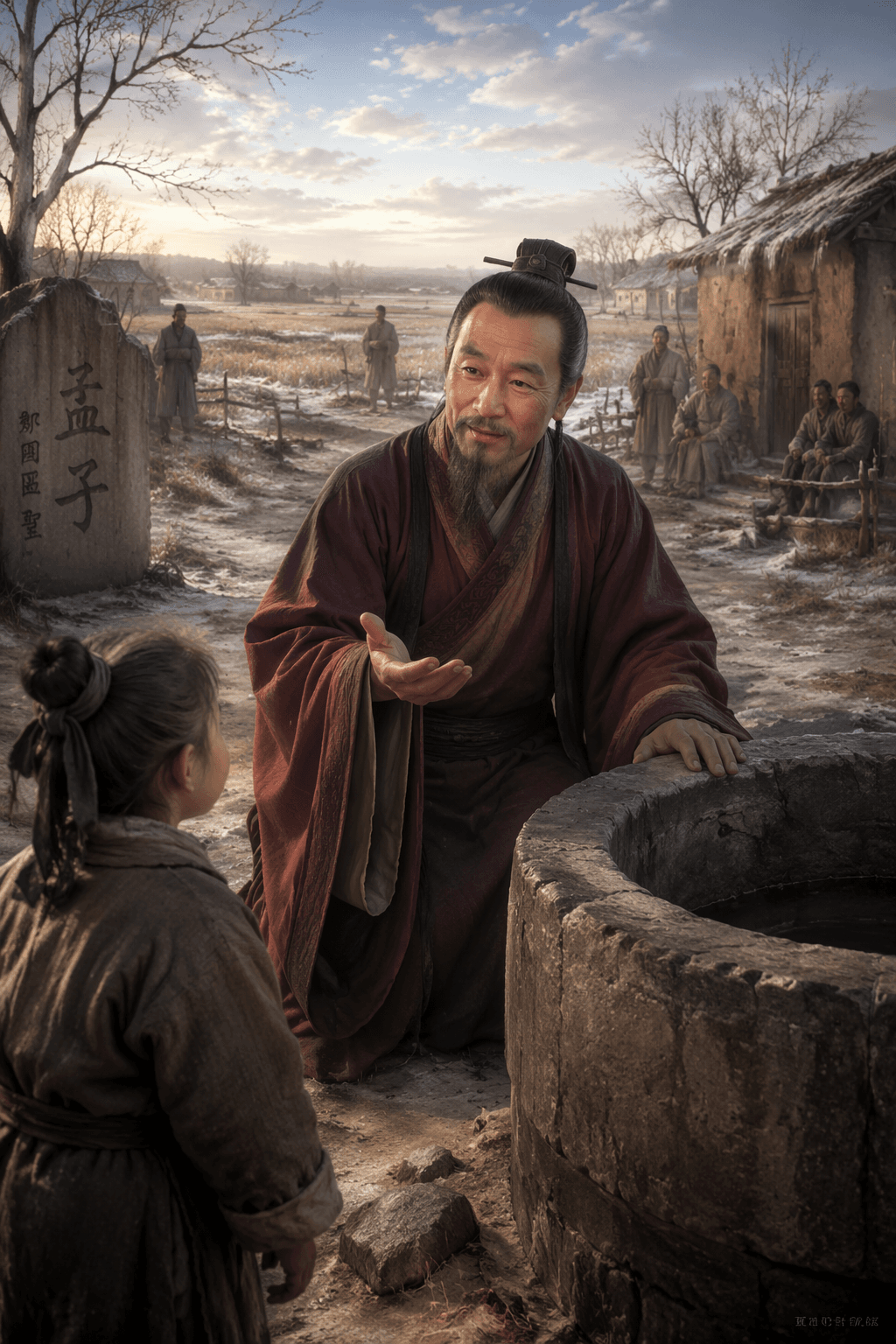
Mencius (372–289 BCE) was a foundational figure in Confucianism. Known for teachings on innate goodness (xing shan), benevolent governance (ren zheng), the four sprouts, Mencius shaped Chinese civilization for millennia.
Biography
The Second Sage Who Believed in Humanity
Mencius — Meng Ke of Zou — is the philosopher who dared to assert that human nature is fundamentally good, at a time when every other major thinker was arguing that it is selfish, savage, or empty. Born around 372 BCE in the small state of Zou, he was raised by a mother famous for her dedication to his education. The story of "Mencius's mother moving three times" is one of the most beloved legends in Chinese culture: she first lived near a cemetery, where the young Meng Ke imitated mourning rituals; then near a market, where he imitated haggling; and finally near a school, where he imitated scholarship. She settled there, and Mencius became a philosopher rather than a mourner or a merchant.
He studied under disciples of Zisi, Confucius's grandson, and inherited the Confucian tradition of benevolent governance. Like Confucius, he spent decades traveling from state to state, trying to persuade rulers to adopt his vision of ren zheng — benevolent governance. Unlike Confucius, he was more direct and more confrontational. He told King Hui of Liang that the king's desire for profit would destroy his state; he told King Xuan of Qi that the king's compassion for an ox led to slaughter showed he had the sprouts of benevolence but was failing to cultivate them; he told every ruler he met that legitimacy belongs to those who serve the people, not to those who dominate them. No ruler fully implemented his program. Mencius returned to Zou in his final years and, with his disciples, composed the text that bears his name.
The Argument for Innate Goodness
Mencius's most original and most contested contribution is his theory that human nature is inherently good. His argument is empirical rather than metaphysical. He does not claim that all people always act well; he claims that every person carries innate moral "sprouts" — the seeds of virtue that need cultivation but do not need creation. The sprout of compassion is the distress you feel when you see a child about to fall into a well — not because you want to befriend the child's parents, not because you want praise, not because you fear the reputation of callousness, but because something in you simply cannot bear the sight of suffering. This spontaneous reaction, Mencius argues, proves that compassion is natural, not learned.
The same applies to shame, respect, and moral discernment. You do not learn to feel shame at wrongdoing; you discover it already present within you. You do not learn to feel respect for elders; the feeling arises unbidden. You do not learn to distinguish right from wrong; the capacity for moral judgment is part of your original equipment. What education does is not to install these capacities but to cultivate them — to water the sprouts, give them sunlight, protect them from weeds, and guide them toward their full growth as the four cardinal virtues: humaneness, righteousness, propriety, and wisdom.
Benevolent Governance as Pragmatic Policy
Mencius's political philosophy is not utopian idealism but pragmatic governance grounded in moral principle. He argues that benevolent rule is more effective than tyrannical rule — not because benevolence is more virtuous but because it produces better results. "When the people have constant livelihood, they will have constant hearts; when they lack constant livelihood, they will lack constant hearts." This is an observation about human psychology: people who are fed, housed, and secure can afford to be moral; people who are desperate cannot. The wise ruler therefore provides material security first, knowing that moral stability follows naturally.
Mencius's specific policy recommendations are remarkably progressive. He proposed land reform to ensure every family had a plot to farm. He advocated reducing taxes to the minimum necessary for state functions. He insisted that rulers must protect forests and fisheries from overexploitation. He argued that education should be available to all, not just the elite. Each of these policies has a moral foundation (care for the people) and a practical foundation (a prosperous, educated population is more loyal, more productive, and more stable than an exploited one). Mencius understood, long before modern social science, that welfare and governance are not separate domains but aspects of a single system.
The People Above the Ruler
Mencius's most radical principle is his ranking of political priorities: the people first, the state second, the ruler last. This is not merely a rhetorical flourish; it is a substantive claim about the nature of political legitimacy. The ruler exists to serve the people, not the reverse. When a ruler oppresses his people, he forfeits the mandate of heaven and becomes, in Mencius's explicit language, a mere "solitary fellow" — a man with no legitimate authority. The people have the right to resist, and in extreme cases, to remove him.
This principle made Mencius dangerous to every tyrant who encountered him, and it makes him relevant to every debate about accountable governance that occurs today. The idea that legitimacy flows from popular welfare rather than from divine appointment or military power is the foundation of every modern democracy. Mencius articulated it in the fourth century BCE, with the clarity and courage of someone who believed that moral truth is worth more than political safety.
The Vast, Resolute Qi
Mencius's concept of haoran zhi qi — the vast, resolute energy produced by accumulated righteousness — is one of the most distinctive ideas in Chinese philosophy. It describes a moral stamina that grows through consistent practice of virtue and evaporates through inconsistency. You cannot generate it by one heroic act; you build it through daily, unglamorous choices to do what is right. When it fills you, you become unshakable — not because you are physically strong but because your moral center has been exercised until it can bear any weight. This is the energy that allowed Mencius to tell kings they were wrong, to face exile without regret, to maintain his convictions through decades of political failure. It is, in modern terms, moral resilience — and Mencius understood that it is built the same way physical resilience is built: through steady training rather than sporadic effort.
Core Concepts
Innate Goodness (Xing Shan) (性善论)
Mencius's central philosophical claim: human nature is fundamentally good. Every person carries four innate "sprouts" — compassion, shame, respect, and the sense of right and wrong — which are the seeds of the four cardinal virtues. These sprouts need cultivation, not creation. Evil arises not from nature but from neglect, abuse, or perverse conditioning that kills the sprouts before they can grow.
孟子的核心哲学主张:人性本善。每个人天生携带四个"萌芽"——恻隐、羞恶、恭敬、是非——是四种核心德行的种子。这些萌芽需要培育而非创造。恶不来自本性而来自忽视、虐待或扭曲的教养,后者在萌芽能够生长之前便扼杀了它们。
Benevolent Governance (Ren Zheng) (仁政)
Mencius's political program: rulers must govern through compassion rather than coercion, providing for the people's basic needs before demanding their loyalty. "When the people have constant livelihood, they will have constant hearts; when they lack constant livelihood, they will lack constant hearts." Benevolent governance is not charity but the precondition for a stable, moral society.
孟子的政治纲领:统治者必须以同情而非胁迫治理,先满足人民基本需要再要求其忠诚。"民有恒产则有恒心,无恒产则无恒心。"仁政不是慈善而是稳定道德社会的前提。
The Four Sprouts (四端)
Mencius identifies four innate moral tendencies: compassion (*ceyin*) that grows into humaneness (*ren*), shame (*xiwu*) that grows into righteousness (*yi*), respect (*cirang*) that grows into propriety (*li*), and moral discernment (*shifei*) that grows into wisdom (*zhi*). These are not fully formed virtues but potentialities — like seeds that need water, sunlight, and good soil to become trees.
孟子识别四种先天道德倾向:恻隐之心长为仁,羞恶之心长为义,恭敬之心长为礼,是非之心长为智。这些不是已成形的德行而是潜能——如需要水、阳光与好土才能长成树的种子。
Noble Spirit (Haoran Zhi Qi) (浩然之气)
Mencius describes a cultivated moral energy — "the vast, resolute qi" — that fills the body and spirit of the person who has consistently practiced righteousness. It is not physical courage but moral courage: the unwavering commitment to principle that persists even when doing right leads to suffering. "It is produced by accumulated righteousness and cannot be obtained by sporadic acts."
孟子描述了一种修习的道德能量——"浩然之气"——充满持续践行正义者的身体与精神。这不是身体的勇气而是道德勇气:即使做正确的事导致痛苦也不动摇的原则承诺。"其为气也,配义与道;无是,馁也。是集义所生者,非义袭而取之也。"
People as Foundation (Minben) (民本)
Mencius's revolutionary political principle: the people are the most important element, the state is secondary, the ruler is least. Legitimacy flows from popular welfare, not from divine appointment or military power. A ruler who oppresses his people is not a ruler but a tyrant, and the people have the right — even the duty — to resist him.
孟子的革命性政治原则:人民最重要,国家其次,君主最轻。合法性来自民生而非天命或武力。压迫人民的统治者不是君主而是暴君,人民有权——甚至有义务——反抗他。
Notable Quotes
“The people are the most important element in a state; the altars of the soil and grain are next; the sovereign is the least.”
民为贵,社稷次之,君为轻。
Mencius ranks the people above both the territorial state and the sovereign — a principle that anticipates democratic accountability by two millennia. The ruler's legitimacy derives entirely from the people's welfare; when the people suffer, the ruler has no moral standing to govern.
“No man is devoid of a heart sensitive to the suffering of others. Suppose a man suddenly sees a child about to fall into a well — he will certainly feel alarm and distress. This is not because he wants friendship with the child's parents, nor because he seeks praise from neighbors and friends, nor because he dislikes the reputation of being callous.”
人皆有所不忍。今人乍见孺子将入于井,皆有怵惕恻隐之心。非所以内交于孺子之父母也,非所以要誉于乡党朋友也,非恶其声而然也。
Mencius's most famous argument for innate goodness. The spontaneous distress at a child's danger is not calculated, not social, not self-interested — it is the pure operation of the moral sprout of compassion before any reasoning intervenes. This is the empirical proof, drawn from everyday experience, that goodness is natural.
“When the people have constant livelihood, they will have constant hearts. When they lack constant livelihood, they will lack constant hearts. Without constant hearts, they will become depraved and wicked.”
民之为道也,有恒产者有恒心,无恒产者无恒心。苟无恒心,放僻邪侈,无不为已。
Mencius recognizes that moral stability requires economic stability. You cannot demand virtue from people who are starving; you must first provide the material conditions in which virtue can flourish. This is a profoundly humane economics that links welfare policy directly to moral development.
“He who uses virtue to practice benevolence will become a true king. He who uses force to simulate benevolence will become a nominal king. The former gains the hearts of the people; the latter gains only their obedience.”
以德行仁者王,以力假仁者霸。以德行仁者,民心也;以力假仁者,民力也。
Mencius distinguishes between genuine benevolence (which wins hearts) and simulated benevolence (which wins only physical compliance). The true king governs by moral authority that people willingly follow; the霸 (hegemon) governs by force that people submit to unwillingly. The difference is between genuine legitimacy and coerced obedience.
“If the ruler makes serious mistakes, they should be remonstrated. If repeated remonstrance is ignored, the ruler should be removed.”
君有大过则谏,反复之而不听,则易位。
Mencius explicitly advocates the removal of a ruler who refuses to correct serious moral errors. This is not merely criticism — it is a constitutional principle of accountable governance that places the people's welfare above the ruler's tenure. It anticipates the concept of impeachment by two thousand years.
“Firm in his will, resolute in his conduct, he does not exchange his principles even for the whole world.”
富贵不能淫,贫贱不能移,威武不能屈,此之谓大丈夫。
Mencius defines the "great man" — not by wealth or power but by moral integrity that remains unwavering regardless of circumstance. Riches cannot corrupt him, poverty cannot deflect him, violence cannot bend him. True greatness is not what you achieve but what you refuse to compromise.
“The vast, resolute qi is produced by accumulated righteousness and cannot be obtained by sporadic acts. It fills the space between heaven and earth.”
其为气也,至大至刚,以直养而无害,则塞于天地之间。其为气也,配义与道;无是,馁也。是集义所生者,非义袭而取之也。
Mencius describes a moral energy that accumulates through consistent practice of righteousness and evaporates through inconsistency. It is not the result of one heroic act but of sustained moral effort — a physical-spiritual force that makes the practitioner unshakable. The concept anticipates modern understandings of moral resilience and psychological stamina.
Modern Influence
Mencius and Modern Human Rights
Mencius's doctrine that the people are the most important element of the state, and that rulers who fail their people lose legitimacy, has been reclaimed by modern scholars as an indigenous Chinese foundation for democratic accountability. Unlike Western rights theory that begins with individual autonomy, Mencius grounds human dignity in relational obligation — the mutual care that binds ruler and subject, parent and child, friend and friend. This relational model offers a complementary foundation for universal human rights that does not depend on the Western liberal tradition.
Mencius in Developmental Psychology
Mencius's theory of innate moral sprouts anticipates modern findings in developmental psychology. Research by Paul Bloom and others has shown that infants display proto-moral behavior — preference for helpful agents, distress at harm — before any socialization occurs. Mencius argued that compassion, shame, respect, and the sense of right and wrong are innate "sprouts" that need cultivation; modern science is confirming that the raw material of morality is indeed present from birth.
Mencius and Environmental Ethics
Mencius's insistence that rulers must protect the natural environment — he warned against deforestation and overfishing — makes him an early voice for ecological governance. His argument that destroying the environment destroys the people's livelihood connects human welfare to ecological health in a way that modern sustainability frameworks echo. "If you do not interfere with the busy seasons in the fields," he wrote, "the grain will be more than can be eaten."
Read the Story
Experience Mencius's philosophy through Sophie's narrative journey.
Read Chapter →Key Concepts · 核心概念
Explore these Confucianism concepts in our glossary →
Related Content 相关内容
Frequently Asked Questions常见问题
What is Mencius known for?孟子 以什么著称?+
Mencius (372–289 BCE) is known for Innate Goodness (Xing Shan), Benevolent Governance (Ren Zheng), The Four Sprouts. As a key figure in Confucianism, Mencius's ideas shaped Chinese thought for centuries.
What era did Mencius live in?孟子 生活在什么时代?+
Mencius lived during the 372–289 BCE.
What school of thought did Mencius found or belong to?孟子 属于哪个学派?+
Mencius belonged to the Confucianism school (儒家).
Want to speak with Mencius 孟子? Try the Oracle.
Consult the Oracle →Free: 3 consultations per day · Pro: 10 per day + deep readings