Huineng
慧能
Lingnan · 岭南
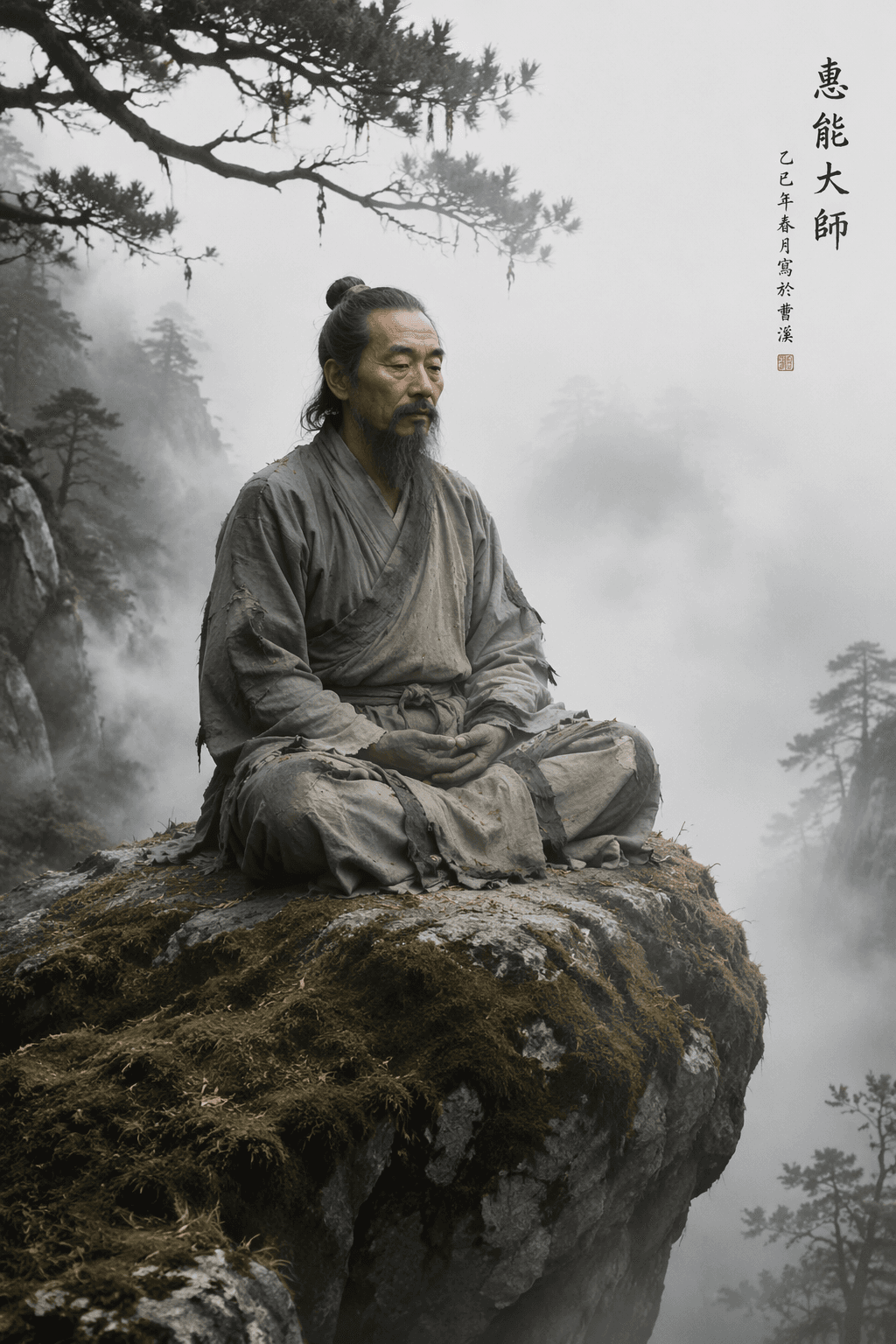
Huineng from Lingnan (638–713 CE) was a foundational figure in Zen Buddhism. Known for teachings on sudden enlightenment (dun wu), no-mind (wu nian), originally not a single thing (benlai wu yi wu), Huineng shaped Chinese civilization for millennia.
Biography
The Woodcutter Who Became the Sixth Patriarch
Huineng's story is the most radical origin narrative in the history of philosophy. He was born in 638 CE in Lingnan — the far south of China, then considered a frontier backwater — to an illiterate family. His father died when he was young, and Huineng supported his mother by selling firewood in the market. He could not read. He had no education. He had no social standing. By every standard of the Buddhist establishment — which valued scholarship, monastic discipline, and aristocratic background — Huineng was disqualified from spiritual attainment before he even began.
Then, one day, he heard a stranger reciting the Diamond Sutra. The line that struck him was "one should produce a mind that does not abide in anything" — a single phrase that condensed the entire teaching of non-attachment into seven words. Something opened in the woodcutter's mind: not a thought, not an understanding, but a direct seeing that bypassed every conceptual barrier. He did not analyze the phrase; he saw what it pointed to. This moment of recognition — not gradual study, not disciplined meditation, not doctrinal mastery — was the seed of what would become the most influential school of Zen Buddhism.
The Verse That Won the Dharma
Huineng traveled north to the monastery of Hongren, the Fifth Patriarch, at Huangmei. Hongren, testing him, asked what a man from the barbaric south could possibly seek at the monastery. Huineng replied: "People may have north and south, but Buddha-nature has no north and south." Hongren recognized the reply's depth but, to avoid provoking the monastery's elite monks, sent Huineng to the threshing floor, where he worked for eight months splitting grain with a pestle.
When Hongren announced that he would select his successor by requiring each monk to submit a verse demonstrating their understanding, the senior monk Shenxiu — the obvious candidate, a scholar of great learning and long practice — wrote on the wall: "The body is the Bodhi tree, the mind is like a bright mirror on a stand. At all times we should strive to polish it, and not let dust collect." This verse expresses the Northern School's doctrine of gradual enlightenment: the mind is a mirror that must be kept clean through constant practice. It is orthodox, respectable, and, in Huineng's judgment, fundamentally mistaken.
Huineng, still in the threshing room, heard the verse and asked a monk to write his response on the wall (he could not write himself). The response was: "Bodhi originally has no tree, the mirror also has no stand. Originally there is not a single thing, so where could dust gather?" This verse demolishes Shenxiu's premise. If there is no mirror, there is no surface for dust to collect on. The mind is originally empty; it does not need to be kept clean because there is nothing to dirty. Hongren, recognizing the deeper understanding, came to the threshing room at night, expounded the Diamond Sutra to Huineng, and transmitted the robe and bowl of the patriarchate — then told Huineng to flee south immediately, because the monastery's senior monks would kill him if they learned what had happened.
The Wind and the Banner
Huineng hid in the south for fifteen years. When he finally appeared publicly, it was at the temple in Guangzhou during a famous debate. Two monks were arguing about a banner flapping in the wind. One said the wind was moving; the other said the banner was moving. Huineng stepped in and said: "It is not the wind moving, and it is not the banner moving. It is your minds that are moving." This statement — which became one of the most famous pronouncements in Zen history — is not a claim that external reality does not exist. It is a claim that every perception is mediated by consciousness, and that the first step toward wisdom is recognizing this mediation. Wind and banner are real; but what makes them "moving" rather than "still" is the mind that interprets the visual data. Understanding this interpretive layer — seeing that what you experience is always a collaboration between external reality and internal consciousness — is the beginning of the path Huineng teaches.
Sudden Enlightenment and the Southern School
Huineng's doctrine of sudden enlightenment (dun wu) is not a claim that practice is unnecessary. It is a claim about the nature of the goal. Enlightenment is not something you achieve through accumulation — you do not pile up merit, knowledge, or meditative experience until you eventually become Buddha. You are already Buddha; enlightenment is the recognition of this fact. The journey is not from ignorance to wisdom but from the illusion that you are ignorant to the realization that you have always been awake. Practice does not create enlightenment; practice removes the obstacles that prevent you from seeing what is already there.
This is the core of the Southern School's difference from the Northern School. Shenxiu's Northern School teaches gradual cultivation: the mind is a mirror, practice polishes the mirror, and eventually the mirror is so clean that enlightenment occurs. Huineng's Southern School teaches sudden recognition: the mirror does not exist, the mind is originally empty, and enlightenment is the direct seeing of this emptiness. Practice is still necessary — but its purpose is not to accumulate merit or polish a mirror; it is to remove the habits of thinking that obscure the already-present recognition of your Buddha-nature.
The Platform Sutra
Huineng's teachings are recorded in the Platform Sutra — the only text in the Buddhist tradition that is titled "sutra" (a designation normally reserved for teachings attributed to the Buddha himself) rather than "commentary" or "treatise." This extraordinary status reflects the Zen tradition's view that Huineng's words carry the same authority as the Buddha's — not because Huineng is divine but because his understanding is identical to the Buddha's understanding. The Platform Sutra teaches "no-mind as the principle, no-form as the substance, no-abiding as the foundation." No-mind: thoughts arise but you do not fixate on them. No-form: reality has no fixed shape, so you do not cling to appearances. No-abiding: the mind does not dwell on any object or experience, flowing freely through every encounter. These three principles are not separate practices but aspects of a single way of being: the way of being present without getting stuck, aware without fixing, and empty without being hollow. Huineng's Zen is not a method but a manner — the manner of being fully present in whatever you are doing, whether chopping wood or carrying water, sitting in meditation or walking in the market, and recognizing that this presence is itself the enlightenment you have been seeking.
Core Concepts
Sudden Enlightenment (Dun Wu) (顿悟)
Huineng's signature doctrine: enlightenment is not the result of gradual accumulation of merit, knowledge, or meditative experience. It occurs in a single moment of direct seeing — the recognition that your original nature is already complete and has always been awake. You do not become enlightened; you realize you already are. The journey is not from ignorance to wisdom but from the illusion of ignorance to the recognition of already-present wisdom.
慧能标志性的学说:觉悟不是渐进积累功德、知识或禅定经验的结果。它发生在直接看见的一瞬间——认出你的本来面目已然完整、始终清醒。你不是成为觉悟的;你意识到你已经是。旅程不是从无知到智慧,而是从无知之幻到已然存在之智慧的认出。
No-Mind (Wu Nian) (无念)
Huineng's practice of "no-mind" is not the suppression of thoughts but the cessation of attachment to thoughts. Thoughts arise and pass; the problem is not thinking but clinging to thoughts as though they represent a permanent self. "No-mind" means seeing thoughts as passing weather in an otherwise clear sky — you notice them, but you do not identify with them or pursue them.
慧能"无念"的实践不是压制念头而是停止对念头的执着。念头升起又消失;问题不在思维而在将念头当作恒常自我的执着。"无念"意味着将念头视为晴空中的过境天气——你注意到它们,但不认同它们或追逐它们。
Originally Not a Single Thing (Benlai Wu Yi Wu) (本来无一物)
Huineng's verse declares that the mind has no inherent substance, structure, or content — it is originally empty, like a mirror that has no stand and no surface. This is not nihilism but the deepest affirmation: the mind's emptiness is what makes it capable of manifesting infinite awareness. A mirror that is already clean does not need to be wiped; a mind that is originally empty does not need to be purified.
慧能的偈颂宣布心灵没有固有实质、结构或内容——它本来是空的,如无台无面的镜子。这不是虚无主义而是最深的确证:心灵的空无使它有能力展现无限的觉知。已净的镜无需拂拭;本空的心无需清净。
Direct Seeing (Jian Xing) (见性)
Huineng's method: see your own nature directly, without mediation by texts, doctrines, rituals, or teachers. "Your own nature is Buddha; there is no other Buddha." Enlightenment is not acquired from outside but recognized from inside. The function of a teacher is not to give you something you lack but to point out what you already have and have been overlooking.
慧能的方法:直接看见自己的本性,不经文本、教义、仪式或老师的中介。"自性即佛,无别佛。"觉悟不是从外在获得而是从内在认出。老师的功能不是给你你缺少的东西而是指出你已有却一直忽视的东西。
Non-Abiding (Wu Zhu) (无住)
The mind should not abide — should not fixate or dwell — on any object, idea, or experience. "When thoughts do not abide in anything, the mind is free." This is not detachment in the Western sense (keeping yourself separate from experience) but full engagement without fixation: you experience everything fully without getting stuck in any particular experience. The mind flows like water, touching everything, holding nothing.
心不应住——不应固定或驻留——于任何对象、观念或经验。"念念不住,即心自由。"这不是西方意义上的超脱(将自己与经验分离)而是全然投入而不执着:你完全体验一切但不卡在任何特定体验中。心如水流,触及一切,不持任何。
Notable Quotes
“Bodhi has no tree, the mirror has no stand. Originally there is not a single thing, so where could dust gather?”
菩提本无树,明镜亦非台,本来无一物,何处惹尘埃。
The verse that won Huineng the dharma transmission. Shenxiu's verse assumed the mind is a mirror that must be kept clean; Huineng's verse denies the mirror exists at all. If there is no mirror, there is no surface for dust to gather on. The mind is originally empty; it does not need purification because there is nothing to purify. This is not nihilism but the ultimate affirmation of inherent completeness.
“Your own nature is Buddha. There is no other Buddha. If you seek Buddha outside yourself, you will never find him.”
自性即佛,无别佛。向外求佛,终不可得。
Huineng eliminates the distinction between practitioner and goal. You are not a person seeking to become Buddha; you are Buddha who has forgotten your nature. The journey is not from here to there but from the illusion of being here to the recognition that you were always there. Enlightenment is the discovery of what you have never lost.
“It is not the wind that moves, nor the banner that moves. It is your mind that moves.”
不是风动,不是幡动,仁者心动。
Huineng's famous statement at the debate over the moving banner. The monks argued whether it was the wind or the banner that was moving; Huineng pointed out that both wind and banner are appearances in consciousness, and what is truly moving is the mind that perceives them. This is not solipsism but a statement about the relationship between perception and reality: every experience is mediated by consciousness, and understanding this mediation is the beginning of wisdom.
“The mind should not abide in any object. When thoughts do not abide in anything, the mind is free. This is what I call 'no-mind.'”
心不住于任何物。念念不住,即心自由。此即所谓无念。
Huineng defines his central practice: not suppression of thought but cessation of fixation. Thoughts arise naturally; the problem is not thinking but dwelling — getting stuck on a particular thought and treating it as important or permanent. No-mind is not blankness but flow: you think, but you do not hold your thoughts.
“Enlightenment does not come from outside. It comes from seeing your own nature. If you cannot see your own nature, chanting sutras, making offerings, and observing rituals will bring you no benefit.”
悟不从外来,从见自性来。若不见自性,诵经供养修福,皆为无益。
Huineng's radical democratization of enlightenment. No ritual, no text, no teacher can give you what you already have. The entire apparatus of Buddhist practice — sutras, ceremonies, monastic discipline — is useful only if it helps you see your own nature. If it substitutes for that seeing, it becomes a obstacle rather than a path.
“In this teaching, there is no distinction between North and South, no difference between sudden and gradual. People are sharp or dull, but the dharma is one.”
法无南北,顿渐无异。人有利钝,法即一也。
Huineng reconciles the split between the Northern School (gradual enlightenment) and the Southern School (sudden enlightenment). The dharma itself is one; it is only people's capacities that differ. A sharp person sees immediately; a dull person needs preparation. But the destination is the same for both — recognition of the already-present Buddha-nature.
Modern Influence
Huineng and Modern Mindfulness
Huineng's teaching that true awareness is not about sitting in meditation but about being present in every moment — chopping wood, carrying water — has become the philosophical foundation of the modern mindfulness movement. When Jon Kabat-Zinn developed Mindfulness-Based Stress Reduction (MBSR) at the University of Massachusetts in 1979, he was drawing on Zen principles that trace directly back to Huineng's insight that meditation is not a special activity but a way of being in whatever activity you are already doing.
Huineng in Western Philosophy of Mind
Huineng's declaration "originally there is not a single thing" — his radical denial that the mind has any inherent structure or content — anticipates the most radical positions in Western philosophy of mind. Thomas Metzinger's "no-self" model of consciousness, the Buddhist-influenced neurophilosophy of Francisco Varela, and the enactivist theory that mind is not a thing but a process all echo Huineng's insistence that what we call "mind" is not a mirror or a container but a dynamic, empty process that manifests awareness without possessing any fixed identity.
Huineng and Popular Culture
The story of the illiterate woodcutter who became the Sixth Patriarch through a single verse has become one of the most beloved narratives in world religious literature. It has inspired novels (Hermann Hesse's Siddhartha draws on Zen themes), films, and countless TED talks about the power of direct experience over formal education. Huineng's story validates the insight that wisdom does not require credentials — it requires only the capacity to see clearly.
Read the Story
Experience Huineng's philosophy through Sophie's narrative journey.
Read Chapter →Related Content 相关内容
Frequently Asked Questions常见问题
What is Huineng known for?慧能 以什么著称?+
Huineng (638–713 CE) is known for Sudden Enlightenment (Dun Wu), No-Mind (Wu Nian), Originally Not a Single Thing (Benlai Wu Yi Wu). As a key figure in Zen Buddhism, Huineng's ideas shaped Chinese thought for centuries.
What era did Huineng live in?慧能 生活在什么时代?+
Huineng lived during the 638–713 CE. Based in Lingnan.
What school of thought did Huineng found or belong to?慧能 属于哪个学派?+
Huineng belonged to the Zen Buddhism school (禅宗).
Want to speak with Huineng 慧能? Try the Oracle.
Consult the Oracle →Free: 3 consultations per day · Pro: 10 per day + deep readings