Originally Nothing
本来无一物
Huineng 惠能 · 638–713 CE · Caoxi (modern Guangdong)
“Originally there is not a single thing — where could dust gather?”— Platform Sutra (六祖坛经)
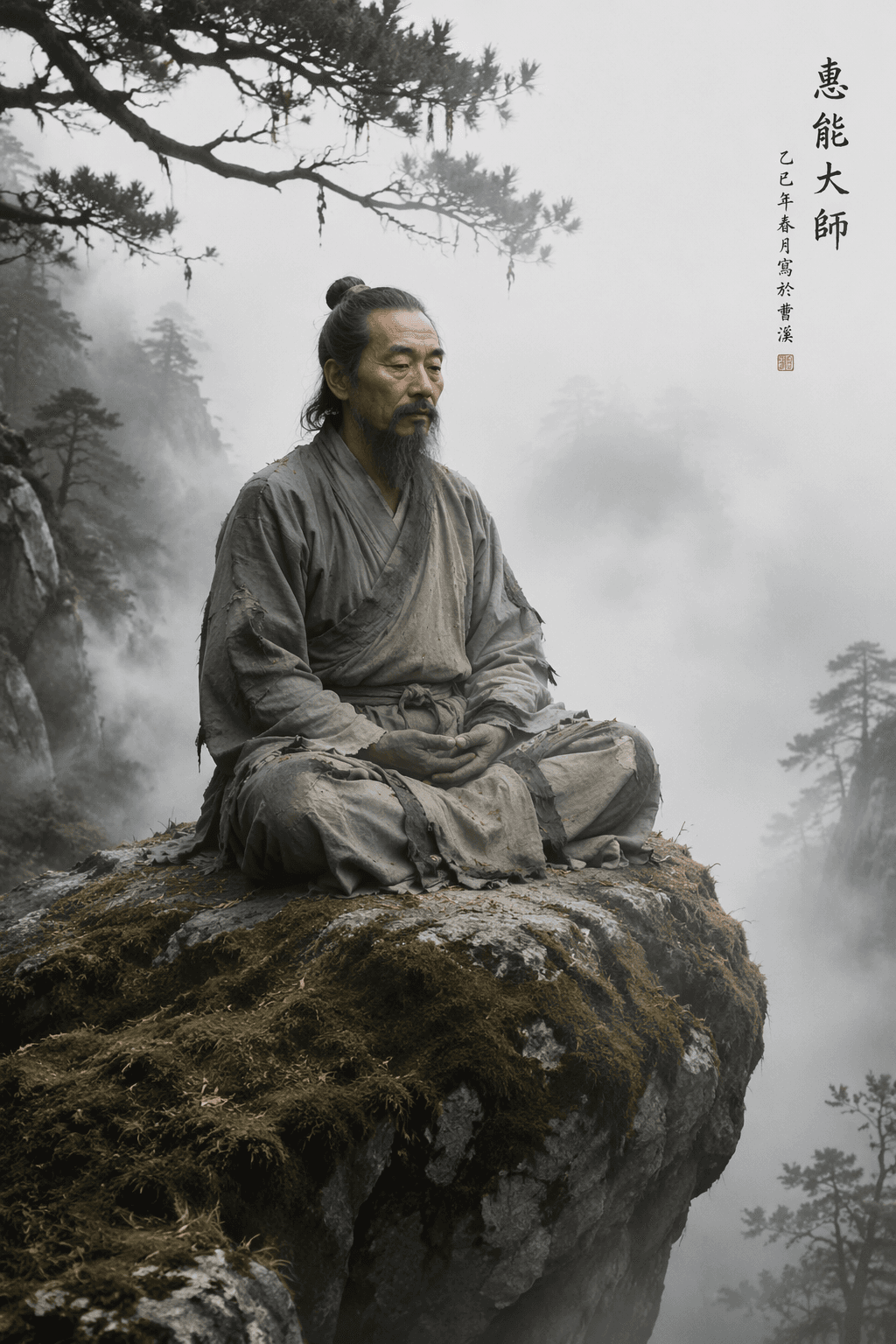
惠能
Chapter 9 of Sophie's Journey East featuring Huineng (zen). Opening quote: "Originally there is not a single thing — where could dust gather?"
Originally Nothing
The mountain path ended at nothing.
Not at a temple gate, not at a clearing with a wise figure waiting on a stone. It ended at moss and silence and a cold white fog that swallowed the trees whole. Sophie stood where the trail dissolved, breathing hard, and felt the weight of everything she had learned pressing against the inside of her skull like a crowd trying to leave through a single door.
Laozi told her to stop trying. Confucius told her to try harder. Mencius said human nature was good. Zhuangzi said human nature was a butterfly dreaming it was human. Zhu Xi told her to investigate things. Zhang Zai told her she was made of the same qi as the stars. Sunzi told her to plan. Mozi told her to love everyone equally.
Each teaching made perfect sense in the moment of hearing it. But now, standing on this mountain in Guangdong province with the fog rolling over her shoes, they collided inside her like waves in a closed harbor — canceling each other out, leaving only noise.
She had come here seeking peace. Someone in the last village had told her there was a temple on this mountain, that a teacher there could show her the stillness she was looking for. But there was no temple. There was only fog and moss and the smell of wet cedar, and the growing suspicion that she had been walking in circles for hours.
Sophie sat down on a rock. She put her head in her hands.
The fog shifted. A man was sitting three meters away, on another rock, as if he had always been there. He wore the grey robes of a monk, patched at the elbows. His face was weathered and plain — the face of someone who had been a woodcutter before he was anything else. He was not looking at her. He was looking at nothing in particular, or perhaps at the fog itself, which for him may have been the same thing.
Sophie waited for him to speak. He did not.
She waited longer. A bird called from somewhere in the white emptiness. The monk's breathing was so quiet it seemed to merge with the wind.
"Excuse me," Sophie said finally. "Are you — are you the teacher from the temple?"
The monk turned his head slowly. His eyes were dark and warm and absolutely still, like the surface of a well that has no bottom.
"I am Huineng," he said. That was all.
Sophie recognized the name. The Sixth Patriarch of the Chan tradition — the one they called Zen in Japan. The illiterate woodcutter from the south who had surpassed the learned monks of the north with a single poem. Originally there is not a single thing — where could dust gather? She had read about him, or heard about him, somewhere along the road.
"I have questions," Sophie said.
Huineng nodded, as if this were the most natural thing in the world. But he did not invite her to ask them. He simply sat.
The silence stretched. Sophie found it unbearable. She had spent months in conversation — with Laozi by the river, with Confucius in the courtyard, with Zhuangzi in the garden of butterflies. She had come to expect philosophy as dialogue, as the careful exchange of question and answer, the back-and-forth of minds working toward clarity. But Huineng offered no opening. He was not a door. He was the wall beside the door, and he seemed entirely content to remain so.
"I've been traveling for so long," Sophie said, filling the silence because she could not stand it. "I've met so many teachers. Each one gave me something — a way of seeing, a way of thinking. But now I feel like I'm carrying too much. Laozi said to empty the vessel. Confucius said to fill it with ritual and care. Mozi said to expand it to hold everyone. And Zhu Xi said to polish it until it reflects the truth. I don't know which vessel I am anymore. I don't know how to find peace."
Huineng raised one hand slowly and pointed at the fog.
Sophie looked. The fog was fog. It hung there, white and formless, doing nothing.
"I don't understand," she said.
Huineng lowered his hand. "What is the fog doing?" he asked.
"Nothing. It's just... being fog."
"Is it trying to be fog?"
"No."
"Is it carrying the weight of being fog? Is it confused about whether it should be fog or rain or cloud?"
Sophie almost smiled. "No. It's just fog."
Huineng said nothing more. He let the silence return, and this time it felt different — not empty, but full. The fog moved through the trees without effort. The bird called again. Somewhere below the mountain, a stream ran over stones, and the sound of it arrived at Sophie's ears like something that had always been there, a sound she had simply not been quiet enough to hear.
She sat with Huineng for what might have been an hour. He did not teach. He did not lecture. He did not correct her understanding or offer counterarguments to the philosophers who had come before. He sat, and the mountain sat, and the fog sat, and Sophie sat, and gradually — so gradually she did not notice it happening — the crowd inside her skull began to thin.
Not because the teachings were wrong. Because they were teachings — things held, things carried, things clutched. And Huineng was demonstrating something that no teaching could transmit: the quality of being without clutching.
"The monks in the north," Sophie said quietly, "they polish the mirror of the mind. They sit in meditation for years, cleaning away the dust. That's what Shenxiu taught — the body is the bodhi tree, the mind is like a bright mirror on a stand. Take care to wipe it continually, and let no dust collect. You answered him with the poem about nothing. About how originally there is not a single thing."
Huineng's expression did not change.
"But what I don't understand," Sophie continued, "is — if there's nothing, then what is this?" She gestured at herself, at the mountain, at the fog. "What is all this? What am I? What is the mind that's supposed to be empty? It doesn't feel like nothing. It feels full. It feels crowded and noisy and —"
She stopped, because Huineng was looking at her in a way that made her words feel like stones dropping into still water. Not with judgment. With attention. Pure, undivided attention, as if everything she had said was both completely important and completely beside the point.
"You ask what the mind is," Huineng said. His voice was soft, almost gentle. "The mind that asks what the mind is — what is that?"
Sophie opened her mouth and then closed it. The question turned back on itself, a snake swallowing its own tail, and for a fraction of a second — no longer than a heartbeat — she felt something she could only describe as openness. Not emptiness in the sense of lack. Emptiness in the sense of room. Vast, unobstructed room, like the sky between clouds.
Then the thought came: I almost had it. And the room collapsed back into the familiar clutter of thinking.
Huineng watched this happen. A faint smile crossed his face, there and gone like the shadow of a bird.
"You saw it," he said. "And then you tried to hold it. The hand that reaches for the sky — what does it grasp?"
"Nothing," Sophie whispered.
"And yet the sky is there."
The fog was thinning now, pulled apart by a wind that came from nowhere and went nowhere. Through the gaps, Sophie could see the mountain's true shape — ridges and valleys, stone and pine, the immense architecture of the earth rising and falling like breath. It had been there all along, behind the fog. The fog had not hidden it. The fog had simply been, and the mountain had simply been, and neither had been troubled by the other.
"Peace is not something you find," Huineng said. It was the longest sentence he had spoken, and he spoke it as though offering a leaf to the wind. "It is not a destination. It is not an achievement. It is what remains when you stop grasping at what is already here."
He stood, slowly, his robes brushing the wet rock. He looked at Sophie with an expression that held no disappointment and no expectation. Only warmth, the way a fire is warm without trying.
"You have traveled far," he said. "You have gathered much. The teachings of the sages are like fingers pointing at the moon. Useful. Necessary, even. But the finger is not the moon. And the one who mistakes the finger for the moon will spend her whole life staring at a hand."
Sophie looked at her own hands. They were empty. They had always been empty. She had been so busy filling them with teachings, with questions, with the desperate need to understand, that she had not noticed the emptiness was not a problem to solve but the nature of the hands themselves.
"Thank you," she said.
Huineng was already walking away, his footsteps making no sound on the moss. The fog closed behind him like water behind a stone.
Sophie sat alone on the mountain. The stream below continued its quiet singing. The bird called. The fog drifted. And for a long, still moment, there was nothing to do and nowhere to go, and it was enough.
But then — as it always does — the moment passed, and a new thought arose. Not a question this time, but something sharper. More urgent.
I know all of this now. Laozi's flowing, Confucius's care, Mencius's goodness, Zhuangzi's freedom, Huineng's emptiness. I know it. But knowing is not enough. I have been a student for so long. When do I become someone who acts on what she knows?
The mountain offered no answer. It was a mountain. It had never claimed to be anything else.
Sophie stood, brushed the moss from her clothes, and began the long descent. Somewhere in the deep south, in a place of exile and hardship, a philosopher was waiting who understood the one thing she had not yet learned: that knowledge without action is a door that opens onto a wall.
Originally there is not a single thing — where could dust gather?
— Platform Sutra (六祖坛经)
Related Content 相关内容
Frequently Asked Questions常见问题
Who is Huineng and what is their significance?惠能 是谁?+
Huineng (638–713 CE) was a major figure in zen philosophy. This chapter of Sophie's Journey East explores their teachings through narrative.
What school of thought does this chapter cover?本章涉及哪个学派?+
This chapter covers the zen school of Chinese philosophy.