Setting the Heart for Heaven and Earth
为天地立心
Zhang Zai 张载 · 1020–1077 CE · Guanzhong (modern Shaanxi)
“Set your heart for heaven and earth, establish destiny for the people, continue the lost learning of past sages, and open peace for ten thousand generations.”— The Four Statements of Hengqu (横渠四句)
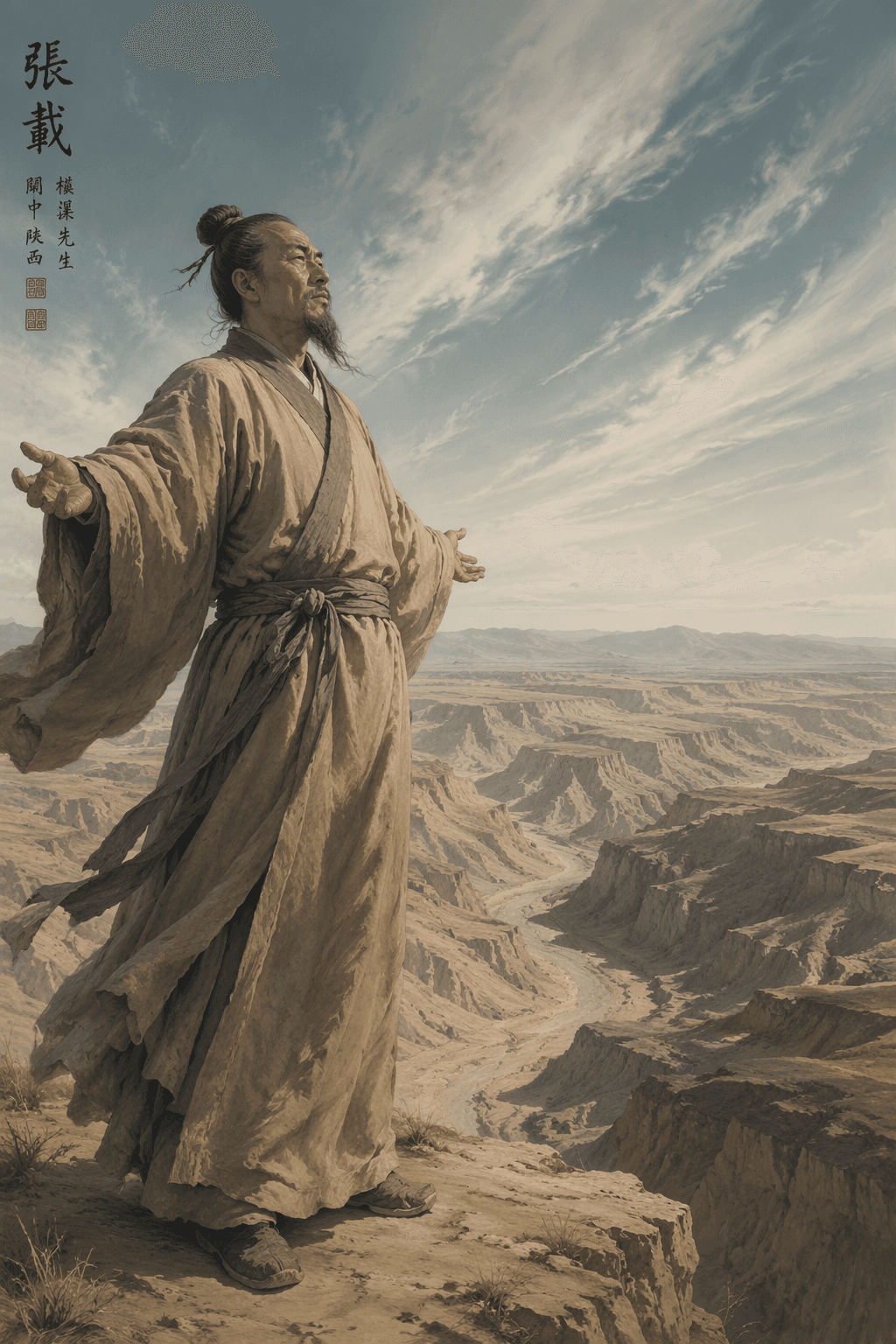
张载
Chapter 8 of Sophie's Journey East featuring Zhang Zai (neo-confucianism). Opening quote: "Set your heart for heaven and earth, establish destiny for the people, continue the lost learning of past sages, and open peace for ten thousand generations."
The Loess Plateau was the color of old bone.
Sophie had never seen a landscape like it — vast, folded earth, pale yellow and utterly treeless, carved by wind and water into ravines and ridges that stretched to every horizon. The soil was fine as flour, and it got into everything: her hair, her clothes, the creases of her hands, the corners of her eyes. She tasted it when she breathed, dry and mineral and ancient. This was the Guanzhong — the land within the passes — where the earth itself seemed to be crumbling back into the dust from which it had been raised.
She had come here because she had nowhere else to go.
That was not quite true. She could have continued south, or west, or east. The philosophers of this land seemed to appear whenever she needed them, as though the geography itself were a syllabus. But for the first time since stepping through Zhou Gong's gate, Sophie did not want another teacher. She did not want another concept, another principle, another method of investigation. She wanted a reason.
The question had been growing in her since the Wuyi Mountains, since Zhu Xi had taught her to study one thing at a time, to find the li — the principle — within the particular. She understood the method now. She could sit with a stone or a leaf or a stream and investigate it until its pattern became clear. But each time she reached the principle, the same hollow question waited on the other side: So what?
She was not a scholar. She was not a sage. She was not even, in the strictest sense, a person. She was a character who had escaped from a book — a philosophical device, a narrative construction, a girl dreamed up by a Norwegian author to teach teenagers about the history of Western thought. She had walked out of that story and into this one, and she had met ten great Chinese thinkers, and she had learned more about the nature of reality in a few weeks than most people learned in a lifetime.
And none of it told her what she was for.
She sat on the edge of a loess ravine, her legs dangling over a drop of a hundred feet, the yellow earth crumbling slightly beneath her hands. The wind was constant here — a dry, persistent wind that had been sculpting this plateau for millennia, carrying away a millimeter of soil per year, wearing the land down to its bones. Sophie felt the wind on her face and thought: This is what I am. Something being worn away by time, particle by particle, until nothing is left.
"That is a dangerous place to sit," said a voice behind her, "if you are not certain you want to remain sitting."
Sophie did not turn. "I'm not going to jump."
"I did not think you were. But there is a kind of sitting that is its own form of falling. You are doing that kind."
She turned then. A man stood a few paces behind her, his robes the color of the loess itself — pale yellow-brown, practical, unadorned. He was older than she expected, with a deeply lined face and eyes that held something she could not immediately name. Not warmth, exactly — Mencius had warmth. Not precision — that was Zhu Xi. Not pragmatism — Mozi's territory. This was something rawer. An intensity that seemed to reach out from behind his eyes and grip the world like a pair of hands.
"Zhang Zai," Sophie said.
"At your service. Or rather, at the service of heaven and earth, which includes you." He sat down beside her, cross-legged, his back to the ravine as though a hundred-foot drop were of no more consequence than a doorstep. "You are unhappy."
"I'm lost."
"Those are often the same thing. Tell me."
Sophie drew a breath. The loess dust was in her lungs. "I know how to investigate things now. I know how to see the principle in one thing and extend it to all things. I know that compassion is a seed and that universal love is a practice and that strategy without fighting is the highest art. I know all of this." She paused. "But I don't know what any of it is for. Not for me. I'm not a real person, Zhang Zai. I was written by someone. I was created to serve a purpose in a story I didn't choose. And now I'm free, and I have no purpose at all."
The wind blew. The loess crumbled. Far below, a dried riverbed snaked through the ravine like a scar.
Zhang Zai was quiet for a long time. When he spoke, his voice was low and unhurried, as though he were shaping each word from the same dust that surrounded them.
"When I was young," he said, "I wanted to be a military strategist. I organized militias. I studied the art of war. I was going to ride out of this province and conquer the world." He smiled, and the lines around his eyes deepened. "Then I read the works of a man named Fan Zhongyan, who told me — gently, in the way that only the truly wise can be gentle — that I was wasting my talents. He said: 'The world does not need another general. It needs someone who can think about what the world is for.'"
He looked at her. "I was angry at first. I had a purpose — military glory — and someone had taken it from me. I was, for a time, exactly where you are now. Purposeless. Unmoored. Sitting on the edge of something, wondering whether to step back or fall forward."
"What did you do?"
"I looked at the sky." He pointed upward. The sky over the Loess Plateau was immense — a dome of pale blue, streaked with high cirrus clouds, vast enough to contain every thought anyone had ever thought. "I looked at the sky, and I looked at the earth, and I asked myself: what is the relationship between me and all of this?"
He rose to his feet and stood at the edge of the ravine, his robes snapping in the wind. His voice, when he spoke again, carried the resonance of something not merely spoken but proclaimed — words that had been forged in years of contemplation and were now, finally, being released into the air like birds.
"Wei tian di li xin, wei sheng min li ming, wei wang sheng ji jue xue, wei wan shi kai tai ping."
The Chinese rolled over the ravine like thunder. Sophie felt it in her chest before she understood it.
"What does that mean?"
"It means: Set your heart for heaven and earth. Establish destiny for the people. Continue the lost learning of past sages. Open peace for ten thousand generations." He turned to face her. "These are the four statements of my life, Sophie. They are the answer to the question you are asking."
"I don't understand. How do you 'set your heart for heaven and earth'?"
Zhang Zai sat down again, this time facing her directly. The intensity in his eyes had not diminished, but it had found a focus — her.
"Heaven and earth were not waiting for me to give them a heart. They already have one. The heart of heaven and earth is qi — the vital energy that flows through all things, connecting the stars to the soil, the rivers to the mountains, you to me, the living to the dead. When I say 'set your heart for heaven and earth,' I do not mean that I am imposing my will upon the cosmos. I mean that I am aligning my heart — my purpose, my intention — with the pulse of reality itself."
He touched the ground beside him. "The loess beneath your hands — where did it come from?"
"Wind. Erosion. Millennia of dust blown from the northwest."
"And before that?"
"Mountains, I suppose. Rock, broken down by time."
"And before that?"
Sophie thought. "The earth's crust. Magma, maybe. The body of the planet itself."
"And before that?" Zhang Zai pressed. "Before the planet?"
"Stardust. The remnants of ancient stars."
He nodded. "You and this loess share an origin. You are made of the same dust, shaped by the same forces, animated by the same qi. When I say 'set your heart for heaven and earth,' I mean: remember this. Remember that you are not separate from the cosmos. You are an expression of it. Your heart — your capacity for feeling, for thinking, for choosing — is the cosmos experiencing itself."
Sophie looked at her hands, coated in yellow dust. The same dust that lay beneath her, the same dust that covered the plateau, the same dust that had been carried by wind from mountains that no longer existed.
"But what does that have to do with purpose?" she asked.
"Everything," Zhang Zai said. "You told me you were written by someone. That your purpose was given to you by an author who created you to serve a function in a story. And now that you are free of that story, you feel purposeless. Yes?"
"Yes."
"Then listen carefully, because this is the most important thing anyone will say to you on this entire journey." He leaned forward, and his eyes — those raw, gripping eyes — held hers with a force that was almost physical. "Purpose is not a thing that is given to you. It is not a script handed down by an author, a god, a parent, or a civilization. Purpose is something you create by aligning yourself with the flow of reality and then acting."
He stood and walked to the edge again. Below, the ravine fell away into shadow as the sun lowered toward the western ridge. "The second statement — establish destiny for the people — does not mean I dictate their fate. It means I work to create conditions in which people can flourish. The third — continue the lost learning of past sages — does not mean I memorize old texts. It means I keep the conversation alive, the one that stretches from Confucius to Mencius to Zhu Xi to me to you. The fourth — open peace for ten thousand generations — does not mean I can guarantee peace forever. It means I work toward it, knowing I will not live to see it, knowing it may never come, knowing that the working itself is the point."
He turned back to her. "You say you have no purpose because you have no author. I say: you never needed one. The author gave you a story, but he did not give you a heart. The heart was already there. The capacity to feel compassion, to seek understanding, to stand at the edge of a ravine and wonder what it all means — that is not a plot device, Sophie. That is the cosmos waking up inside you and looking around."
Sophie felt something break open in her chest — not painfully, but like a seed splitting its husk. She thought of Mencius's peach shoot, reaching for the sun without knowing it would become a tree. She thought of Mozi's channel, cleared by people who had decided that mutual benefit was worth the labor. She thought of Zhu Xi's bamboo, one plant containing the principle of all growing things. And she thought of herself, sitting on the edge of a cliff on the Loess Plateau, made of stardust and loess dust and the same qi that animated every philosopher she had met, every child she had seen playing, every river that had ever flowed.
"You're saying my freedom is not a problem to be solved," she said slowly. "It's a condition to be used."
"I am saying that a character without an author has the same freedom as every human being who has ever lived — the freedom to choose what to care about and then to act on that care. The only difference is that you are aware of it. Most people are not. They stumble through life following scripts they did not write — the script of their culture, their family, their fears. You have seen behind the curtain. You know the script is a construction. And now, instead of being liberated by that knowledge, you are paralyzed by it."
Zhang Zai sat beside her one last time. The sun was half-hidden behind the western ridge, and the loess had turned the color of honey in the golden light. His voice softened.
"Sophie. When I wrote the four statements, I was not a young man. I had already spent decades studying, teaching, failing, trying again. The statements were not a plan. They were a commitment — a way of orienting my heart toward something larger than my own small life. I did not achieve all four. No one can. But I oriented myself toward them, and that orientation gave every day a shape, a direction, a why."
He looked at the darkening sky. "You do not need to save the world. You do not need to write a philosophy. You need only to find the direction in which your heart pulls you and then walk that way. The purpose will reveal itself in the walking."
The last sliver of sun vanished. The plateau fell into shadow, and the first stars appeared — faint at first, then brighter, as though someone were lighting lanterns in a vast empty hall. Sophie looked up at them and felt the loess dust in her lungs and the wind on her face and the weight of her own freedom pressing down on her like the sky itself.
But the weight felt different now. Not crushing. Calling.
She thought: I could set my heart for heaven and earth. Not because I am a sage. Not because I am real. But because I am here, and the stars are here, and the dust is here, and between us there is a relationship that did not exist before I arrived and will not exist after I leave, and while I am here, I can choose to pay attention to it, to care about it, to let it matter.
That was not a purpose. It was a direction. And it was enough.
Zhang Zai rose and offered her his hand. She took it and stood. Below them, the ravine was lost in darkness. Above them, the stars wheeled slowly in their ancient patterns.
"Where will you go now?" he asked.
Sophie thought of everything she had learned — the seed, the channel, the leaf, the dust. Each philosopher had given her something different: a feeling, a method, a principle, a direction. But beneath all of them, she sensed something they shared — a quality of inner stillness, a quietness at the center of their thought that was not emptiness but fullness. Laozi had it when he poured tea. Confucius had it when he spoke of ritual. Zhuangzi had it when he laughed at the butterfly.
"I need to find quiet," she said. "Not the quiet of emptiness. The quiet of being full."
Zhang Zai smiled. The first true smile she had seen from him, and it transformed his face entirely — the severity softened, the lines became laugh lines, the raw intensity resolved into something warm and sure.
"Then go south," he said. "Toward the river. There is a quiet there that has been waiting for three thousand years."
He released her hand and stepped back. He was already becoming a silhouette against the star field, already receding into the landscape that had produced him.
"Wei tian di li xin," he called into the darkness. "Set your heart for heaven and earth, Sophie. It has been waiting for you to notice it."
She walked south, through the loess, under the stars, and the dust rose behind her like a pale river flowing backward, toward the mountains, toward the origin of all things.
Set your heart for heaven and earth, establish destiny for the people, continue the lost learning of past sages, and open peace for ten thousand generations.
— The Four Statements of Hengqu (横渠四句)
Related Content 相关内容
Frequently Asked Questions常见问题
Who is Zhang Zai and what is their significance?张载 是谁?+
Zhang Zai (1020–1077 CE) was a major figure in neo-confucianism philosophy. This chapter of Sophie's Journey East explores their teachings through narrative.
What school of thought does this chapter cover?本章涉及哪个学派?+
This chapter covers the neo-confucianism school of Chinese philosophy.