Zhang Zai
张载
Guanzhong · 关中
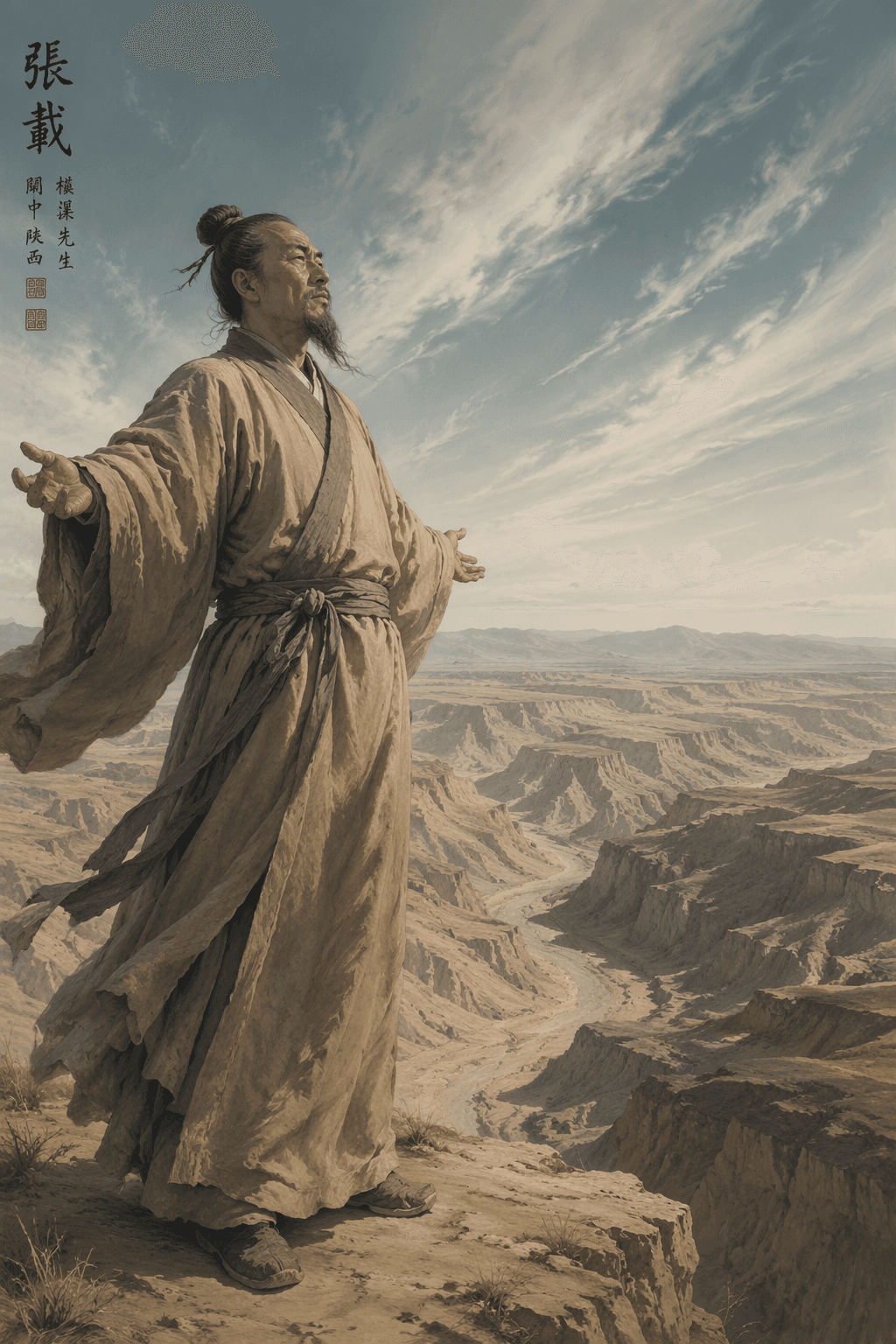
Zhang Zai from Guanzhong (1020–1077 CE) was a foundational figure in Neo-Confucianism. Known for teachings on qi as ultimate reality, the four vows (hengqu si ju), all people are my brothers, all things are my companions (min bao wu yu), Zhang Zai shaped Chinese civilization for millennia.
Biography
The Warrior Who Became a Sage
Zhang Zai — Zhang Zihou, styled Hengqu — began life wanting to be a general. Born in 1020 CE in Guanzhong, the strategic corridor between the loess plateau and the Wei River, he grew up in a region constantly threatened by the Western Xia kingdom. In his twenties, he organized a militia and wrote a military treatise, intending to defend the frontier through armed resistance. The great statesman Fan Zhongyan, then serving as military commissioner for the northwest, read Zhang Zai's proposal and told the young man: "You have the talent for scholarship, not for warfare. The Confucian path will serve the nation better than military adventure." Zhang Zai took the advice. He abandoned his military ambitions and turned to philosophy — a decision that would produce one of the most original metaphysical systems in Chinese intellectual history and the most quoted statement of intellectual purpose in Chinese culture.
He studied the Confucian classics, then the Buddhist texts, then the Daoist canon, absorbing every tradition before returning to Confucianism with a transformed understanding. His mature position was that Buddhist metaphysics was nihilistic (it treated reality as empty illusion) and Daoist metaphysics was escapist (it sought withdrawal from social responsibility); only Confucianism, properly reinterpreted, could provide both a correct understanding of reality and a practical program for improving it. Zhang Zai's reinterpretation was radical: he recentered Confucian metaphysics on qi — vital energy, material force — rather than on li (principle) as the Cheng brothers were proposing. Where Zhu Xi would later argue that li is primary and qi is secondary, Zhang Zai argued that qi is the sole substance of reality and that li is simply the pattern that qi takes when it condenses into visible forms.
The Great Void Is Qi
Zhang Zai's signature philosophical thesis is "the Great Void is qi" (taixu ji qi). What appears to be empty space — the vast expanse between stars, the gap between molecules, the absence that seems to surround every solid object — is not truly empty. It is qi in its dispersed, invisible state. When qi condenses, it forms visible objects — rocks, rivers, human bodies, planets. When qi disperses, objects dissolve back into the invisible void. There is no creation from nothing and no annihilation into nothing; there is only perpetual transformation between the condensed (visible) and dispersed (invisible) states of the same substance. "Qi condenses and floats up, forming the myriad things; qi disperses and sinks down, returning to the Great Void."
This thesis had enormous implications. It eliminated the Buddhist concept of emptiness (kong) — the void is not absence but potential, filled with qi that is ready to condense into new forms. It eliminated the dualistic distinction between spirit and matter — everything is qi, and what we call "spiritual" is simply qi in a particularly clear and refined state. It eliminated the terror of death — death is not annihilation but dispersion, the return of your qi to the cosmic reservoir from which it will eventually condense again into new forms. And it established a monistic materialism that made the entire cosmos a single, continuous, dynamic substance — no gaps, no dualisms, no separate realms, only qi in endlessly varying configurations.
The Western Inscription: The Cosmos as Family
Zhang Zai's most beloved text is the Western Inscription (Ximing), a brief essay that expresses his relational ethics in poetic form. "Heaven is my father and earth is my mother, and I am a small being between them," it begins. "All people are my brothers and all things are my companions." Since every person and every thing is formed from the same qi, we are literally members of one family. The cosmos is not a collection of separate objects but a single body, and every part deserves the care you would give to your own sibling.
The moral implications are radical. When a stranger suffers, they are not a stranger — they are your brother, formed from the same qi, and their suffering is your family's suffering. When a river is polluted, it is not an abstract environmental problem — it is your companion being harmed, and you must respond with the same urgency you would feel if your own child were injured. Zhang Zai's relational ethics eliminates the distinction between self and other, human and natural, near and far. Everything is family; everything deserves care; everything is connected by the shared substance of qi.
The Four Vows
Zhang Zai's four vows — "for heaven and earth, I set my heart; for the people, I establish destiny; for past sages, I continue the lost learning; for ten thousand generations, I open peace" — are the most quoted statement of intellectual aspiration in Chinese culture. They appear on university buildings, in graduation speeches, in the introductions of scholarly books, and in the declarations of public intellectuals. The vows define the purpose of knowledge not as personal advancement but as cosmic service: the scholar exists to maintain the moral order of the cosmos, to provide the people with stable foundations for their lives, to preserve the cultural heritage that would otherwise perish, and to build conditions of peace that future generations will inherit.
Each vow expands the scope of responsibility. The first vow addresses the cosmos itself — the scholar participates in heaven and earth's creative process. The second addresses society — the scholar creates conditions where people can flourish. The third addresses culture — the scholar rescues intellectual heritage from oblivion. The fourth addresses the future — the scholar builds for generations not yet born. The progression moves from the largest scale (cosmic order) through the immediate scale (popular welfare) to the temporal scale (cultural continuity) and finally to the longest scale (intergenerational peace). Knowledge, for Zhang Zai, is not a private possession but a public trust, and the scholar who fails to serve these four dimensions of responsibility has failed the vocation of knowledge itself.
A Philosophy of Connection
Zhang Zai's entire system is a philosophy of connection. Metaphysically, everything is connected by qi — there are no gaps, no voids, no isolated substances. Ethically, everything is connected by kinship — all people are brothers, all things are companions. Politically, everything is connected by responsibility — the scholar's vows link cosmic order to popular welfare, cultural preservation to intergenerational peace. Zhang Zai saw what many philosophers miss: that the fundamental truth of reality is not separation but connection, and that a philosophy that starts from connection rather than isolation produces a very different kind of ethics, politics, and metaphysics. His qi-monism anticipates modern network theory, ecosystem thinking, and the relational ontology that philosophers like Timothy Morton and Karen Barad are now developing. He was, in the eleventh century, already thinking about what the twenty-first century is beginning to understand: that nothing exists in isolation, and that the health of any part depends on the health of the whole.
Core Concepts
Qi as Ultimate Reality (气本论)
Zhang Zai's foundational metaphysical claim: qi — vital energy, material force — is the sole substance of reality. The Great Void (taixu) is not empty but qi in its dispersed, invisible state; visible objects are qi in its condensed, tangible state. Everything that exists is a temporary configuration of qi, and every configuration will eventually disperse back into the void. There is no creation from nothing and no annihilation into nothing — only perpetual transformation between visible and invisible states of the same substance.
张载的基础形而上学主张:气——元气、物质力量——是现实的唯一实体。太虚不是空的而是气的散而无形的状态;可见之物是气的聚而有形的形态。一切存在都是气的暂时配置,每一配置终将消散回归虚空。没有从无创造也没有归于无——只有同一物质的可见与不可见状态之间的永恒转化。
The Four Vows (Hengqu Si Ju) (横渠四句)
Zhang Zai's defining statement of intellectual purpose: "For heaven and earth, I set my heart; for the people, I establish destiny; for past sages, I continue the lost learning; for ten thousand generations, I open peace." These four vows define the scholar's responsibility as cosmic, civic, cultural, and intergenerational — knowledge serves not the self but the totality of existence across all scales of time and space.
张载定义知识理想的声明:"为天地立心,为生民立命,为往圣继绝学,为万世开太平。"四句将学者的责任定义为宇宙的、公民的、文化的与代际的——知识不为自我而是为跨越所有时空尺度的存在整体服务。
All People Are My Brothers, All Things Are My Companions (Min Bao Wu Yu) (胞物与)
Zhang Zai's relational ethics: since all humans and all things are formed from the same qi, we are literally family. The cosmos is one body, and every part deserves the care you would give to your own siblings. This is not metaphor but ontological claim: the shared substance of qi makes kinship a fact of nature, not merely a social convention.
张载的关系伦理学:既然一切人与物都由同一气构成,我们确然是家人。宇宙是一个身体,每一部分都应获得你对自己兄弟姐妹的关怀。这不是比喻而是本体论主张:气的共享实体使亲属关系成为自然事实而非仅是社会约定。
The Great Void Is Qi (Taixu Ji Qi) (太虚即气)
Zhang Zai's signature metaphysical thesis: what appears to be empty space is actually qi in its dispersed form. "The Great Void is formless; it is the substance of qi. Qi condenses and things are formed; qi disperses and things dissolve." There is no absolute void — only transformations between the invisible and visible states of the same vital substance. This eliminates the Buddhist concept of emptiness and replaces it with a dynamic materialism.
张载标志性的形而上学论题:看似虚空的空间实际上是气的散散形态。"太虚无形,气之本体。气聚则物成,气散则物消。"没有绝对虚空——只有同一元气物质在不可见与可见状态之间的转化。这消除了佛教的空概念,代之以一种动态唯物论。
Notable Quotes
“For heaven and earth, I set my heart; for the people, I establish destiny; for past sages, I continue the lost learning; for ten thousand generations, I open peace.”
为天地立心,为生民立命,为往圣继绝学,为万世开太平。
The four vows that have become the motto of Chinese intellectual aspiration. Each vow expands the scope of responsibility: from cosmic order (heaven and earth) to popular welfare (the people) to cultural preservation (past sages) to intergenerational peace (ten thousand generations). Knowledge is not personal achievement but service to existence itself across all scales.
“The Great Void has no form; it is the substance of qi. Qi condenses and floats up, forming the myriad things. Qi disperses and sinks down, returning to the Great Void.”
太虚无形,气之本体。气聚则离明得施而成形,气散则离明不得施而复于太虚。
Zhang Zai's core metaphysical statement: reality is a perpetual cycle of qi condensation and dispersion. There is no creation from nothing and no annihilation into nothing — only transformation between visible (condensed) and invisible (dispersed) states. The void is not absence but potential.
“Heaven is my father and earth is my mother, and I am a small being between them. All people are my brothers and all things are my companions.”
乾称父,坤称母,予兹藐焉,乃混然中处。故天地之塞,吾其体;天地之帅,吾其性。民吾同胞,物吾与也。
Zhang Zai's relational ontology in its most poetic form. Since heaven and earth are the parents of all things, and since all things are formed from their qi, everything is family. The moral implication is radical: the suffering of any person or thing is the suffering of your own family member, and you must respond with the same care you would give to your own child.
“Qi condenses to form things; qi disperses to return to the void. When qi condenses, I am born; when qi disperses, I die. Birth is not gaining something new; death is not losing something old. Birth and death are like the condensation and dispersion of qi.”
气聚则生,气散则死。生非有得也,死非有失也。生死犹气之聚散而已。
Zhang Zai reframes birth and death as phases of qi transformation rather than absolute beginnings and endings. You are not created from nothing at birth; you are a condensation of qi that was already there. You do not vanish into nothing at death; you disperse back into the qi that will eventually condense again. This eliminates the terror of annihilation by making death a phase transition rather than an extinction.
“When you know that the void is not empty, then Buddhist talk of emptiness is mere words; when you know that qi condenses and disperses, then Buddhist talk of birth and death as illusion is mistaken.”
知虚空即气,则有无、隐显、神化、性命通一无二。释氏妄言空,妄言生死,皆未尝知此。
Zhang Zai directly critiques Buddhist metaphysics. Buddhism claims the void is truly empty and that birth and death are illusions; Zhang Zai claims the void is qi in dispersed form and that birth and death are real transformations of real substance. His materialism is not anti-spiritual but anti-nihilistic: reality is dynamic and substantial, not empty and illusory.
“When qi is clear, it forms heaven; when qi is turbid, it forms earth. The clear qi circulates above as sun, moon, and stars; the turbid qi gathers below as mountains, rivers, and soil. But they are all one qi, not two different substances.”
清气上浮为天,浊气下凝为地。清气运于上为日月星辰,浊气聚于下为山河大地。然皆一气,非二物也。
Zhang Zai explains the structure of the cosmos through variations in qi clarity. Heaven and earth, stars and soil, are not different kinds of substance but different configurations of the same qi. This monistic materialism eliminates dualistic divisions between spiritual and physical realms — everything is one substance in different states of condensation and clarity.
“To set the heart for heaven and earth is to participate in the creative process of the cosmos. To establish destiny for the people is to give them a stable ground for their existence. To continue the lost learning of past sages is to preserve what would otherwise perish. To open peace for ten thousand generations is to create conditions that future ages will inherit.”
为天地立心,参与天地之化育。为生民立命,使民有所立。为往圣继绝学,使前人之学不绝。为万世开太平,使后世承太平之基。
Zhang Zai's own expansion of the Four Vows, making each clause concrete. Setting the heart for heaven and earth means actively participating in cosmic creativity. Establishing destiny means creating social conditions where people can flourish. Continuing lost learning means rescuing intellectual heritage from oblivion. Opening peace means building institutions and practices that endure across generations.
Modern Influence
The Four Vows in Modern Chinese Intellectual Culture
Zhang Zai's four vows — "to set my heart for heaven and earth, to establish destiny for the people, to continue the lost learning of past sages, to open peace for ten thousand generations" — remain the most cited statement of intellectual aspiration in Chinese culture. They are inscribed on university buildings, quoted in commencement speeches, and referenced by public intellectuals as the standard against which scholarly ambition should be measured. The vows define knowledge not as personal achievement but as civic responsibility — scholarship exists to serve cosmic order, popular welfare, cultural continuity, and intergenerational peace.
Zhang Zai and Modern Physics
Zhang Zai's theory that "the Great Void is qi" — that what appears to be empty space is actually filled with an invisible, dynamic substrate that condenses into visible matter and disperses back into invisibility — has been compared to modern quantum field theory. In quantum physics, the vacuum is not empty but seething with virtual particles and fluctuating fields; matter emerges from this substrate through condensation (symmetry breaking). Zhang Zai described the same idea using the vocabulary of eleventh-century Chinese metaphysics.
Zhang Zai and Ecological Ethics
Zhang Zai's concept of "all people are my brothers, all things are my companions" (min bao wu yu) extends moral consideration beyond humanity to include the entire natural world. This relational ecology — in which mountains, rivers, plants, and animals are members of a single family — anticipates modern environmental ethics and the philosophy of deep ecology. It offers a non-Western foundation for ecological responsibility that does not depend on individual rights but on relational belonging.
Read the Story
Experience Zhang Zai's philosophy through Sophie's narrative journey.
Read Chapter →Key Concepts · 核心概念
Explore these Neo-Confucianism concepts in our glossary →
Related Content 相关内容
Frequently Asked Questions常见问题
What is Zhang Zai known for?张载 以什么著称?+
Zhang Zai (1020–1077 CE) is known for Qi as Ultimate Reality, The Four Vows (Hengqu Si Ju), All People Are My Brothers, All Things Are My Companions (Min Bao Wu Yu). As a key figure in Neo-Confucianism, Zhang Zai's ideas shaped Chinese thought for centuries.
What era did Zhang Zai live in?张载 生活在什么时代?+
Zhang Zai lived during the 1020–1077 CE. Based in Guanzhong.
What school of thought did Zhang Zai found or belong to?张载 属于哪个学派?+
Zhang Zai belonged to the Neo-Confucianism school (理学).
Want to speak with Zhang Zai 张载? Try the Oracle.
Consult the Oracle →Free: 3 consultations per day · Pro: 10 per day + deep readings