Investigating Things
格物致知
Zhu Xi 朱熹 · 1130–1200 CE · Wuyi Mountains (Fujian)
“To investigate things is to exhaust their principle.”— Greater Learning Commentary (大学章句)
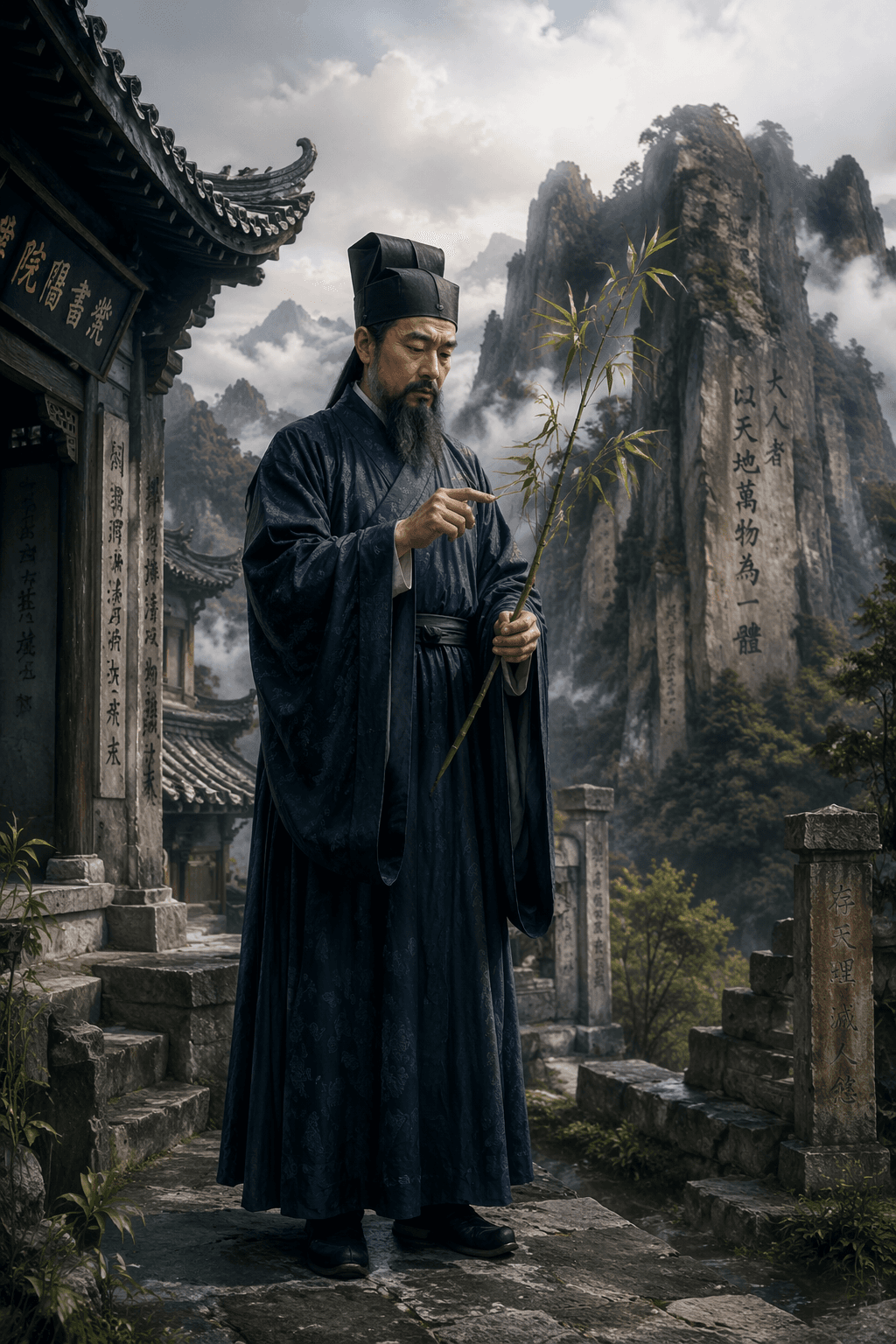
朱熹
Chapter 7 of Sophie's Journey East featuring Zhu Xi (neo-confucianism). Opening quote: "To investigate things is to exhaust their principle."
The Wuyi Mountains rose like the teeth of a sleeping dragon, their peaks wreathed in cloud so thick that Sophie could not tell where the rock ended and the sky began. She had climbed for hours — through forests of ancient camphor and pine, past tea terraces carved into the mountainside in neat green steps, over stone bridges that spanned gorges where white water boiled far below. The air was thick with moisture and the scent of wet earth, and everywhere — everywhere — there were inscriptions. Characters carved into cliff faces, poem fragments etched into stone tablets, calligraphy painted onto temple walls in strokes so bold they seemed to have grown there, like moss or lichen.
She could not read a single one.
The thought had been building in her for days, since the river valley where Mozi had shown two villages how to share water. It had grown as she traveled south, through landscapes of increasing beauty and complexity — salt fields glittering like shattered mirrors, canal cities where the streets were water, mountain temples where monks chanted in rhythms she could not follow. Each new sight, each new taste, each new sound added another thread to a tapestry so vast and dense that she could no longer see the pattern. She was drowning in the particular.
The academy sat on a ledge of rock halfway up the mountain, its wooden buildings arranged around a courtyard where a single bamboo grew from a crack in the stone floor. The eaves curved upward like the wings of birds about to take flight, and the whole structure seemed to hover between earth and cloud, belonging fully to neither.
Sophie sat on the steps of the main hall, her knees drawn to her chest, and felt defeated.
"I can't do this," she said to no one.
"You haven't specified what 'this' is," said a voice from inside the hall. "One must define the problem before one can solve it."
A man emerged from the shadows. He was tall for his era, with a long face and a high forehead beneath his black scholar's cap. His beard was neatly trimmed, his robes immaculate — dark indigo with subtle geometric patterning that Sophie recognized, after a moment, as a miniature representation of the trigrams of the I Ching. He moved with the careful precision of someone who had trained himself to notice everything and waste nothing.
"I am Zhu Xi," he said, arranging himself on the step beside her with the formality of a man settling into a lecture hall. "You are Sophie. You have met many of my predecessors — Laozi, Confucius, Mencius, Mozi — and now you sit outside my academy, telling the air that you cannot do 'this.' May I ask what 'this' is?"
Sophie gestured at the mountains, the inscriptions, the vast white clouds rolling through the peaks. "This. All of this. Chinese culture. I've been traveling for weeks, and every time I think I understand something, I discover ten things I didn't know. The language. The philosophy. The poetry. The rituals. The history." She pressed her forehead against her knees. "It's too much. I'm trying to drink the ocean."
"Mozi told you that," Zhu Xi said. It was not a question.
Sophie looked up, startled. "How do you—"
"I make a study of studying, Sophie. The words of previous thinkers are the things I investigate most carefully." He folded his hands in his lap. "Mozi was correct: you cannot drink the ocean. But his solution — take one thing, study it, move to the next — was incomplete. He was an engineer. He thought in straight lines. I am something else."
He rose and walked to the bamboo that grew from the stone. It was a modest plant — a dozen stalks, perhaps, rising from a single root system, their green segments clicking softly in the mountain breeze. The leaves were narrow and sharp, pale on their undersides, dark and glossy on top.
"Come here," Zhu Xi said.
Sophie dragged herself off the steps and stood beside him.
"What do you see?" he asked.
"A bamboo."
"What do you observe about it?"
Sophie looked. Really looked. The stalks were jointed, each segment a hollow cylinder divided by a solid node. The newest shoots were pale green, almost white at the base, darkening as they rose. The leaves grew in clusters at the nodes, each leaf slightly different in size and angle. The root system — what she could see of it — emerged from a crack in the stone, gripping the rock with a tenacity that seemed almost aggressive.
"It's growing out of solid rock," she said. "There's almost no soil."
"And yet it thrives. Go on."
"The stalks are hollow."
"Yes."
"They bend in the wind but don't break."
"Correct. Continue."
Sophie leaned closer. She could smell the bamboo — a clean, slightly green scent, like fresh-cut grass after rain. She touched a stalk: smooth, hard, cool. She ran her finger along a node: a ridge, slightly rough, like a knuckle. She looked at where the leaves met the stem: a thin sheath, papery, like the wrapping of a very old letter.
"The leaves are different sizes," she said. "The ones near the base are bigger. The ones at the top are smaller. And they all point slightly outward, away from the stalk — like they're trying to catch as much light as possible."
Zhu Xi nodded. He looked genuinely pleased, though his pleasure was measured, like everything else about him. "You have just performed ge wu — the investigation of things. You observed. You attended. You did not impose your assumptions. You let the bamboo reveal itself to you, layer by layer."
He walked around the plant, examining it from all sides. "Now. What does this bamboo teach you about the nature of growing things?"
Sophie thought. "That they find a way, even in impossible conditions. That hollowness can be a strength — the wind passes through instead of breaking the stalk. That growth is segmented — it happens in stages, not all at once."
"Good. And what does this bamboo teach you about all bamboo?"
"Other bamboo would have the same structure. Hollow stalks, jointed segments, the same way of growing."
"And what does this bamboo teach you about all growing things?"
Sophie hesitated. "That... they all follow patterns? That each one contains the principles of growth within it?"
"Now," Zhu Xi said, and his voice shifted — became quieter, more intense, as though he were letting her in on a secret that had kept him awake for decades — "you are touching the edge of something I have spent my life trying to articulate. Every particular thing in the universe contains li — principle. The li of bamboo is not different from the li of a pine tree, and the li of a pine tree is not different from the li of a human being, because all li partake of the one great principle that underlies all of reality."
"I don't understand."
Zhu Xi picked up a fallen bamboo leaf and held it between them. "This leaf is one thing. One particular, specific, irreplaceable thing. No other leaf in the history of the world is exactly this leaf. And yet, within this leaf, the principle of all leaves is present. Study this one leaf thoroughly — its shape, its veins, its color, its texture, the way it falls, the way it decays — and you will understand something not just about bamboo leaves, but about the nature of form itself."
He let the leaf fall. "This is ge wu zhi zhi — investigating things to extend knowledge. You do not need to study every thing in the universe, Sophie. You need to study one thing deeply enough to see the principle within it, because the principle is the same in all things. The universe is not a collection of disconnected objects. It is a single pattern, expressing itself through infinite variations."
Sophie stared at the bamboo. She thought of the I Ching, which Zhou Gong had shown her — sixty-four hexagrams, each one a different pattern of solid and broken lines, and yet all of them variations of the same eight trigrams, which were themselves variations of yin and yang. She thought of Laozi's water, which took the shape of every container but was always, essentially, water. She thought of Mencius's seed — one seed, containing the principle of an entire peach tree.
"You're saying the whole universe is like this bamboo," she said slowly. "One pattern, expressing itself in different forms."
"I am saying that the way to understand the whole is to study the part with complete attention. Not to rush from one thing to the next, accumulating facts. Not to stand back and try to grasp the totality from a distance — that way lies the despair you were feeling on my steps." Zhu Xi looked at her with his precise, measuring gaze. "You told yourself you could never understand Chinese culture because it is too vast. But vastness is not the obstacle. Inattention is."
He walked back toward the hall, then paused at the threshold. "Tomorrow morning, you will choose one thing in this mountain — a stone, a stream, a character carved in a cliff face — and you will study it until you understand its principle. Not until you know everything about it. Until you understand its li — the pattern it shares with all things of its kind, and ultimately with all things."
"And that will help me understand Chinese culture?"
"It will help you understand anything. Chinese culture is not a fortress you must storm. It is a pattern you must learn to see. And the pattern is the same in a tea ceremony and a military strategy and a love poem and a method of irrigating fields. The sages who created these things were not performing ten thousand different activities. They were expressing one understanding through ten thousand forms."
He disappeared into the hall. Sophie stood alone in the courtyard with the bamboo, the mountain clouds drifting through the eaves, the sound of water running somewhere beneath the stone.
She looked at the bamboo again. She picked a leaf and turned it over. The underside was pale, almost silver, with a central vein that branched into finer and finer tributaries — a river system in miniature, a map of the way life distributes itself.
One leaf. One principle. One pattern, repeating.
She held it up to the light and watched the sun shine through, and for the first time in weeks, the weight on her chest lifted, just slightly. Not because she understood everything. Because she understood that she did not need to. She needed to understand one thing, and then one more, and then one more, and the principles would accumulate like tributaries joining a river, and one day she would look up and realize she could see the shape of the whole.
But even as the thought formed, she felt another current beneath it — a restlessness that had nothing to do with knowledge. She could learn to investigate things. She could learn to see the principle in a leaf, in a stone, in a stream. But to what end? What was she investigating things for? What was the purpose of all this seeing, all this understanding, if she had no destination, no author, no plot?
Zhu Xi had given her a method. But a method without a purpose is a road without a destination.
She pocketed the leaf and walked to the edge of the cliff. The mountains stretched away below her, fold after fold of green and grey and white, each peak a word in a sentence too vast to read. The sun was setting behind the western range, and the clouds caught fire — orange, then crimson, then deep violet.
Somewhere in that vast landscape, she sensed, someone was waiting. Not to teach her how to see, but to teach her why she should bother looking at all.
To investigate things is to exhaust their principle.
— Greater Learning Commentary (大学章句)
Related Content 相关内容
Frequently Asked Questions常见问题
Who is Zhu Xi and what is their significance?朱熹 是谁?+
Zhu Xi (1130–1200 CE) was a major figure in neo-confucianism philosophy. This chapter of Sophie's Journey East explores their teachings through narrative.
What school of thought does this chapter cover?本章涉及哪个学派?+
This chapter covers the neo-confucianism school of Chinese philosophy.