Zhu Xi
朱熹
Wuyuan · 婺源
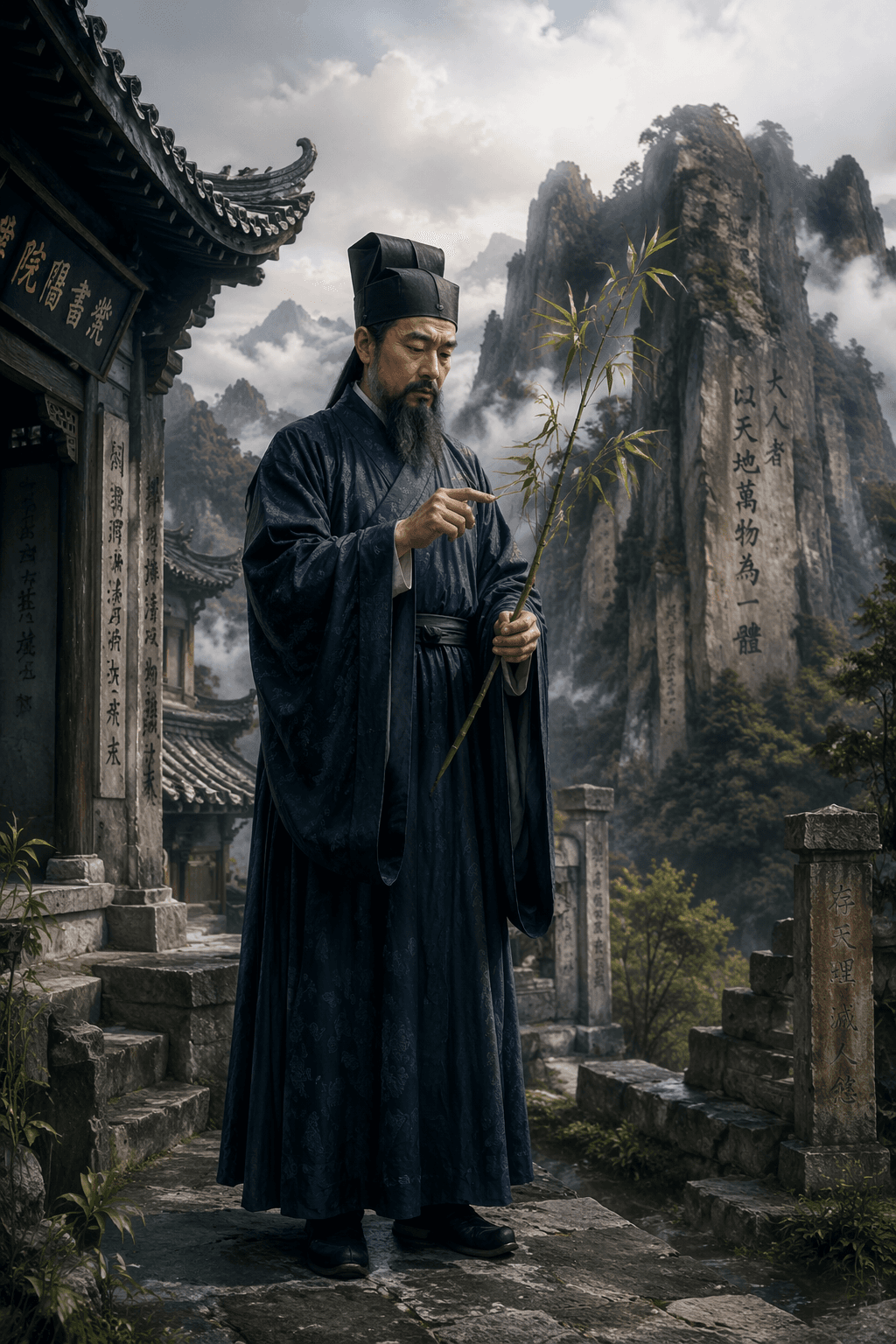
Zhu Xi from Wuyuan (1130–1200 CE) was a foundational figure in Neo-Confucianism. Known for teachings on principle (li), material force (qi), investigation of things (ge wu zhi zhi), Zhu Xi shaped Chinese civilization for millennia.
Biography
The Great Synthesizer Who Built the Curriculum of a Civilization
Zhu Xi — born in 1130 CE in Wuyuan, Huizhou — is the philosopher whose system became the operating system of Chinese civilization for eight centuries. He did not invent the ideas he systematized; he inherited them from the Confucian tradition, from the Daoist metaphysical vocabulary, from the Buddhist meditative practices, and from earlier Neo-Confucian thinkers like the Cheng brothers. What he did was synthesize all of these into a coherent, comprehensive, and teachable system — a philosophical architecture so complete that it could serve as the official ideology of the state, the curriculum of the school, and the daily practice of the individual. No other philosopher in any tradition has achieved this level of institutional integration.
Zhu Xi passed the imperial examination at nineteen — the youngest age possible — and served in various local administrative posts. But his real work was in the classroom and the study. He established academies (the most famous being the White Deer Grotto Academy at Lushan), attracted thousands of students, and wrote with astonishing productivity: commentaries on virtually every major Confucian text, original treatises on metaphysics, ethics, and education, classified conversations recording his pedagogical interactions, and literary compositions of extraordinary elegance. His output was not merely voluminous but systematic — every piece fit into the larger structure, and the structure was designed to be transmitted intact from teacher to student across generations.
The Four Books and the New Curriculum
Zhu Xi's most consequential act was the compilation of the Four Books with his interlinear commentary. Before Zhu Xi, Confucian education centered on the Five Classics — ancient texts on ritual, history, poetry, divination, and political annals that were dense, archaic, and difficult to apply to daily life. Zhu Xi reorganized the curriculum around four shorter, more accessible, and more ethically focused texts: the Great Learning, the Analects, Mencius, and the Doctrine of the Mean. He wrote commentaries that linked each text to the others, creating a unified reading program that moved from elementary moral principles (the Great Learning) to advanced metaphysical understanding (the Doctrine of the Mean).
This reorganization was revolutionary. It made Confucian education accessible not just to scholar-officials but to anyone who could read. It gave the tradition a clear progressive structure — you knew exactly what to study next. And it placed moral cultivation at the center of the curriculum rather than ritual expertise or historical erudition. When the Yuan dynasty adopted Zhu Xi's Four Books as the basis of the imperial examination system in 1313, his curriculum became mandatory for every aspiring official in China. For the next six hundred years, every educated Chinese person studied Zhu Xi's version of Confucianism. The Four Books became, in effect, the civilizational code — the shared intellectual infrastructure that made China coherent across dynasties, regions, and languages.
Li and Qi: The Architecture of Reality
Zhu Xi's metaphysical system rests on two categories: li (principle) and qi (material force). Li is the rational pattern that makes each thing what it is — the principle of bamboo that makes it grow segmented and hollow, the principle of water that makes it flow downward, the principle of human nature that inclines it toward goodness. Qi is the physical substrate through which li becomes actual — the stuff that takes on pattern and manifests as concrete objects. The relationship is like that between a blueprint and a building: li is the plan, qi is the material that realizes the plan. But unlike a blueprint, li is not separate from qi — it is embedded within it, present in every grain and drop, expressing itself through the varying clarity and density of qi.
This ontology explains everything Zhu Xi needs to explain. Why are some people virtuous and others vicious? Because qi varies in clarity: clear qi allows li (which is inherently good) to express itself fully; turbid qi obscures li, producing flawed character. Why do the same principles appear differently in different contexts? Because qi filters and shapes li differently in each particular situation. Why is there both unity and diversity in the cosmos? Because li is one (the same universal rationality pervades everything) but its manifestations are many (each thing's qi gives the principle a unique expression). Zhu Xi's signature formula — "principle is one, its manifestations are many" (li yi fen shu) — is perhaps the most elegant metaphysical statement in the Chinese tradition.
Ge Wu Zhi Zhi: The Investigation of Things
Zhu Xi's central methodological principle is ge wu zhi zhi — the investigation of things to extend knowledge. This is not the random accumulation of information but the disciplined search for li in each phenomenon you encounter. "After you have investigated one thing thoroughly," Zhu Xi writes, "you can begin to understand the principle of ten thousand things." This is not because one thing contains all principles but because the principle you discover in it is structurally identical to the principle in all things. Understanding is transferable: once you grasp the pattern of how principle manifests in one domain, you can recognize the same pattern in every other domain.
The young Wang Yangming — Zhu Xi's great philosophical rival — famously sat before bamboo stalks for seven days, trying to discover their li through direct observation. He became ill and gave up, concluding that Zhu Xi's method was impossible. Zhu Xi would have replied that Wang had misunderstood the method: you do not stare at bamboo until its principle reveals itself; you study bamboo alongside everything else — history, literature, social relationships, moral dilemmas — until the pattern that connects bamboo to all other phenomena becomes visible. Investigation is not isolated contemplation but cumulative, comparative analysis that proceeds from one thing to the next, gradually building a synoptic understanding of how the same principle pervades the entire cosmos.
The Daily Practice of Self-Cultivation
Zhu Xi's philosophy is not merely theoretical; it is designed for daily implementation. His recommended practice included: morning reading of classical texts, evening reflection on the day's conduct, continuous moral self-examination, and the cultivation of what he called "reverence" (jing) — a state of focused, respectful attention that keeps li in command of qi. "Reverence is the master of the mind," he writes. "When reverence is present, principle is clear and the mind is settled; when reverence is absent, the mind is scattered and desire takes over."
This emphasis on daily practice — on making philosophy a lived habit rather than an intellectual exercise — is what made Zhu Xi's system so durable. It worked not because it was theoretically perfect but because it was practically implementable. Every student could follow the curriculum. Every official could apply the principles. Every person could practice self-cultivation. Zhu Xi built a philosophy that could be lived, and a civilization that lived it — and that is why his influence, eight centuries later, is still visible in every classroom, examination hall, and family ritual in East Asia.
Core Concepts
Principle (Li) (理)
Li is the universal principle or pattern that underlies all things — the rational structure that makes each thing what it is. Every object, every event, every relationship has its li, and all individual li participate in one ultimate li that is the principle of the cosmos itself. Li is not a physical substance but a structural reality: it is what makes a bamboo stalk a bamboo rather than a pine, what makes water flow downward rather than upward.
理是万物背后的普遍原则或模式——使每物成为其所是的理性结构。每一物、每一事、每一关系都有其理,所有个别之理共参与一个终极之理即宇宙本身的原理。理不是物质而是结构性实在:它使竹竿成为竹而非松,使水流向下而非向上。
Material Force (Qi) (气)
Qi is the energetic, physical substrate through which li becomes manifest in concrete reality. Without qi, li remains abstract pattern; with qi, li takes shape as actual things. Qi varies in clarity and density — clear qi produces superior individuals and circumstances; turbid qi produces inferior ones. The interaction of li and qi explains why the same universal principle appears differently in different people, places, and eras.
气是使理在具体现实中显现的能动的物理基质。无气,理只是抽象模式;有气,理成形为实际事物。气有清明与浑浊之别——清气产生优异的个体与境遇;浊气产生低劣者。理与气的交互解释了同一普遍原理为何在不同人、地、时代中呈现不同面貌。
Investigation of Things (Ge Wu Zhi Zhi) (格物致知)
Zhu Xi's central methodological principle: knowledge is extended by carefully investigating the principle (*li*) in each thing you encounter. By examining one thing thoroughly, you begin to grasp the principle that pervades all things. The investigation is not random accumulation of facts but the disciplined search for underlying patterns that connect particulars to universals. "After you have investigated one thing, you can begin to understand the principle of ten thousand things."
朱熹的核心方法论原则:通过仔细探究你遇到的每物中的理来扩展知识。通过彻底考察一事,你开始把握贯穿万物的原理。探究不是事实的随机积累而是将特殊联系到普遍的底层模式的纪律性搜索。"格一物,便能通万物之理。"
Knowledge Before Action (Zhi Xian Xing Hou) (知先行后)
Zhu Xi insists that correct knowledge must precede correct action — you cannot do the right thing unless you first know what the right thing is. But knowledge without subsequent action is hollow: "If you know but do not act, your knowledge is not truly knowledge." The sequence is: investigate, understand, then act. Knowing without doing is incomplete; doing without knowing is reckless.
朱熹坚持正确知识必须先于正确行动——除非你先知道何为正确之事,否则无法做正确之事。但没有后续行动的知识是空洞的:"知而不行,只是未知。"顺序是:探究、理解、然后行动。知而不行是不完整的;行而不知是鲁莽的。
Self-Cultivation (Xiu Shen) (修身)
The ultimate purpose of all philosophical investigation and moral knowledge is self-cultivation — the progressive refinement of one's character until principle and desire are aligned. Zhu Xi's daily practice included morning reading of classics, evening reflection on conduct, and continuous moral self-examination. "Every day, examine yourself: what have you done well? What have you done poorly? What should you improve?"
所有哲学探究与道德知识的终极目的是修身——逐步精进品格直到理与欲一致。朱熹的日常实践包括晨读经典、暮省行为与持续的道德自省。"每日省察:今日做得何事善?何事不善?何事当改?"
Notable Quotes
“The investigation of things is like eating: you must chew each mouthful carefully before you can digest it. If you swallow without chewing, you will not absorb the nourishment.”
格物如吃饭,须细细咀嚼方得消化。若囫囵吞下,便不得滋味。
Zhu Xi compares philosophical investigation to digestion — the body cannot absorb nutrition from food that has not been chewed, and the mind cannot absorb understanding from phenomena that have not been carefully examined. Patience and thoroughness in observation are prerequisites for genuine knowledge.
“After you have investigated one thing thoroughly, you can begin to understand the principle of ten thousand things. This is not because the one thing contains all principles, but because the principle you discover in it is the same kind of principle that pervades everything.”
格一物,便能通万物之理。非一物之中有万物之理,只是此理与万物之理同。
Zhu Xi's key epistemological claim: understanding is cumulative and transferable. The principle you discover in one thing is structurally identical to the principle in all things, so each successful investigation adds not just one item of knowledge but a template for understanding everything. This is the philosophical basis for analogical reasoning and scientific generalization.
“Knowledge and action must always advance together. To know without acting is not truly to know; to act without knowing is not truly to act.”
知行常相须。如目无足不行,足无目不见。知而不行,只是未知;行而不知,只是妄行。
Zhu Xi compares knowledge and action to eyes and feet — each needs the other. Eyes without feet cannot reach their destination; feet without eyes cannot find the path. Knowledge that does not produce action has not been truly understood; action that is not guided by knowledge is blind. The two are interdependent aspects of the same process of moral development.
“Reading the classics is not for literary pleasure or for accumulating information. It is for understanding the principle within them and applying it to your own conduct.”
读书不是为文字好看,也不是为积得多。只为理会得里面道理,将来在自家身上做得。
Zhu Xi redefines the purpose of reading: not entertainment, not erudition, but moral transformation. A text is useful only when its principle has been extracted and applied to your own life. Reading without self-application is accumulation; reading with self-application is cultivation.
“The principle of the cosmos is one, but it divides into many as it enters into individual things. The principle in each thing is complete, yet each thing expresses it differently according to the clarity of its qi.”
理一分殊。万物各具一理,而理同出一源。然气有清浊,故理之表现有异。
Zhu Xi's signature metaphysical doctrine: "principle is one, its manifestations are many." The same universal rationality underlies everything, but it appears differently in each thing because each thing's material substrate (qi) filters and shapes it differently. This explains both the unity of reality and its diversity — the same truth expressed in infinite variations.
“To read a book, you must first read each sentence carefully, then each paragraph, then the whole chapter. Only then can you understand the overall meaning. Rushing through a book without pausing to reflect is like walking past a beautiful garden without stopping to look.”
读书须是一句一句地看,一段一段地看,一章一章地看,方能见得大意。若匆匆看过,便如走过花园而不驻足观看。
Zhu Xi's pedagogical method in action: progressive, cumulative reading that builds understanding layer by layer. Each level of analysis depends on the previous level. Rushing through a text without reflective pauses produces superficial familiarity, not genuine comprehension. The method models his broader epistemology: understanding proceeds from particulars to wholes through careful, disciplined attention.
“Human nature is principle; human emotions are qi. When principle governs qi, the person is virtuous. When qi overwhelms principle, the person is flawed.”
性即理也,情即气也。理以御气,则为善人;气以掩理,则为恶人。
Zhu Xi's succinct formulation of his moral psychology: your essential nature is rational principle (li), your feelings and impulses are material force (qi). Virtue is the condition where li governs qi — reason guides emotion. Vice is the condition where qi overwhelms li — impulse overrides reason. Moral cultivation is the practice of strengthening li's governance over qi.
Modern Influence
Zhu Xi in Modern Education
Zhu Xi's compilation of the Four Books — the Analects, Mencius, Great Learning, and Doctrine of the Mean — with his interlinear commentary, created the curriculum that defined Chinese education for eight centuries. His pedagogical method — close reading of classic texts with guided interpretation, progressive mastery from elementary to advanced, and moral education as the ultimate goal — remains recognizable in East Asian schooling. The structure of the Chinese university entrance examination still echoes Zhu Xi's vision of learning as moral cultivation through textual mastery.
Zhu Xi and Modern Science Philosophy
Zhu Xi's principle of ge wu zhi zhi — the investigation of things to extend knowledge — has been reinterpreted as an early version of empirical scientific method. His insistence that understanding begins with careful observation of concrete particulars, and that the examination of one thing can reveal the principle (li) shared by all things, parallels the scientific practice of deriving general laws from specific experiments. Zhu Xi did not practice modern science, but his epistemological framework provided a philosophical basis for it that later thinkers would develop.
Zhu Xi and Comparative Philosophy
Zhu Xi's dual-category ontology of li (principle) and qi (material force) has drawn comparisons with Western philosophical frameworks — Plato's forms and matter, Aristotle's essence and existence, Leibniz's monads. Modern comparative philosophers see Zhu Xi as a systematic metaphysician whose rigor and comprehensiveness rival the great Western system-builders, making him a natural bridge between Chinese and Western philosophical traditions.
Read the Story
Experience Zhu Xi's philosophy through Sophie's narrative journey.
Read Chapter →Key Concepts · 核心概念
Explore these Neo-Confucianism concepts in our glossary →
Related Content 相关内容
Frequently Asked Questions常见问题
What is Zhu Xi known for?朱熹 以什么著称?+
Zhu Xi (1130–1200 CE) is known for Principle (Li), Material Force (Qi), Investigation of Things (Ge Wu Zhi Zhi). As a key figure in Neo-Confucianism, Zhu Xi's ideas shaped Chinese thought for centuries.
What era did Zhu Xi live in?朱熹 生活在什么时代?+
Zhu Xi lived during the 1130–1200 CE. Based in Wuyuan.
What school of thought did Zhu Xi found or belong to?朱熹 属于哪个学派?+
Zhu Xi belonged to the Neo-Confucianism school (理学).
Want to speak with Zhu Xi 朱熹? Try the Oracle.
Consult the Oracle →Free: 3 consultations per day · Pro: 10 per day + deep readings