The Art of Universal Love
兼爱之术
Mozi 墨子 · 470–391 BCE · Lu (modern Shandong)
“Universal love and mutual benefit — these are the principles of the benevolent.”— Mozi (墨子), Chapter 15
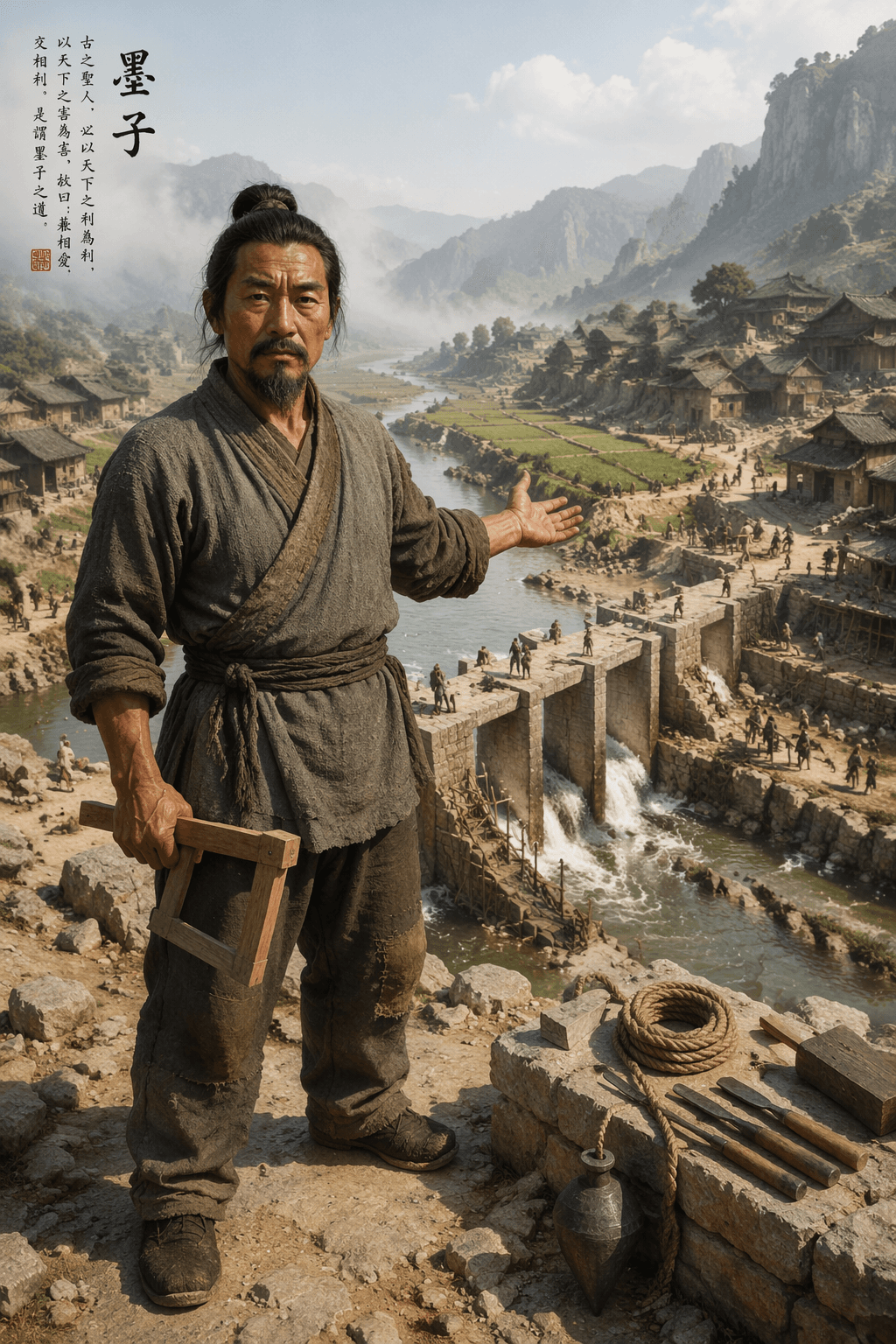
墨子
Chapter 6 of Sophie's Journey East featuring Mozi (mohism). Opening quote: "Universal love and mutual benefit — these are the principles of the benevolent."
The dispute had been going on for longer than anyone could remember.
Sophie arrived at the river valley in the hour before dawn, when the mist still lay on the water like white silk and the only sound was the complaints of a single heron. The river — a modest waterway, no wider than a city street — divided the valley into two halves. On the north bank, the village of Shi. On the south bank, the village of Yan. Between them, the river, and three thousand years of grievance.
The problem, as far as Sophie could gather from the angry shouts echoing across the water, was irrigation. A dam upstream — built by Shi, maintained by Shi, claimed by Shi — controlled the flow that watered the fields of both villages. When the spring rains were heavy, neither side complained. But in dry years — and this had been a dry year — the fields of Yan withered while the fields of Shi stayed green. Yan accused Shi of hoarding. Shi accused Yan of laziness. Both sides had brought out weapons. Both sides had drawn blood.
Sophie sat on a rock above the river, watching the two delegations line up on their respective banks, shouting across the brown water. The men of Shi carried hoes and iron bars. The men of Yan carried wooden staves and rope. It was not yet a war, but it was no longer a negotiation.
"Children," said a voice behind her. "Frightened children fighting over a toy."
Sophie turned. A man stood there, shorter than she expected, stocky and sun-darkened, with hands that were calloused not from writing but from labor. His robes were practical — undyed hemp, reinforced at the knees and elbows, stained with what looked like sawdust and iron filings. He wore no ornament, no jade, no silk. His face was broad and plain, and his eyes were the eyes of a man who had looked at the world and decided it needed fixing, not philosophizing about.
"Mozi," Sophie said. It was not a question.
"The same." He sat beside her on the rock, uninvited, and began unwrapping a hard millet cake from a piece of cloth. He bit into it and chewed thoughtfully, watching the two delegations below. "You are Sophie. You've been wandering through my homeland asking questions. Good. Questions are useful. Philosophy that does not build walls — literal walls — is just poetry."
He said the word poetry with the affection a carpenter reserves for a beautiful but structurally unsound chair.
"That dam," Sophie said, pointing upstream to where a low stone barrier held back the river. "Who does it belong to?"
"Who does the rain belong to?" Mozi countered. "The people of Shi built it, yes. With stone from the quarry on the Yan side. With labor from both villages, three generations ago. The grandfather of the current headman of Shi built it alongside the grandfather of the current headman of Yan. Now the grandsons want to kill each other over it." He shook his head. "This is what partiality produces. This is what happens when you love your own and regard the other as foreign."
"Partiality?"
"Confucius and his followers — and I notice you've been spending time with them — teach that love should be graduated. First your parents, then your family, then your neighbors, then your community, radiating outward like ripples from a stone. Respectable. Intuitive. And," he said, biting off another piece of millet cake, "the single greatest cause of war in human history."
Sophie blinked. "How is loving your family a cause of war?"
"Because the moment you say 'my family first,' you have said 'your family second.' The moment you say 'my village first,' you have said 'your village may go thirsty.'" Mozi gestured at the two angry crowds below. "Look at them. Each side loves its own. Each side would sacrifice for its own. And because each side loves its own more than it loves the other, they are about to kill each other over water that falls from the sky for free."
He finished his millet cake, dusted his hands, and stood. "Come. I will show them what jian ai looks like."
Sophie followed him down to the riverbank. Mozi did not approach the delegations directly. Instead, he walked to the dam itself — a structure of fitted stone, old but solid — and began examining it with the practiced eye of an engineer. Which, Sophie realized, he was. She had heard of Mozi's followers, the Mohists, famous across the ancient world for their mastery of defensive fortifications. They were the people you called when your city was besieged and you needed walls that would hold.
But Mozi's reputation was paradoxical: the greatest military engineer of his age was also its most passionate advocate for peace.
"The dam is sound," Mozi announced to no one in particular, running his hand along the stones. "But the channel that feeds Yan's fields is blocked. Not deliberately — look, here. The spring floods brought silt. The channel is choked. Shi's channel is clear because it's shorter and steeper; the silt washes through. Yan's channel is longer, lower, the silt settles."
He turned to face the two delegations, who had fallen somewhat silent, watching this strange man in hemp robes fondling their dam.
"The problem is not malice," Mozi called out, his voice carrying easily across the water. "The problem is mud. Shi is not stealing your water, Yan. Yan is not too lazy to dig, Shi. The channel needs clearing. It will take two hundred people four days. If each village provides one hundred workers, the channel will be clear before the spring planting. If you fight over who should clear it, the spring will pass, and both villages will go hungry."
Silence. Then a man from the Shi side — the headman, Sophie guessed, from his finer clothes and the way others deferred to him — called out: "Why should our men work on Yan's channel?"
Mozi's expression did not change, but Sophie saw something harden in his eyes. Not anger. Something more patient and more dangerous than anger.
"Because when Yan's fields are green," Mozi said, "Yan has no reason to fight you. And when Yan has no reason to fight you, your children do not grow up learning to hate. And when your children do not grow up learning to hate, the dam your grandfathers built together continues to stand, because no one comes in the night to smash it." He paused. "Your grandfather built that dam, Headman. The grandfather of the man across the river helped him. Are you going to be the generation that lets it fall?"
The headman of Shi opened his mouth, then closed it. On the far bank, the headman of Yan stood with his hands at his sides, watching.
Mozi turned to Sophie and spoke quietly, for her alone. "This is jian ai. It does not mean loving everyone with the same warmth. It means treating everyone's interests as equally valid. Universal love is not a feeling. It is a practice. You do not have to love the people of Yan the way you love your own children. You have to acknowledge that their children need water just as much as yours do."
Sophie watched as, slowly, impossibly, men from both banks began to move toward the dam. Not with weapons. With shovels.
"Confucius would say that graduated love is natural," she said.
Mozi gave her a look that was almost affectionate. "Natural," he repeated. "The tiger eating the deer is natural. The flood drowning the village is natural. Disease is natural. Since when do we take 'natural' as our standard for what is good? The Confucians confuse what is familiar with what is right. They say: love your parents more. I say: why stop there? Your parents are not more deserving of life than anyone else's parents. Your village's thirst is not more real than another village's thirst."
"But people do love their own more. You can't change human nature."
Mozi laughed — a short, practical sound, like a hammer striking true. "You sound like the people who told me defensive fortifications were impossible. 'Cities have always fallen to siege,' they said. 'It is natural for the strong to take what they want.' And then my disciples built walls that held. The possible is larger than the familiar, Sophie. What people call 'human nature' is often just human habit. Habits can be changed."
Below them, the work had begun. Men from Shi and Yan stood side by side in the muddy channel, scraping out silt. Someone had brought food. Someone else had brought wine. A child — Sophie thought it might be the headman of Shi's son — was playing with a child from Yan, chasing each other along the riverbank.
"Look at them," Mozi said softly. "Two hours ago they were ready to kill each other. Now they are sharing bread. What changed? Not their natures. Their circumstances. I gave them a reason to work together and a practical way to do it. Jian ai is not sentimental. It is the most pragmatic philosophy in the world. Love everyone equally because it works. Partiality produces conflict. Universality produces harmony. It is that simple."
Sophie looked at the children playing on the bank. She thought of Mencius and his seed of compassion — the instinctive lurch of the heart at the sight of suffering. Mencius would say that what was happening by the river was the seed bearing fruit. Mozi would say it was engineering.
Perhaps both were right.
"It isn't always this easy," Sophie said. "Not every conflict has a blocked channel you can clear."
"No," Mozi agreed. "Some conflicts require harder work. Some require sacrifice. Some require you to love people who have hurt you, which is the hardest thing a human being can do." He looked at her with those plain, practical eyes. "But the alternative is this — " he gestured at the river, at the history of grievance it represented " — an endless cycle of partiality, grievance, retaliation, and suffering. The Confucian way is to manage this cycle with ritual and propriety. My way is to break it."
"By loving everyone equally."
"By treating everyone's well-being as your own concern. Jian xiang ai, jiao xiang li. Universal love, mutual benefit. Not because it is beautiful — though it is — but because it is the only principle that has ever actually produced peace."
The afternoon wore on. The channel was clearing. The water, released from its prison of silt, began to flow toward Yan's fields again — a thin, dirty stream at first, then stronger, cleaner, until it ran clear and steady between the rows of winter wheat. Sophie watched the Yan farmers kneel beside their channels, touching the water with their hands, their faces unreadable.
Mozi had begun to pack his tools. He carried, Sophie noticed, a small wooden case filled with precisely calibrated instruments — a plumb line, a compass, a set of graduated measuring sticks. The tools of a man who believed the world could be measured, understood, and improved.
"Where will you go now?" he asked her.
"I don't know. I'm still trying to understand this place. This culture." Sophie looked out over the valley — the two villages, the river between them, the patchwork of fields climbing the hillsides. "There's so much of it. Three thousand years of thought. I Ching, Laozi, Confucius, Sunzi, Zhuangzi, Mencius, you. Every time I think I understand something, ten more questions appear."
Mozi buckled his tool case and slung it over his shoulder. "Understanding is not a river you cross once. It is a channel you keep clear." He looked at her with something that was almost tenderness. "You are trying to drink the whole ocean at once. That is not how knowledge works. That is not how love works. Take one thing. Study it. Understand it. Then take the next."
He began to walk away, following the river north. Then he paused and turned back.
"Sophie. When you meet the next teacher — and you will, the land always provides the teacher the student needs — tell them Mozi sends his regards. Even the ones who disagree with me." A faint smile. "Especially the ones who disagree with me. They need love most of all."
He walked on, a stocky figure in hemp robes, disappearing into the afternoon haze. Below, the river ran clear, and the children of Shi and Yan played together in the mud, building a dam of their own — a small one, a foolish one, made of stones and sticks and the kind of laughter that has not yet learned the word enemy.
Sophie sat alone on the rock and felt the weight of everything she did not know pressing down on her like the sky itself. The culture was vast. The philosophy was deep. The language, the history, the poetry, the ritual — it was an ocean, and she was standing at the shore with a cup.
She closed her eyes. The water whispered below. The children laughed. Somewhere, far away, a bell was ringing — the evening bell of a mountain academy she had not yet found.
Universal love and mutual benefit — these are the principles of the benevolent.
— Mozi (墨子), Chapter 15
Related Content 相关内容
Frequently Asked Questions常见问题
Who is Mozi and what is their significance?墨子 是谁?+
Mozi (470–391 BCE) was a major figure in mohism philosophy. This chapter of Sophie's Journey East explores their teachings through narrative.
What school of thought does this chapter cover?本章涉及哪个学派?+
This chapter covers the mohism school of Chinese philosophy.