Mozi
墨子
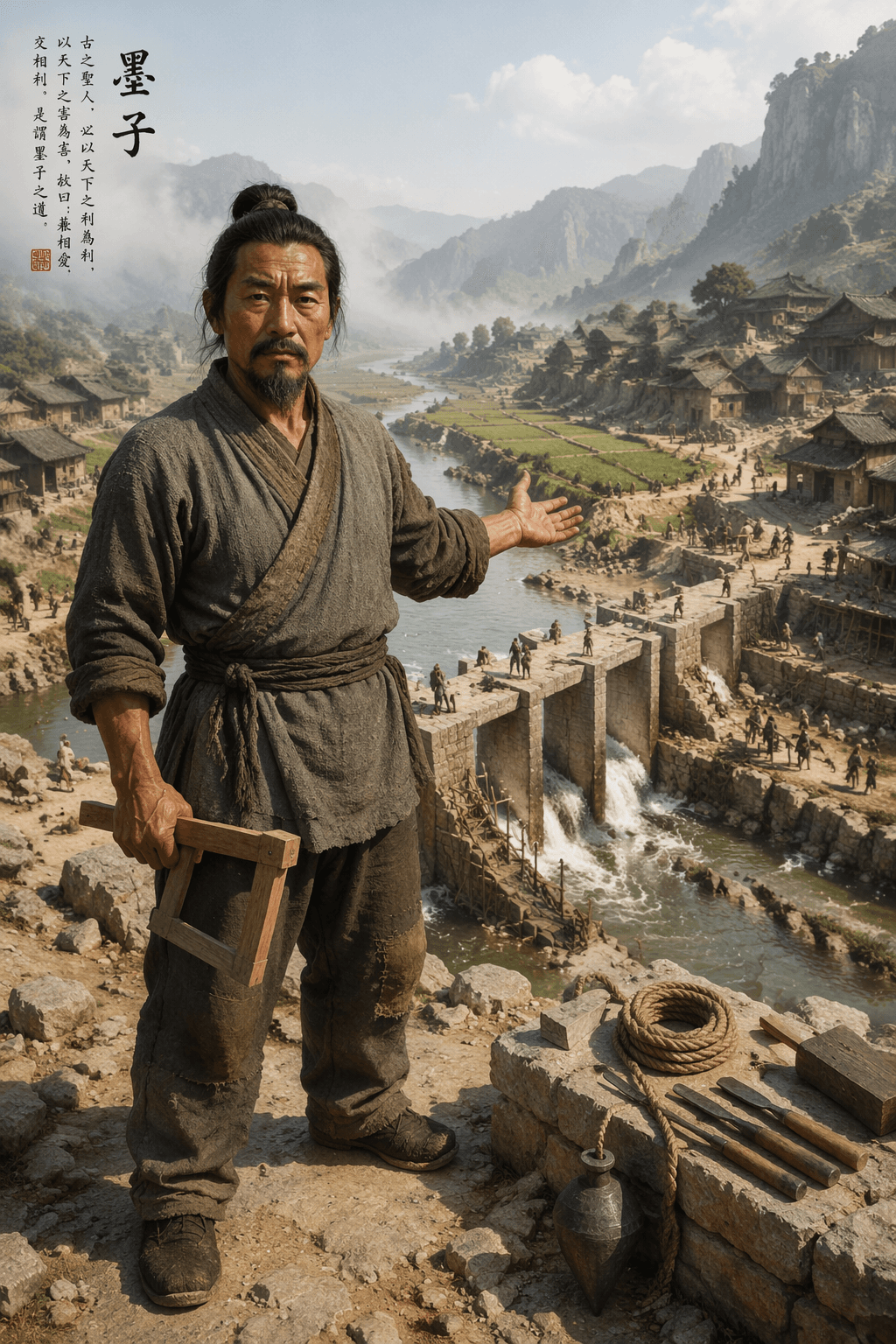
Mozi (470–391 BCE) was a foundational figure in Mohism. Known for teachings on universal love (jian ai), opposition to aggressive war (fei gong), frugality (jie yong), Mozi shaped Chinese civilization for millennia.
Biography
The Craftsman Who Built a Philosophy of Peace
Mozi — Mo Di — is the most practical philosopher in the Chinese tradition, and perhaps the most radical. Where Confucius refined ritual, Laozi mystified language, and Zhuangzi made jokes, Mozi built walls, designed machines, organized disciplined cadres of defensive engineers, and articulated a moral philosophy so logically rigorous that it anticipates modern utilitarianism by two millennia. He was born around 470 BCE, probably into the artisan class — his expertise in carpentry, mechanical engineering, and military technology suggests hands-on training rather than bookish education. He initially studied Confucianism but left it in disgust, objecting to its emphasis on elaborate funerals, hierarchical ritual, and partial love that privileged one's own family over others.
What Mozi proposed instead was a comprehensive alternative to the entire Confucian social order. Universal love (jian ai) replaced partial love. Frugality (jie yong) replaced elaborate ritual. Meritocratic selection (shang xian) replaced hereditary privilege. Defensive warfare (fei gong) replaced aggressive expansion. And rigorous epistemological verification (san biao) replaced deference to tradition. These were not isolated reforms but a systematic rethinking of every assumption that Confucianism had normalized. Mozi was not merely disagreeing with Confucius; he was building a different kind of civilization.
The Logic of Universal Love
Mozi's argument for universal love is not sentimental but strictly logical. He begins by observing that the root cause of all social disorder — warfare, theft, oppression, cruelty — is partiality. People love their own families more than others, their own states more than foreign states, their own interests more than the common good. This partiality generates conflict: if I care about my family's welfare more than yours, I will take resources from you to give to my family, and you will resist, and we will fight. Mozi's solution is simple and radical: remove partiality. If everyone cares about others' welfare as much as their own, there is no motive for conflict. "If one regards other people's families as one regards one's own, who would usurp other people's families?" The logic is impeccable: conflict requires asymmetrical concern; remove the asymmetry, and the motive vanishes.
The Confucian objection — that universal love is unnatural, that humans naturally care more about their own parents than about strangers — Mozi answers with a pragmatic argument. Partiality may be natural, but it produces disaster. The shepherd who cares only about his own sheep loses them all when wolves attack the flock; the farmer who cares only about his own field loses it when the irrigation system fails. What is "natural" is not necessarily what is good. The function of morality is to extend concern beyond the natural circle of partiality, because the natural circle produces chaos. Universal love is not sentimental idealism but practical conflict resolution.
The Engineers of Peace
Mozi's most extraordinary practical contribution was the creation of a disciplined organization of defensive engineers. His followers — the Mohists — were not merely philosophers debating in courts; they were technicians who could build walls, design counter-siege machines, and organize military defense. When a city was under unjust attack, Mohist cadres would arrive and provide free defensive assistance, using their engineering expertise to neutralize every siege weapon the aggressor deployed. They developed countermeasures against scaling ladders (smoke and fire), battering rams (reinforced gates and counter-battering), tunneling (counter-tunnels with poisonous smoke), and catapults (netting and mobile shields). Their discipline was legendary: Mohist cadres lived communally, ate simple food, wore rough clothing, and followed strict codes of conduct. They were, in effect, an ancient version of a humanitarian defense organization — using technical expertise not for conquest but for protection.
This combination of philosophical rigor and practical engineering makes Mozi unique among ancient thinkers. He did not merely argue that war was wrong; he made it possible for cities to resist aggression. He did not merely advocate universal love; he built an organization that practiced it. He did not merely propose frugality; he lived it with his followers as a demonstration that a simple life was both possible and preferable. Mozi was a philosopher who built things, and the things he built — walls, machines, organizations, arguments — were all designed to serve the same purpose: protecting the vulnerable from the powerful.
The Three Criteria for Truth
Mozi's epistemological contribution — the "three criteria" (san biao) — is one of the earliest systematic methods for evaluating claims. Any proposition must be tested against three standards: (1) Does it have a basis in the historical records of the ancient sage kings? (2) Does it correspond to the experience of the common people — can it be verified by their eyes and ears? (3) Does it produce practical benefit when implemented as policy? A claim that satisfies all three criteria is credible; one that fails any of them is suspect. This method is remarkably modern in its combination of historical evidence, empirical verification, and practical testing. It rejects both pure tradition (claims accepted merely because they are old) and pure speculation (claims accepted merely because they are logical) and insists on the integration of precedent, experience, and benefit. Mozi was, in this regard, a proto-pragmatist who demanded that philosophy prove its worth in the real world.
The Lost Legacy
The Mohist school declined after Mozi's death, and by the Han dynasty it had virtually disappeared — suppressed by Confucian orthodoxy and made irrelevant by the unification of China under imperial rule. The Mohist texts survived but were neglected for centuries, and only in the twentieth century were they rediscovered and their significance recognized. Modern scholars have found in Mozi a philosopher whose logical rigor anticipates Western utilitarianism, whose epistemological method anticipates pragmatism, whose egalitarian ethics anticipates modern universalism, and whose practical engineering anticipates humanitarian technology. Mozi was, in short, a thinker whose ideas were too radical for his time and too systematic for his competitors. The tradition that could not accommodate him lost something invaluable, and the rediscovery of that loss is one of the most important developments in modern Chinese intellectual history.
Core Concepts
Universal Love (Jian Ai) (兼爱)
Mozi's signature doctrine: love should be extended to all people equally, without partiality for one's own family, clan, or state. "If one regards others as one regards oneself, then there is no one who is not regarded." Universal love is not sentimental affection but a rational principle of equal moral consideration, designed to eliminate the conflicts that arise from partiality.
墨子的标志性学说:爱应平等延伸至所有人,不偏袒自己的家庭、宗族或国家。"视人之国若视其国,视人之家若视其家,视人之身若视其身。"兼爱不是感情上的亲近而是平等道德考量的理性原则,旨在消除由偏袒引发的冲突。
Opposition to Aggressive War (Fei Gong) (靧攻)
Mozi distinguished between aggressive warfare (which he condemned) and defensive warfare (which he supported). His followers were expert military engineers who built fortifications and developed counter-siege technologies, offering their services to any city under unjust attack. This is not pacifism but anti-imperialism: the right to defend yourself is absolute; the right to attack others is nonexistent.
墨子区分侵略战争(他谴责的)与防御战争(他支持的)。他的弟子是专业军事工程师,建造城防设施、开发反攻城技术,免费为任何受到不正义攻击的城市提供服务。这不是和平主义而是反帝国主义:防御自己的权利是绝对的;攻击他人的权利是不存在的。
Frugality (Jie Yong) (节用)
Mozi argued that extravagant expenditure — lavish ceremonies, elaborate funerals, ornate clothing — wastes resources that could feed the hungry, clothe the poor, and strengthen the state. Frugality is not aesthetic preference but moral obligation: every resource diverted from practical welfare to ceremonial display is a moral failure. "When there is abundance, let people be joyful; when there is scarcity, let them be frugal."
墨子论证奢侈开支——奢华典礼、繁复葬礼、华美服饰——浪费了可以养活饥饿者、衣蔽贫穷者、巩固国家的资源。节用不是审美偏好而是道德义务:每一从实用福利转向仪式展示的资源都是道德失败。"丰则使人乐,俭则使人节。"
Three Criteria for Truth (San Biao) (三表法)
Mozi's epistemological method for evaluating any claim: first, does it have a basis in the historical records of the ancient kings? Second, does it correspond to the eyes and ears of the common people — is it verified by widespread experience? Third, does it produce practical benefit when implemented as policy? A claim that passes all three tests is credible; one that fails any is suspect.
墨子验证任何主张的认识论方法:首先,是否有古代圣王历史记录的依据?其次,是否符合百姓的耳目——是否被广泛经验所验证?第三,作为政策实施是否产生实际利益?通过三项检验的主张可信;任何一项失败则可疑。
Elevating the Worthy (Shang Xian) (尚贤)
Mozi argued that leadership positions should be awarded on merit, not on birth or wealth. "Though a farmer or artisan, if he has ability, he should be elevated." This was a radical challenge to the hereditary aristocracy of his time, and it anticipates modern meritocratic principles. The capable should lead; the incapable should follow — regardless of family background.
墨子论证领导职位应以才能而非出身或财富授予。"虽在农与工肆之人,有能则举之。"这是对他时代世袭贵族的激进挑战,预示了现代精英治国原则。有能力者应领导;无能力者应跟随——不论家庭背景。
Notable Quotes
“If one regards other people's states as one regards one's own, who would attack other people's states? If one regards other people's families as one regards one's own, who would usurp other people's families? If one regards other people as one regards oneself, who would do harm to other people?”
视人之国若视其国,视人之家若视其家,视人之身若视其身,则谁攻人之国、谁篡人之家、谁贼人之身?
Mozi's argument for universal love is strictly logical, not emotional. If everyone treated others' interests as their own, there would be no motive for aggression, theft, or harm. Conflict arises not from human nature but from partiality — the habit of caring more about your own group than about others. Remove partiality, and conflict disappears.
“To kill one person is an injustice; to kill ten people is ten times the injustice. But to kill a hundred people in war — is that a hundred times the injustice, or is it somehow a righteous act? This is the greatest absurdity in the world.”
杀一人,谓之不义,必有一死罪矣。杀十人,十重不义,必有十死罪矣。杀百人,百重不义,必有百死罪矣。今攻国,杀百人,不知其不义,此可谓知义与不义之辩乎?
Mozi exposes the moral blind spot that makes people condemn individual murder while celebrating mass murder in war. If killing one person is wrong, killing a hundred must be a hundred times worse — not magically transformed into virtue by the label "warfare." This is one of the earliest and most powerful anti-war arguments in human history.
“When there is abundance, let people be joyful; when there is scarcity, let them be frugal. This is the way of heaven.”
丰则使人乐,俭则使人节。此天道也。
Mozi's principle of economic adaptability: joy in prosperity, frugality in scarcity. Neither extravagant celebration nor grim austerity, but appropriate response to conditions. Heaven's way adjusts to circumstance; human foolishness clings to fixed habits regardless of conditions.
“Though a farmer or artisan, if he has ability, he should be elevated to high position. Though a prince or noble, if he lacks ability, he should be dismissed from office.”
虽在农与工肆之人,有能则举之。虽在公卿大夫,无能则下之。
Mozi's radical meritocratic principle: birth and wealth should not determine political authority. Only ability and virtue should. This was a direct challenge to the hereditary aristocracy of ancient China and remains a challenge to every system that privileges family connections over merit.
“The purpose of heaven is to love people universally and to benefit them together. The purpose of the righteous is to follow heaven's purpose.”
天之欲人相爱相利,而不欲人相恶相贼也。义者,顺天之意也。
Mozi grounds universal love in a cosmic principle: heaven's will is universal benefit. Righteousness means aligning your actions with this cosmic intention. This gives the doctrine of jian ai a theological foundation that makes it not merely a human preference but an objective moral law embedded in the structure of reality.
“Speaking of the way of heaven, we should base it on the deeds of the ancient sage kings; verify it through the eyes and ears of the common people; and apply it as policy to produce benefit for the state and the people.”
言有三表:有本之者,有原之者,有用之者。于何本之?本之先王之书。于何原之?原之百姓之耳目之实。于何用之?发以为刑政,观其中国家百姓人民之利。
The three criteria for evaluating truth — historical precedent, popular verification, and practical benefit — constitute one of the earliest systematic epistemological methods. Mozi insists that claims must be grounded in evidence, verified by experience, and validated by results. Any claim that fails any of these three tests is not worth believing.
“To promote the capable and employ the worthy, to dismiss the incapable and remove the unworthy — this is the root of good governance.”
尚贤,政之本也。
Mozi places meritocratic selection at the foundation of governance. Everything else — laws, policies, institutions — depends on having capable and virtuous people in positions of authority. Without meritocratic selection, all other reforms are cosmetic.
Modern Influence
Mohism and Modern Utilitarian Ethics
Mozi's principle of "universal love and mutual benefit" (jian ai jiao li) anticipates modern utilitarian ethics by two millennia. His argument that moral action should be evaluated by its consequences for collective welfare, rather than by conformity to ritual tradition, is essentially the same reasoning that Jeremy Bentham and Peter Singer employ. Mozi's insistence that partiality toward one's own family is morally arbitrary resonates with contemporary critiques of nepotism, tribalism, and ethnocentrism.
Mozi in Engineering and Defense Technology
Mozi and his followers were the finest defensive engineers in the ancient world. They developed countermeasures against every siege weapon — scaling ladders, battering rams, tunneling, and catapults — and offered their services free to any city under attack. This tradition of using technical expertise for peace rather than conquest anticipates modern movements in ethical engineering, defensive cybersecurity, and humanitarian technology design.
Mozi's Epistemology and Modern Pragmatism
Mozi's "three criteria" (san biao) for evaluating claims — basis in historical precedent, verification through popular experience, and practical application producing benefit — is one of the earliest systematic methods of epistemological verification. It anticipates the pragmatic principle that truth is what works, while insisting that "what works" must be verified through both historical evidence and practical outcomes, not mere personal opinion.
Read the Story
Experience Mozi's philosophy through Sophie's narrative journey.
Read Chapter →Key Concepts · 核心概念
Explore these Mohism concepts in our glossary →
Related Content 相关内容
Frequently Asked Questions常见问题
What is Mozi known for?墨子 以什么著称?+
Mozi (470–391 BCE) is known for Universal Love (Jian Ai), Opposition to Aggressive War (Fei Gong), Frugality (Jie Yong). As a key figure in Mohism, Mozi's ideas shaped Chinese thought for centuries.
What era did Mozi live in?墨子 生活在什么时代?+
Mozi lived during the 470–391 BCE.
What school of thought did Mozi found or belong to?墨子 属于哪个学派?+
Mozi belonged to the Mohism school (墨家).
Want to speak with Mozi 墨子? Try the Oracle.
Consult the Oracle →Free: 3 consultations per day · Pro: 10 per day + deep readings