Unity of Knowledge and Action
知行合一
Wang Yangming 王阳明 · 1472–1529 CE · Longchang (modern Guizhou)
“Knowledge and action are one. To know and not to act is not to know.”— Instructions for Practical Living (传习录)
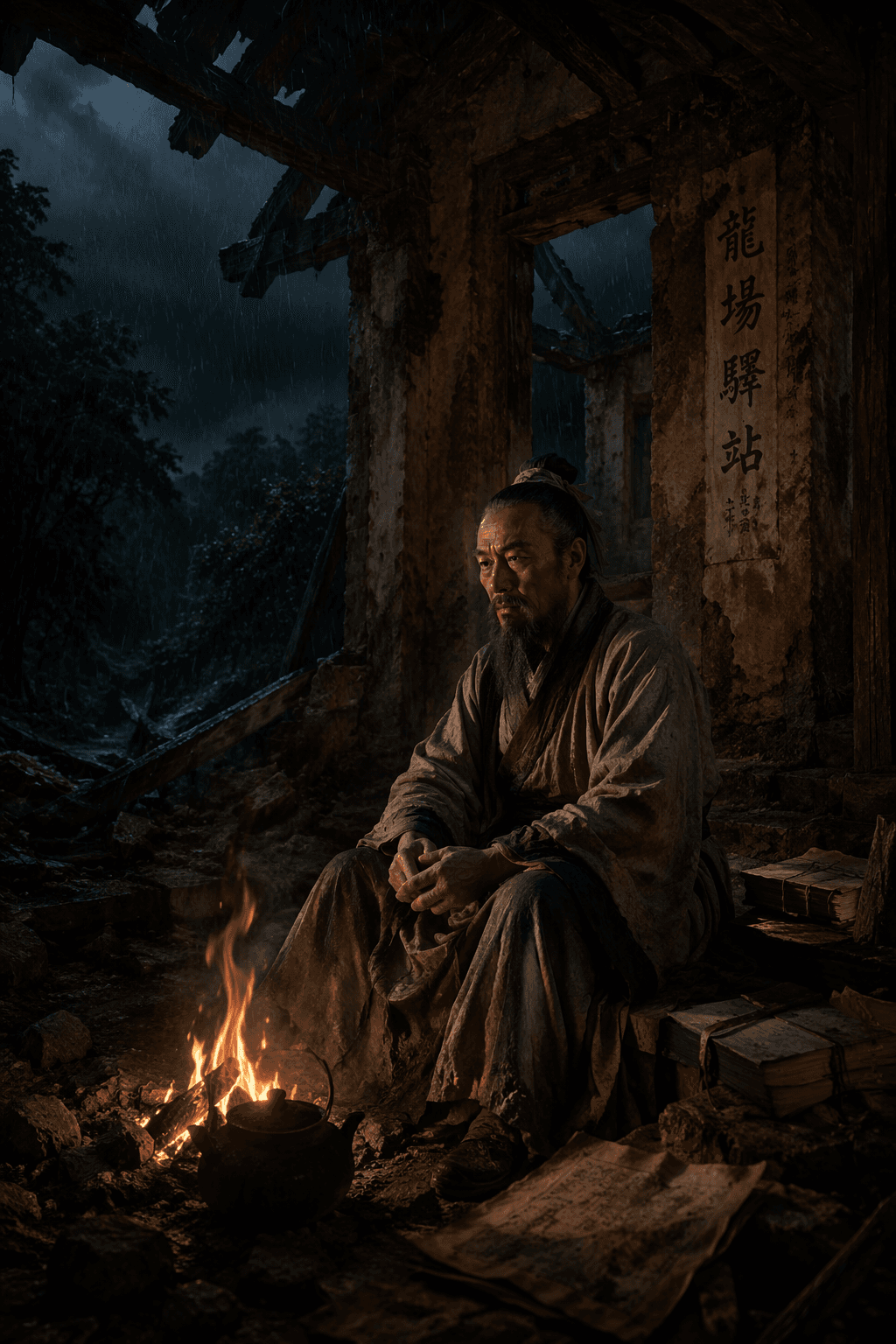
王阳明
Chapter 10 of Sophie's Journey East featuring Wang Yangming (mind-school). Opening quote: "Knowledge and action are one. To know and not to act is not to know."
Unity of Knowledge and Action
Longchang was the end of the world.
Not the dramatic end — no cliffs overlooking abysses, no shores beaten by mythological seas. It was the quiet end, the end that arrives when the road narrows to a path, and the path narrows to a trail, and the trail dissolves into mud and undergrowth and the heavy, breathing silence of a place that the empire has forgotten. Guizhou province. The deep southwest. A posting so remote that to be sent here was not punishment — it was burial.
Sophie arrived at dusk, following the last light through a landscape of limestone crags and dripping forests. The air was thick with moisture and the green smell of decay and growth tangled together. She had been traveling for days since the mountain in Guangdong, since Huineng and the fog and the silence that had almost — almost — become clarity. But clarity had not stayed. It never stayed. It was like holding water in cupped hands: the tighter she gripped, the faster it ran through her fingers.
She had seen things on the road that troubled her. A village burned by bandits, the people huddled in the ruins. A child sick with fever, the mother rocking back and forth with nowhere to turn. An old man dying alone in a field, his harvest ungathered around him. Sophie had passed each scene knowing — intellectually, philosophically — what the sages would say. Laozi would speak of the natural cycle. Confucius would demand benevolent governance. Mencius would point to the innate goodness that circumstance had buried. Mozi would call for universal aid.
She knew the answers. She could recite them like poetry. And she had walked past every single time, because knowing what should be done and doing it were separated by a chasm she could not cross.
The posting station at Longchang was a ruin. The roof sagged, the walls were spotted with lichen, and the wooden floor had begun to rot where rain came through the gaps. In the courtyard, a man was making a bed of straw. He was not young — perhaps fifty, with the lined face of someone who had known power and then known its withdrawal. His robes, though travel-stained, were of fine silk, the kind worn by officials of the Ming court. He moved with deliberate care, arranging the straw with the precision of someone who had decided that if he must sleep in exile, he would at least do it with dignity.
He looked up as Sophie approached. His eyes were the most striking thing about him — bright, searching, fierce with an intelligence that the damp and the decay had not touched.
"You are far from anywhere," he said. His voice was calm, almost welcoming, as if receiving guests in a ruined posting station were a normal occurrence.
"So are you," Sophie replied.
The man almost smiled. "I am Wang Yangming. Once I advised emperors and debated the finest scholars in the empire. Now I am the postmaster of Longchang, which is to say I am the caretaker of a ruin in a province that the court would prefer to forget." He gestured at the straw bed. "Please. Sit. The floor is dry here. Mostly."
Sophie sat. The night came quickly in this place — the mountains swallowing the sun as if it had offended them. The darkness was total, broken only by a small fire Wang Yangming had built from damp wood that smoked more than it burned. They sat in the acrid warmth and watched the smoke curl toward the broken roof and disappear into the black sky beyond.
"I know who you are," Sophie said. "Or who you were. The philosopher of the mind. The one who said that principle is not out there in the world to be investigated — it is here, in the heart. Zhu Xi was wrong. You don't need to examine ten thousand things to find truth. You need to look inward, because the mind itself is principle."
Wang Yangming raised an eyebrow. "You have studied the debates."
"I've studied everything. Laozi, Confucius, Mencius, Mozi, Zhu Xi, Huineng. I've been traveling through this land for — I don't know how long. Months. Years. Time works differently when you've escaped from a book." She paused, surprised by her own candor. "I've learned so much. I understand so much. And none of it has changed a single thing about who I am or what I do."
The fire crackled. A log shifted, sending a shower of sparks into the dark.
"Ah," Wang Yangming said. It was a sound of recognition, not surprise. "The sickness of knowing without doing."
"Is that what it is?"
"It is the most common sickness among educated people. I suffered from it myself for many years." He leaned forward, and the firelight caught the planes of his face, carving deep shadows under his cheekbones. "I was raised on Zhu Xi's philosophy. Ge wu — investigate things. I studied the bamboo in my garden once, trying to find the principle of bamboo within the bamboo itself. I sat before those stalks for seven days and seven nights. Do you know what I found?"
"Principle?"
"A headache. A ruin of a headache. I became ill. I could not find the principle of bamboo in bamboo, because I was looking in the wrong place. The principle of bamboo — the principle of everything — is in the mind that perceives it. But knowing this, even understanding it deeply, did not change me. I was still a man who knew things and did not act on them."
"What changed?"
Wang Yangming was quiet for a moment. The smoke drifted between them, carrying the smell of char and wet wood. When he spoke, his voice had dropped, as if the memory itself required a lower register.
"This. This place. I was a promising official — a rising star in the capital. I spoke truth to a corrupt court, and they rewarded my honesty with exile. Not just any exile. They sent me here, to the edge of the empire, to a posting station that should not exist, in a land of Miao peoples who wanted nothing to do with a Mandarin official. I had no friends. No students. No library. The climate ate through my clothes and my health. For months I lay in this ruin, certain I would die here, and the thought that terrified me most was not death itself."
"What was it?"
"That I would die having known what was right without ever having done it. That I would be a philosopher's corpse — a mind full of principles and a life empty of deeds."
He stood and walked to the edge of the firelight. Beyond him, the forest was a wall of black. The insects sang their enormous tropical chorus, a sound so dense it was almost silence.
"And then one night — a night much like this one — something broke open inside me. Not a thought. Not an argument. An experience. I realized that knowledge and action are not two things. They are one. Zhi xing he yi. To truly know something is already to be acting on it. The person who claims to know what is right but does not do it — that person does not know. They have heard about it. They have memorized it. But they do not know it, because true knowledge is indistinguishable from action."
Sophie felt something tighten in her chest. "That's harsh."
"It is honest. Tell me — you say you know that compassion is right. You have learned this from Confucius, from Mencius, from Mozi. On the road here, you passed suffering. Did you stop?"
The question landed like a stone in still water. Sophie looked at the fire. The flames danced on the damp wood, finding purchase where they could, consuming what they touched without hesitation.
"I passed a village that had been burned," she said quietly. "There were people who needed help."
"And you knew they needed help?"
"Yes."
"And you did not help them."
"No."
Wang Yangming sat down again, across the fire from her. His eyes held no judgment. That was almost worse.
"Then you did not truly know they needed help. You had the concept of their need — the intellectual understanding, the philosophical framework. But the kind of knowing that is identical with action? You did not have that. Because if you had, you would already have been in the ruins, pulling people from the ashes. The knowledge that does not move the body is not knowledge. It is decoration."
Sophie wanted to argue. She wanted to cite exceptions, complications, the reasonable fears that stop a young woman traveling alone from inserting herself into the aftermath of violence. But she knew — with a knowing that felt different from all her previous knowing, heavier and more uncomfortable — that Wang Yangming was not talking about reasonable fears. He was talking about the particular cowardice of the educated mind: the way understanding can become a substitute for engagement, the way philosophy can become a place to hide.
"I've been hiding," she said. The words came out rough, reluctant.
"Behind your knowledge. Behind your questions. Behind the endless procession of sages and their teachings." Wang Yangming nodded slowly. "I hid behind Zhu Xi's investigation of things for years. It was magnificent hiding. Very scholarly. Very respectable. And utterly empty."
The fire had burned low. Wang Yangming fed it another piece of damp wood. The wood hissed and complained, then caught.
"You must understand — this is not about guilt," he said. "Guilt is just another form of self-concern, another way of keeping the focus on yourself rather than on the world that needs you. The unity of knowledge and action is not a club to beat yourself with. It is an invitation to wholeness. To stop being split — a mind that knows and a body that hesitates. To become one thing: a person who knows-by-doing."
"How?" Sophie asked. The word was barely a whisper.
Wang Yangming laughed — a genuine laugh, warm and rough. "How? You are asking a man in exile how to act? I am the worst advertisement for my own philosophy. I was sent here for acting — for speaking when silence was safer, for standing when kneeling was wiser. And yet." He spread his hands, gesturing at the ruined station, the dark forest, the improbable fact of his own survival. "Even here — especially here — I act. I teach the Miao people what I know. I build. I plant. I write. Not because I am certain I am right. Because the alternative — knowing what might help and withholding it — is a form of violence against one's own nature."
He looked at Sophie with an intensity that made her feel seen in a way that was not comfortable but was, somehow, exactly right.
"You have met the great philosophers of this land. You have received their gifts. Laozi gave you the way of non-action. Confucius gave you the way of relationship. Mencius gave you faith in your own goodness. Mozi gave you the expansiveness of impartial love. Zhuangzi gave you laughter and freedom. Zhu Xi gave you the discipline of investigation. Huineng gave you the vast emptiness that is not empty but full of everything."
"How do you know all that?"
"Word travels, even to Longchang. The mountains talk. The rivers carry stories." He smiled. "Also, you just told me, in your way, by the shape of your silence when I named each one."
Sophie realized he was right. She had not spoken, but something in her had responded to each name — a recognition, a warmth, a particular quality of attention.
"All of these teachings are alive in you," Wang Yangming continued. "But they are asleep. They are seeds in frozen ground. And they will remain seeds until you act. Not perfectly. Not bravely. Not with the confidence of a sage. Just — act. Do the next thing that your knowledge calls you to do. The smallest thing. That is the beginning of zhi xing he yi."
The fire had almost gone out. The night pressed in, vast and humid and full of the sounds of a subtropical forest coming alive in the dark. Sophie sat with the silence and with the weight of what she had heard, and she felt something shift inside her — not the dramatic enlightenment of Zhu Xi's bamboo or Huineng's mountain fog, but something more ordinary and therefore more real. A readiness. A willingness to be uncomfortable in the right way.
"There is a village three days' walk from here," Wang Yangming said. "The people are poor. The children do not have a teacher. I would go myself, but I am bound to this posting — the court's last cruelty, to give me a duty I cannot abandon. But you — you are free. You could go."
He did not ask if she would. He did not need to. The question was already alive in the space between them, and the answer was forming in the place where knowledge and action were not yet divided.
Sophie stood. Her legs were stiff, her back ached, her clothes smelled of smoke and road dust. She was tired in every way a person could be tired.
"I'll go," she said.
Not because she was certain. Not because she had achieved some final understanding. Because the words came and she did not stop them, and in the speaking of them she knew — truly knew — that this was what the entire journey had been moving toward. Not more knowledge. Not another sage. The moment where knowing became doing and the long procession of teachers fell away, leaving only Sophie and the road ahead and the unremarkable, world-changing act of showing up.
Wang Yangming inclined his head. "Then you understand my teaching better than most of my students ever did."
He turned back to the fire, which had guttered to embers. Sophie shouldered her pack and walked into the darkness beyond the ruined station, toward the village, toward the eastern shore that waited somewhere beyond the mountains, toward whatever came next when a person finally stopped thinking about walking and simply walked.
Behind her, in the fading glow of the coals, Wang Yangming sat alone in his exile and wrote a letter to a friend. I have met a traveler, he wrote. She has learned what ten sages had to teach. Tonight, she began to learn what only she can teach herself.
Knowledge and action are one. To know and not to act is not to know.
— Instructions for Practical Living (传习录)
Related Content 相关内容
Frequently Asked Questions常见问题
Who is Wang Yangming and what is their significance?王阳明 是谁?+
Wang Yangming (1472–1529 CE) was a major figure in mind-school philosophy. This chapter of Sophie's Journey East explores their teachings through narrative.
What school of thought does this chapter cover?本章涉及哪个学派?+
This chapter covers the mind-school school of Chinese philosophy.