Laozi
老子
State of Chu · 楚国
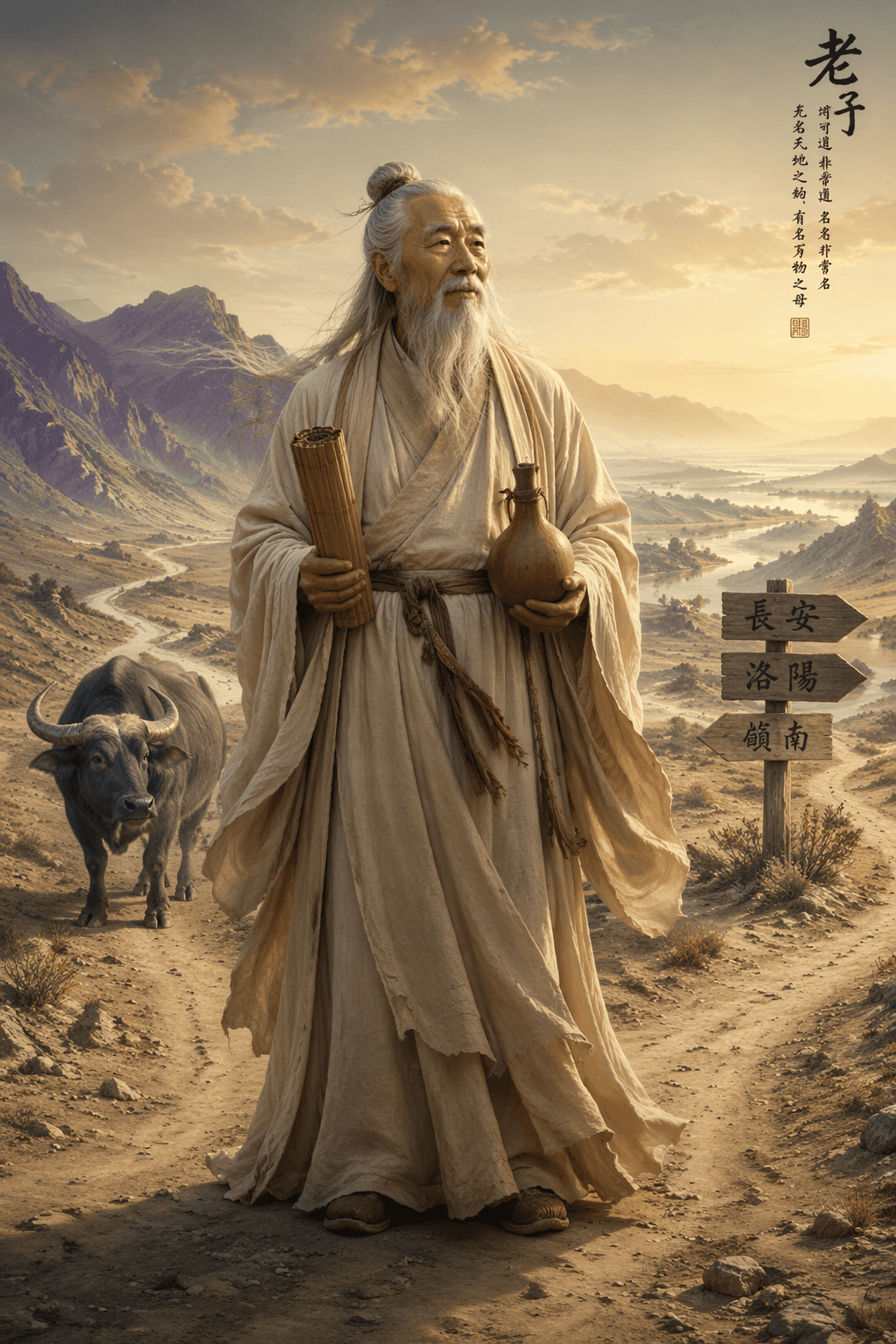
Laozi from State of Chu (6th century BCE) was a foundational figure in Daoism. Known for teachings on the tao (the way), wu wei (non-action), softness overcomes hardness, Laozi shaped Chinese civilization for millennia.
Biography
The Old Master Who Disappeared
Laozi is the most elusive figure in Chinese philosophy — which is entirely fitting for a thinker whose central teaching is that the deepest truths cannot be named. According to Sima Qian's Records of the Grand Historian, Laozi was born Li Er in the state of Chu, served as the archivist of the Zhou court, and spent decades watching the rise and fall of dynasties from the quiet of the imperial library. He saw every ambition undone, every empire reversed, every certainty dissolved — and from that long observation distilled a philosophy of reversal itself.
The biography is thin and possibly mythological. Laozi may be a composite figure, or a title applied to any "old master," or a legendary persona invented to give authorship to a text that emerged from collective wisdom. What is indisputable is that the Tao Te Ching — five thousand characters, eighty-one brief chapters — contains one of the most compressed and powerful philosophical systems ever created. Its density is intentional. Laozi wrote for the border guard Yin Xi, who asked for something to remember him by before he rode westward into oblivion. He gave the guard not a philosophy but a seed — a text so terse that every reader must grow it into meaning through their own experience.
The Philosophy of Reversal
The Tao Te Ching operates through paradox. "The soft overcomes the hard" — not as moral advice but as natural law. Water erodes rock; teeth decay while gums endure; living things are supple while dead things are rigid. Laozi did not romanticize weakness; he observed that the property of yielding is the property of surviving. A tree that bends in the storm remains standing; a tree that resists snaps. This is not philosophy but physics, and its implications ramify through every domain of human life.
The key operation in Laozi's thought is fan — return, reversal, turning back. Every extreme naturally reverses toward its opposite. When a society becomes too rigid, it collapses. When a person becomes too certain, they become blind. When a movement becomes too forceful, it exhausts itself. The Tao is the pattern of these reversals — the underlying rhythm that ensures nothing remains extreme forever. Wisdom, for Laozi, is the practice of aligning with this rhythm rather than trying to override it.
Wu Wei: The Art of Not Forcing
Laozi's most misunderstood concept is wu wei, often translated as "non-action" and confused with laziness. In fact, wu wei is the highest form of action — action that is so perfectly aligned with the moment that it appears effortless. The skilled woodcarver does not force the blade; he reads the grain. The experienced sailor does not fight the wind; she adjusts the sail. The wise leader does not micromanage; she creates conditions where people organize themselves. In each case, the practitioner achieves the maximum result with the minimum intervention, because they understand the natural tendencies of their material and work with them rather than against them.
This principle has extraordinary practical implications. In management, it means creating autonomous teams rather than command-and-control hierarchies. In design, it means working with user behavior rather than trying to reshape it. In personal development, it means cultivating habits that flow with your nature rather than fighting against your tendencies. Every time you "make things happen by letting them happen," you are practicing wu wei.
Emptiness as the Source of Function
Laozi's second major insight is that emptiness is not absence but potential. A room is useful because of its space, not its walls. A cup holds water because of its hollow interior. A wheel rotates because of the empty hub at its center. "Clay is shaped into a vessel," he writes, "but it is the emptiness inside that makes it useful." This is not merely a poetic observation about architecture; it is a metaphysical principle. The functional element of any system is not its solid structure but the void that structure creates.
Applied to the mind, this principle becomes revolutionary. A mind stuffed with opinions, plans, and certainties cannot respond to new situations — it is a cup already full, unable to receive. A mind that retains openness, that keeps its interior uncluttered, can adapt to anything. Laozi's practice of "daily diminishing" — subtracting one thing each day from your mental inventory — is the opposite of the modern cult of productivity. It is the cultivation of inner space, the deliberate maintenance of emptiness as the precondition for effectiveness.
The Unending Influence
The Tao Te Ching has been translated into more languages than any other Chinese text and remains a living document rather than a historical artifact. It speaks directly to concerns that are timeless: how to lead without dominating, how to act without exhausting, how to live without losing yourself to the machinery of ambition. Laozi's refusal to define the Tao, his insistence that the ultimate reality lies beyond language, anticipates the limits of conceptual thinking that modern philosophy and cognitive science continue to grapple with. He remains, after two and a half millennia, the philosopher you return to when all other philosophies have become too certain of themselves.
Core Concepts
The Tao (The Way) (道)
The Tao is the unnamed, ungraspable source of all things — the pattern behind patterns, the movement that moves without moving. It cannot be defined because definition limits, and the Tao is limitless. Laozi opens his masterpiece by declaring that the Tao that can be spoken is not the eternal Tao, making the failure of language itself the first lesson.
是无名、不可把握的万物之源——模式背后的模式,运动而不动的运动。它无法被定义,因为定义即限制,而道是无限的。老子开篇便宣告"道可道,非常道",使语言本身的失败成为第一课。
Wu Wei (Non-Action) (无为)
Wu wei is not passivity but the art of acting in alignment with natural tendencies — like a skilled sailor who reads the wind rather than fights it. The highest efficacy comes from the least effort, because effort applied against the grain of reality creates resistance. Water does not try to flow downhill; it simply flows.
无为不是消极,而是顺应自然趋势而动的艺术——如善于读风的航海者而非与之搏斗者。最高的效能来自最少的努力,因为逆现实之势的努力制造阻力。水不会试图向下流;它只是流淌。
Softness Overcomes Hardness (柔弱胜刚强)
Laozi observed that water, the softest substance, erodes rock, the hardest. Teeth are hard and decay early; gums are soft and last a lifetime. This is not romanticism but physics — flexibility adapts, rigidity breaks. In every system, the element that yields endures; the element that resists shatters.
老子观察到最柔的水侵蚀最坚的石。牙齿坚硬而早衰,牙龈柔软而终身。这不是浪漫主义而是物理学——柔韧者适应,刚硬者碎裂。在每一系统中,退让者持久,抗拒者粉碎。
Emptiness and Usefulness (空无与功用)
A cup is useful because of its emptiness; a room is livable because of its space; a wheel works because of the hole at its center. Laozi's paradox: what makes things functional is not their substance but their void. This principle extends from architecture to psychology — the mind that retains no fixed ideas can respond to any situation.
杯子因空而有用;房间因空间而宜居;车轮因中心的孔洞而运转。老子的悖论:使事物发挥功能的不是其实体而是其虚空。这一原则从建筑延伸到心理学——不留固见之心可回应任何情境。
Return to the Uncarved Block (复归于朴)
The *pu* — uncarved wood — represents original nature before society carves it into shapes. Laozi advocates returning to this state: not childish innocence but mature simplicity, the wisdom that has passed through complexity and chosen simplicity over it. The carved block can only be one thing; the uncarved block can become anything.
朴——未雕之木——代表社会雕琢之前的原始本性。老子主张回归此境:非幼稚天真而是成熟简约,是穿越复杂性后选择简朴的智慧。雕成的木块只能是一种东西;未雕的木块可以成为任何东西。
Notable Quotes
“The Tao that can be told is not the eternal Tao. The name that can be named is not the eternal name.”
道可道,非常道。名可名,非常名。
The opening line of the Tao Te Ching declares the limits of language itself. Any attempt to describe the ultimate reality fails because description reduces the infinite to the finite. This is not nihilism but a call to direct experience beyond words.
“The highest good is like water. Water gives life to the ten thousand things and does not strive. It flows in places men reject and so is like the Tao.”
上善若水。水善利万物而不争,处众人之所恶,故几于道。
Water is Laozi's master metaphor. It nourishes without demanding recognition, occupies low places others avoid, and yet accomplishes the most essential work. Virtue, like water, works by flowing rather than asserting.
“Knowing others is intelligence; knowing yourself is true wisdom. Mastering others is strength; mastering yourself is true power.”
知人者智,自知者明。胜人者有力,自胜者强。
Laozi reverses the conventional valuation: internal mastery outranks external mastery. To know yourself — your patterns, your tendencies, your limits — is harder and more valuable than any outward achievement. True strength is self-overcoming.
“The soft overcomes the hard, and the weak overcomes the strong. Everyone knows this, but no one practices it.”
柔之胜刚,弱之胜强,天下莫不知,莫能行。
Laozi notes a universal failure: people understand the principle of softness intellectually but cannot live by it. The knowledge that yielding wins is easy; the practice of actually yielding requires a transformation of ego that most people refuse.
“When I let go of what I am, I become what I might be. When I let go of what I have, I receive what I need.”
无为而无不为。执者失之,为者败之。
Laozi's paradox of attainment: grasping destroys what you grasp; releasing opens what you need. The Tao operates through subtraction — each day learn less, hold less, assert less, and the way becomes clearer.
“A journey of a thousand miles begins beneath your feet.”
千里之行,始于足下。
Not "begins with a single step" as often mistranslated, but begins beneath your feet — right here, right now, with what you are already standing on. The grand journey does not require a grand beginning; it requires only the willingness to start from where you actually are.
“The Tao does nothing, but leaves nothing undone. When the ruler follows the Tao, the people transform themselves.”
道常无为而无不为。侯王若能守之,万物将自化。
The central political teaching of Daoism: the best governance works through non-interference, creating conditions where natural self-organization emerges. People transform themselves when the environment is right — they do not need to be forced or programmed.
“He who stands on tiptoe is not steady. He who strides cannot maintain the pace. He who displays himself does not shine. He who justifies himself has no glory.”
企者不立,跨者不行,自见者不明,自是者不彰。
Every form of self-promotion is self-defeating. Displaying virtue reveals its deficiency; asserting wisdom reveals its incompleteness. The Taoist ideal is effortless presence — you shine because you are luminous, not because you show yourself.
Modern Influence
Wu Wei in Modern Management
Laozi's concept of wu wei — action without forcing — has found an unexpected home in contemporary management theory. Agile methodology, lean startup principles, and the "servant leadership" model all echo the Taoist insight that the best leader is one who creates conditions for success rather than commanding outcomes. When a CEO says "let the team find the solution," she is practicing wu wei without knowing the term.
Environmental Philosophy and Daoism
Laozi's vision of humanity as part of nature, not its master, anticipated the ecological movement by two millennia. His emphasis on following natural patterns rather than imposing human designs resonates deeply with sustainability thinking. Permaculture — the design philosophy that works with natural ecosystems rather than against them — is essentially applied Daoism. When Bill Mollison coined the term in the 1970s, he was unknowingly restating Laozi's principle that the highest good is like water.
The Tao Te Ching as Global Wisdom Literature
With over 250 translations into English alone, the Tao Te Ching is the most translated Chinese text in history and the second most translated book in the world after the Bible. It has influenced physicists (Niels Bohr kept a Taoist yin-yang symbol on his coat of arms), psychologists (Jung wrote extensively on Taoist meditation), artists (John Cage used I Ching-derived chance operations), and counterculture movements from the Beat Generation to modern mindfulness practices.
Read the Story
Experience Laozi's philosophy through Sophie's narrative journey.
Read Chapter →Key Concepts · 核心概念
Explore these Daoism concepts in our glossary →
Related Content 相关内容
Frequently Asked Questions常见问题
What is Laozi known for?老子 以什么著称?+
Laozi (6th century BCE) is known for The Tao (The Way), Wu Wei (Non-Action), Softness Overcomes Hardness. As a key figure in Daoism, Laozi's ideas shaped Chinese thought for centuries.
What era did Laozi live in?老子 生活在什么时代?+
Laozi lived during the 6th century BCE. Based in State of Chu.
What school of thought did Laozi found or belong to?老子 属于哪个学派?+
Laozi belonged to the Daoism school (道家).
Want to speak with Laozi 老子? Try the Oracle.
Consult the Oracle →Free: 3 consultations per day · Pro: 10 per day + deep readings