The Way Without Direction
無為之道的方向
Laozi 老子 · 6th century BCE · Silk Road
“The Tao that can be told is not the eternal Tao.”— Tao Te Ching (道德经), Chapter 1
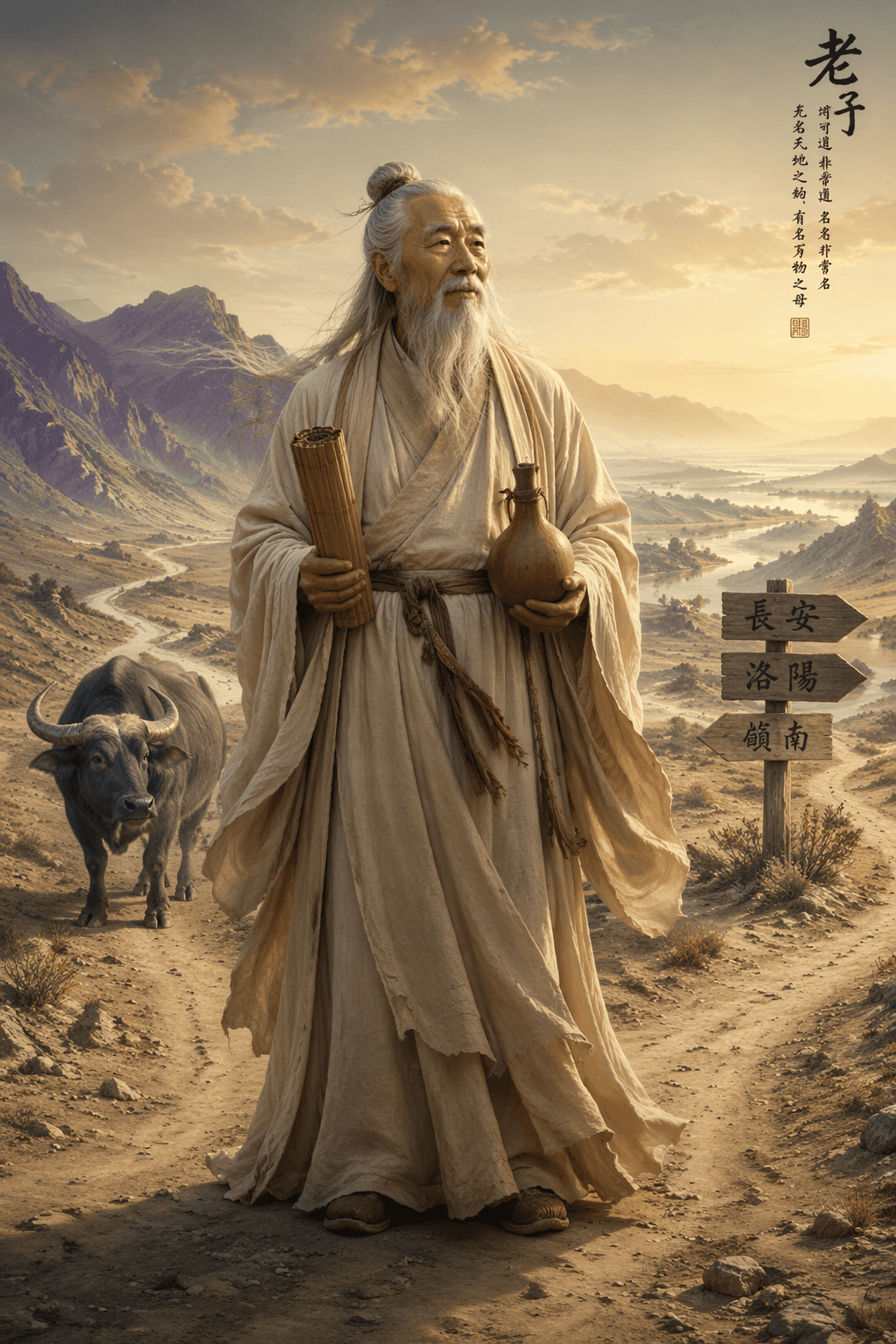
老子
Chapter 1 of Sophie's Journey East featuring Laozi (daoism). Opening quote: "The Tao that can be told is not the eternal Tao."
I
The road split into three, and Sophie stopped.
She had been walking since the gate — since Zhou Gong's dream had swallowed her whole and deposited her on a dusty track somewhere east of everywhere she had ever known. The land was vast and dry, the sky an immensity of bleached blue. To her left, the road wound toward distant purple mountains. To her right, it descended into a river valley shrouded in morning mist. Straight ahead, it dissolved into the ochre horizon without any apparent destination.
There was no signpost. No marker. No Alberto Knox to send her a letter explaining which path led where. There was only the wind, carrying the scent of dust and something else — the faint, green smell of tea leaves steeping.
Sophie looked behind her. The gate was gone. In its place, the road stretched back into nothing — no landmarks, no footprints, no evidence that she had come from anywhere at all. She had stepped through a membrane once before, from fiction into reality. Now it seemed she had stepped through another, from one kind of reality into something older and stranger.
She stood at the crossroads for a long time. The sun climbed. Her throat grew dry. She began to feel the particular panic of having too many choices and no basis for choosing among them — a panic she recognized from her old life, from the weeks when Alberto's letters had piled philosophical questions upon her until she could barely breathe under their weight.
"You are standing on the wrong question," said a voice.
Sophie turned. A few paces from the crossroads, half-hidden by a tumbled stone wall, sat an old man. He was small and weathered, dressed in rough robes the color of river clay. Before him, on a flat rock, a clay teapot sat beside two cups — simple, unglazed things that looked as though they had been made by hand and fired in a hole in the ground. He was pouring. The water moved in a thin, precise arc.
"The question is not which road to take," the old man continued, not looking up. "The question is why you believe you must choose."
Sophie stared at him. "I have to go somewhere."
"Do you? Where are you trying to go?"
She opened her mouth and found she had no answer. Where was she trying to go? She had no map, no destination, no purpose beyond the forward motion itself. She had left the book. She had left Alberto's study and the garden party and the whole architecture of someone else's story. But she had not, she realized, replaced that architecture with anything. She was free — gloriously, terrifyingly free — and she had been using that freedom to walk in a straight line, as though freedom were simply a wider road.
"Sit," the old man said. He gestured to the flat rock beside him. "The tea is ready."
II
His name was Laozi, though he told it to her as though the name were a convenience he did not particularly require.
"I am old," he said, pouring her a cup. The tea was pale green, almost colorless, and it smelled of wet stone and spring. "Older than these mountains, older than the names people give to things. But you may call me that if you need something to hold onto."
Sophie took the cup. The clay was warm against her palms. "Are you a philosopher?"
The old man considered this. "I am a man who has watched water flow for a very long time. Whether that makes me a philosopher, I cannot say. The word is too heavy for what I do."
He sipped his own tea. Sophie sipped hers. The flavor was startling — not the bitter briskness of the tea her mother made in their kitchen in Oslo, but something subtler, rounder, with a sweetness that appeared only after she swallowed, like an afterthought.
"You are lost," Laozi said. It was not a question.
"I escaped from a book," Sophie said. She had not planned to say it. The words rose from somewhere below her deliberation, the way the tea's sweetness rose after the fact. "I was a character — a girl in a novel about philosophy. And then I... got out. I became real. Or at least I thought I did. And now I'm here, and I don't know where I'm going, and I can't even decide which road to take."
Laozi set down his cup. His eyes, when they met hers, were the color of the tea — amber-brown, deep, unhurried.
"You are making the mistake that all young philosophers make," he said gently. "You believe that movement is progress. That choosing is the same as going. That standing still is the same as being stuck."
He pointed to the teapot. "Watch."
Steam rose from the spout in a slow spiral. The old man did nothing to direct it. He did not fan it, or blow on it, or tilt the pot to change its course. The steam rose as steam rises — because it was the nature of heated water to rise, because the air received it, because the world arranged itself that way without anyone's intervention.
"Wu wei," Laozi said. "Non-action. Not laziness, not passivity. It is the art of acting without forcing. Of moving with the nature of things rather than against them."
"But how can I move with the nature of things if I don't know what the nature of things is?" Sophie asked. "I don't even know what I am."
Laozi smiled — the smile of someone who had heard this question ten thousand times and still found it beautiful.
"Pour the tea," he said.
Sophie looked at him, confused. "You already poured —"
"Pour it again. Into your cup. From the pot."
She picked up the teapot. It was heavier than it looked. She tilted it over her cup and the tea came — but too fast, splashing over the rim, pooling on the stone. She flinched, set the pot down, looked at the mess.
"You forced it," Laozi said. "You decided where the tea should go, and you made it go there. And the tea rebelled. It went where you did not intend." He picked up the pot himself. His hands were steady. He tilted it the smallest degree, and the tea flowed — a single, perfect thread that found the center of the cup and filled it exactly to the rim without spilling a drop.
"The tea wants to flow," he said. "The cup wants to receive it. My job is not to command the tea. My job is to understand the tea well enough to let it do what it already wants to do."
III
They sat together for hours. The sun moved across the sky. The shadows of the mountains lengthened. Laozi poured tea and spoke of the Tao — the Way — though every time he tried to define it, he stopped himself and laughed.
"The Tao that can be told is not the eternal Tao," he said. "I wrote that once, on bamboo slips, for a border guard who asked me to leave something behind before I disappeared into the west. I wrote five thousand characters about a thing that cannot be described in five thousand characters. That is the central joke of my life, and I think the universe enjoys it."
"But if the Tao can't be described," Sophie said, "how can anyone follow it?"
"By not following. By not trying to follow." He gestured at the landscape around them — the mountains, the river valley, the three roads. "Does the river try to reach the sea? Does the mountain try to be tall? They are what they are, and they move as they move, and the Tao is simply the name we give to the pattern of all that moving. You cannot follow the Tao the way you follow a road. You can only stop resisting it."
Sophie thought about this. She thought about her old life in the book — the way Alberto's lessons had always seemed to lead somewhere, each philosopher a stepping stone to the next, the whole history of Western thought a grand narrative arc with a beginning and a middle and an implied end. Even her escape had felt like a plot point, a climax, a resolution.
But what if there was no resolution? What if freedom was not the end of a story but the dissolution of the need for stories altogether?
"I have spent my whole life being pulled forward by questions," Sophie said quietly. "What is real? What is true? Who am I? Every question led to the next question, and I always felt like I was running to keep up."
Laozi nodded. "Questions are wonderful servants and terrible masters. The mind asks because asking is its nature. But the Tao does not answer questions. The Tao dissolves them. Not by providing the answer, but by making the question irrelevant."
He poured the last of the tea. The pot was empty. He set it down and looked at her with something that was neither pity nor judgment but a kind of ancient, patient warmth.
"You escaped from a book," he said. "And now you are trying to write yourself a new one. A book about a girl who travels East and finds wisdom. But perhaps wisdom is not a book. Perhaps it is the space between the words — the emptiness in the cup that makes the cup useful."
Sophie looked at her empty cup. The clay was stained with tea, a thin amber ring at the level where the liquid had been. The emptiness below the ring was the shape of what she had consumed. The emptiness above was the shape of what she had not yet received.
IV
The afternoon aged into gold. Laozi began to gather his things — the teapot, the cups, a small cloth bag — with the unhurried movements of someone for whom time was not a resource to be managed.
"Where will you go?" Sophie asked.
Laozi looked at the three roads. "West," he said. "I have been going west for a very long time. Beyond the pass, beyond the mountains, beyond the edge of the world that people have named. I am told there is a gate there, and beyond the gate, nothing at all. I should like to see what nothing looks like."
"And me? Which road should I take?"
Laozi smiled again — that same patient, bottomless smile. "You already know."
Sophie looked at the three roads. The one to the mountains. The one to the river valley. The one that dissolved into the horizon. And she realized he was right. She did know. Not because she had decided, but because the decision had already been made — not by her will, but by the shape of the moment, the direction of the wind, the particular quality of the light on the valley road that made it seem, without reason or argument, like the next thing.
She did not say goodbye. Neither did he. She simply walked, and the road received her, and the dust rose behind her feet in small, unhurried spirals.
She did not look back. Not because she did not want to, but because looking back had ceased to feel necessary. The tea was in her. The emptiness was in her. The Tao — whatever it was, wherever it led — was already moving her the way steam moves, the way water finds its level, the way a story continues not because someone is writing it but because it has not yet found its stillness.
The road descended. The valley opened. Somewhere below, she could hear the sounds of human life — voices, the clatter of cart wheels, the distant percussion of a blacksmith's hammer. A city. A real, living Chinese city, the first she had encountered.
Sophie walked toward it without knowing its name, without knowing its customs, without knowing anything at all except that she was walking, and the walking was enough.
The Tao that can be told is not the eternal Tao.
— Tao Te Ching (道德经), Chapter 1
Related Content 相关内容
Frequently Asked Questions常见问题
Who is Laozi and what is their significance?老子 是谁?+
Laozi (6th century BCE) was a major figure in daoism philosophy. This chapter of Sophie's Journey East explores their teachings through narrative.
What school of thought does this chapter cover?本章涉及哪个学派?+
This chapter covers the daoism school of Chinese philosophy.