Zhuangzi
庄子
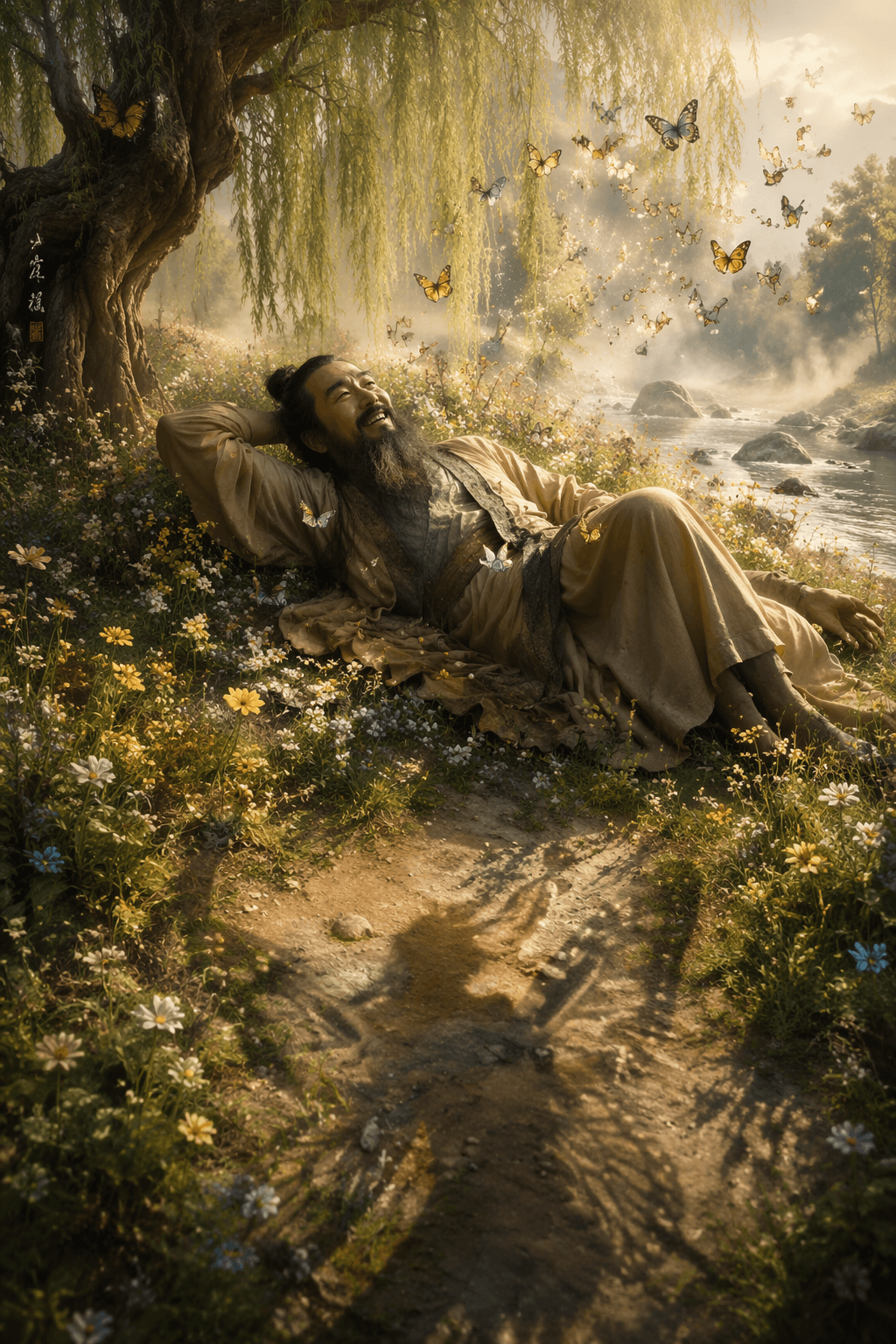
Zhuangzi (4th century BCE) was a foundational figure in Daoism. Known for teachings on free wandering (xiaoyao), the butterfly dream, uselessness as virtue, Zhuangzi shaped Chinese civilization for millennia.
Biography
The Butterfly Who Woke Up
Zhuangzi — Zhuang Zhou of Meng, in the state of Song — is the most literary and imaginative philosopher in the Chinese tradition, and perhaps in any tradition. Where Laozi wrote in compressed paradox, Zhuangzi wrote in wild, comedic, and surreal narratives. Where Confucius sought order through ritual, Zhuangzi sought freedom through the demolition of every conceptual cage. He lived in the fourth century BCE, roughly contemporary with Mencius, and like many Chinese philosophers of that era, he held a minor official post — keeper of a lacquer garden — before abandoning it for a life of deliberate poverty and deliberate freedom.
The most famous anecdote about Zhuangzi's life is his refusal of power. The king of Chu sent two high officials to offer Zhuangzi the position of prime minister. Zhuangzi was fishing by the river. He told the officials: "I hear that Chu has a sacred turtle that has been dead for three thousand years, wrapped in silk and stored in a temple. Would that turtle prefer to be dead and honored, or alive and dragging its tail in the mud?" The officials admitted the turtle would prefer to be alive. "Then go away," Zhuangzi said. "I will drag my tail in the mud." This story captures the essence of Zhuangzian philosophy: the refusal to exchange authentic existence for social prestige, the preference for life over reputation, the insistence that freedom is more valuable than any honor.
The Master of Paradox
Zhuangzi's text, which survives in thirty-three chapters (seven "inner" chapters generally considered authentic, plus outer and miscellaneous chapters), is a workshop of deconstruction. His method is to take a fixed conceptual category — useful/useless, right/wrong, self/other, life/death — and show that it depends on perspective rather than reflecting an absolute truth. The gnarled tree that the carpenter rejects as useless lives for centuries while the straight tree is cut down. The ugly duckling survives because no one wants it; the beautiful swan is hunted for its feathers. Zhuangzi does not argue that uselessness is objectively better than usefulness; he shows that the distinction itself is relative to the perspective that makes it. From the carpenter's perspective, the gnarled tree is useless; from the tree's perspective, its gnarliness is its salvation.
This technique of perspective-shifting is Zhuangzi's signature philosophical move. He does not offer a new system of beliefs to replace the old one; he offers a way of seeing that makes every system of beliefs look partial and contingent. The "equalizing of all things" (qiwu) is not a claim that all things are the same but a recognition that every judgment about what things are depends on the position of the judge. The mosquito sees the human as enormous; the mountain sees the human as tiny. Neither perspective is wrong; both are incomplete. Wisdom, for Zhuangzi, is the capacity to hold multiple perspectives simultaneously without committing to any one as absolute.
Cook Ding and the Art of Effortless Mastery
Zhuangzi's most celebrated story is the account of Cook Ding, who carves an ox with such precision that his blade has lasted nineteen years without needing sharpening. When asked how he achieves this, Cook Ding explains: "What I care about is the Tao, which goes beyond skill. When I first began cutting up oxen, I saw nothing but the whole ox. After three years, I no longer saw the whole ox. Now, I meet it with my spirit rather than my eyes. My senses stop and my spirit moves. I follow the natural openings, moving through the large gaps and guiding the blade through the empty spaces. I never touch a joint or ligament, much less a bone."
This passage is Zhuangzi's theory of mastery, and it describes a progression that any practitioner of any discipline will recognize. The beginner sees the task as a solid mass. The intermediate sees the parts. The master sees the spaces — the openings, the gaps, the negative spaces where action can flow without resistance. At this level, the distinction between technique and the Tao dissolves. Cook Ding is not applying a skill; he is responding to the structure of the ox with such intimacy that the blade moves by itself. This is wu wei made vivid — not the absence of action but action so perfectly aligned with the material that it appears effortless.
Freedom as Forgetfulness
Zhuangzi's ideal state is one of forgetfulness — not amnesia but the kind of forgetting that happens when something becomes so natural it disappears from attention. "When the shoe fits, the foot is forgotten; when the belt fits, the belly is forgotten; when the heart is right, right and wrong are forgotten." A well-fitting shoe does not require you to think about your foot; a well-functioning moral sense does not require you to think about morality. Zhuangzi's freedom is not the freedom of the rebel who opposes every constraint but the freedom of the person who has become so fluid that constraints no longer register as constraints.
This ideal culminates in the "perfect man" who "has no self, no achievement, no name." Zhuangzi defines perfection not by what someone has accumulated but by what they have shed. The perfect person has released the compulsion to define themselves, to prove themselves, to distinguish themselves from others. They exist without agenda, without identity, without the anxious project of self-improvement. This is not nihilism but the deepest affirmation: life is worth living precisely when you stop trying to justify it.
The Dream That Has No Answer
The butterfly dream remains Zhuangzi's most enduring contribution to philosophy because it refuses resolution. Other philosophers try to prove that reality is real, that the self is solid, that knowledge is certain. Zhuangzi simply notes that from within experience, you cannot tell whether you are awake or dreaming, whether you are Zhuang Zhou or a butterfly. He does not offer a solution; he offers a question that undermines all solutions. This is not skepticism but a deeper kind of wisdom: the recognition that certainty is always built on assumptions, and that the most productive philosophical stance is not to resolve doubt but to inhabit it creatively, letting the uncertainty open you to possibilities that certainty would exclude.
Core Concepts
Free Wandering (Xiaoyao) (逍遥)
Xiaoyao — free, unfettered wandering — is Zhuangzi's highest ideal. Not freedom in the political sense (the right to act without constraint) but freedom in the existential sense: liberation from the conceptual categories, social roles, and psychological habits that imprison the mind. The free wanderer is not bound by usefulness, reputation, or even the distinction between self and world.
逍遥——自由无拘的漫游——是庄子的最高理想。不是政治意义上的自由(不受约束行动的权利),而是存在意义上的自由:从囚禁心灵的概念范畴、社会角色与心理习惯中解放。逍遥者不受有用、名声甚至自我与世界之区分的束缚。
The Butterfly Dream (梦蝶)
Zhuangzi dreamed he was a butterfly, happily fluttering, with no thought of being Zhuang Zhou. Upon waking, he could not determine whether he was Zhuang Zhou dreaming he was a butterfly, or a butterfly now dreaming he was Zhuang Zhou. This is not merely a charming story but a profound epistemological challenge: if subjective experience cannot distinguish dream from reality, what grounds do we have for claiming any particular identity?
庄子梦见自己是一只蝴蝶,翩翩飞舞,毫无庄周之念。醒来后他无法确定:是庄周梦为蝴蝶,还是蝴蝶现在梦为庄周。这不仅是迷人的故事,更是深刻的认识论挑战:如果主观体验无法区分梦与现实,我们有何根据声称任何特定身份?
Uselessness as Virtue (无用之用)
Zhuangzi repeatedly celebrates things that are useless by conventional standards — the gnarled tree that cannot be cut for timber, the decrepit horse that cannot be ridden. Their uselessness is what saves them from exploitation. Zhuangzi reverses the usual valuation: usefulness makes you a target; uselessness grants you survival. The highest usefulness is the usefulness of being useless.
庄子反复赞颂按常规标准无用的事物——不能伐为木材的扭曲大树,不能骑乘的老迈马匹。它们的无用正是免于被剥削的保障。庄子翻转了常规价值:有用让你成为目标;无用赋予你生存。最高的用处是无用的用处。
Equalizing All Things (Qiwu) (齐物)
Zhuangzi argues that all conceptual distinctions — right/wrong, beautiful/ugly, large/small — are relative to perspective, not absolute. From the perspective of a mosquito, a human is enormous; from the perspective of a mountain, a human is tiny. "Equalizing things" means recognizing that no single viewpoint has privileged access to truth; every perspective reveals one facet of an irreducibly complex reality.
庄子论证所有概念区分——对/错、美/丑、大/小——都是相对于视角的,而非绝对的。从蚊子的视角看,人是巨大的;从山的视角看,人是微小的。"齐物"意味着认识到没有单一视角拥有对真理的特权通道;每一视角揭示不可简化的复杂现实的一个面相。
Skill as Dao (Jiyang) (技进乎道)
Zhuangzi's story of Cook Ding, who carves an ox with such effortless precision that his blade has lasted nineteen years without sharpening, illustrates the principle that technical mastery at its highest becomes spiritual mastery. When skill is so thoroughly internalized that the craftsman acts without thinking, the boundary between technique and the Tao dissolves.
庄子庖丁解牛的故事——以毫不费力的精准切割牛体,刀刃十九年未磨——阐明了技艺在其最高处成为精神 mastery 的原则。当技艺如此彻底内化以至于匠人无需思考便行动时,技术与道之间的界限消融了。
Notable Quotes
“Once I, Zhuang Zhou, dreamed that I was a butterfly, fluttering happily here and there. I was convinced that I was a butterfly, with no knowledge of Zhuang Zhou. Suddenly I woke up, and there I was, unmistakably Zhuang Zhou. But I do not know whether I was Zhuang Zhou dreaming I was a butterfly, or a butterfly dreaming I am now Zhuang Zhou.”
昔者庄周梦为胡蝶,栩栩然胡蝶也。自喻适志与!不知周也。俄然觉,则蘧蘧然周也。不知周之梦为胡蝶与,胡蝶之梦为周与?
The most famous passage in Chinese philosophy. Zhuangzi does not resolve the paradox — he leaves it open, forcing the reader to confront the inadequacy of any fixed identity. The point is not that reality is a dream but that certainty about who you are is always provisional.
“The fish trap exists because of the fish; once you have the fish, you can forget the trap. The rabbit snare exists because of the rabbit; once you have the rabbit, you can forget the snare. Words exist because of meaning; once you have the meaning, you can forget the words.”
筌者所以在鱼,得鱼而忘筌;蹄者所以在兔,得兔而忘蹄;言者所以在意,得意而忘言。
Language is a tool, not the thing itself. Once you grasp the meaning, cling to the words and you lose the meaning. Zhuangzi's entire literary method — absurd stories, contradictions, deliberate nonsense — is designed to break the reader's attachment to linguistic formulation and push them toward direct understanding.
“A frog in a well cannot conceive of the ocean; a summer insect cannot conceive of ice. How can a person with a small mind discuss great things?”
井蛙不可以语于海者,拘于虚也;夏虫不可以语于冰者,笃于时也;曲士不可以语于道者,束于教也。
Every perspective is limited by its conditions — space, time, and conceptual training. Zhuangzi does not dismiss the small perspective but notes that it cannot comprehend the large. Wisdom is not the replacement of a small perspective with a large one but the recognition that all perspectives are partial.
“My life has a limit, but knowledge has no limit. To pursue what has no limit with what has a limit is dangerous.”
吾生也有涯,而知也无涯。以有涯随无涯,殆已。
Zhuangzi warns against the Sisyphean pursuit of total knowledge. Since life is finite and knowledge infinite, trying to know everything exhausts the knower without reaching the goal. The wise approach is to know what you need, let go of what you do not, and focus on living well rather than accumulating information.
“When the shoe fits, the foot is forgotten; when the belt fits, the belly is forgotten. When the heart is right, right and wrong are forgotten.”
忘足,履之适也;忘要,带之适也;知忘是非,心之适也。
The highest state of any practice is when it becomes so natural that you forget you are practicing. A well-fitting shoe disappears from attention; a well-functioning moral sense disappears from consciousness. Zhuangzi's ideal is not conscious virtue but unselfconscious adequacy — the state where right action flows without deliberation.
“The perfect man has no self; the holy man has no achievement; the sage has no name.”
至人无己,神人无功,圣人无名。
Zhuangzi's definition of human perfection is defined by absences, not additions. The perfect person is not someone who has accumulated virtues but someone who has shed attachments — to self, to achievement, to reputation. Freedom is subtraction, not accumulation.
“The usefulness of the useless.”
无用之用。
Zhuangzi's signature reversal. The gnarled tree lives because no carpenter wants it; the ugly duckling survives because no hunter values it. What conventional judgment calls useless, Zhuangzi reveals as the condition of freedom from exploitation. Usefulness makes you a tool of others; uselessness makes you your own.
“Cook Ding laid down his knife and said: 'What I care about is the Tao, which goes beyond skill. When I first began carving oxen, I saw nothing but the whole ox. After three years, I no longer saw the whole ox. Now I meet it with my spirit rather than my eyes. My senses stop and my spirit moves.'”
庖丁释刀对曰:'臣之所好者道也,进乎技矣。始臣之解牛之时,所见无非牛者。三年之后,未尝见全牛也。方今之时,臣以神遇而不以目视,官知止而神欲行。'
The passage that defines Zhuangzi's theory of skill. Mastery proceeds through stages: from seeing the whole, to seeing the parts, to seeing nothing at all — only the spaces between the parts where the blade can move without resistance. At the highest level, the craftsman does not cut the ox; the ox opens itself.
Modern Influence
Zhuangzi and Cognitive Science
Zhuangzi's butterfly dream has become a touchstone in modern philosophy of consciousness. The question "Am I Zhuang Zhou dreaming I was a butterfly, or a butterfly dreaming I am Zhuang Zhou?" anticipates the simulation hypothesis, virtual reality theory, and the hard problem of consciousness. Daniel Dennett, Thomas Metzinger, and other cognitive scientists have referenced Zhuangzi's paradox as a premodern version of the same problem they grapple with: what is the relationship between subjective experience and objective reality?
Zhuangzi in Art and Literature
Zhuangzi's prose — playful, paradoxical, and wildly imaginative — has influenced Chinese literature more deeply than any other philosophical text. His techniques of analogy, allegory, and incongruous juxtaposition became the foundation of Chinese literary aesthetics. The tradition of "using absurdity to reveal truth" that runs from Zhuangzi through Li Bai, Su Shi, and modern writers like Lu Xun is essentially a Zhuangzian literary lineage.
Zhuangzi and Postmodern Philosophy
Zhuangzi's relentless deconstruction of conceptual categories — his refusal to accept any fixed distinction between right and wrong, useful and useless, self and other — resonates with postmodern and deconstructive thought. Derrida's critique of binary oppositions and Foucault's analysis of conceptual regimes both echo Zhuangzi's insight that categories are tools, not truths, and that rigid adherence to any conceptual system is a form of intellectual tyranny.
Read the Story
Experience Zhuangzi's philosophy through Sophie's narrative journey.
Read Chapter →Key Concepts · 核心概念
Explore these Daoism concepts in our glossary →
Related Content 相关内容
Frequently Asked Questions常见问题
What is Zhuangzi known for?庄子 以什么著称?+
Zhuangzi (4th century BCE) is known for Free Wandering (Xiaoyao), The Butterfly Dream, Uselessness as Virtue. As a key figure in Daoism, Zhuangzi's ideas shaped Chinese thought for centuries.
What era did Zhuangzi live in?庄子 生活在什么时代?+
Zhuangzi lived during the 4th century BCE.
What school of thought did Zhuangzi found or belong to?庄子 属于哪个学派?+
Zhuangzi belonged to the Daoism school (道家).
Want to speak with Zhuangzi 庄子? Try the Oracle.
Consult the Oracle →Free: 3 consultations per day · Pro: 10 per day + deep readings