The Butterfly's Question
蝴蝶之问
Zhuangzi 庄子 · 4th century BCE · Meng (modern Henan)
“I do not know whether I was Zhuangzi dreaming I was a butterfly, or a butterfly dreaming I am Zhuangzi.”— Zhuangzi (庄子), Chapter 2
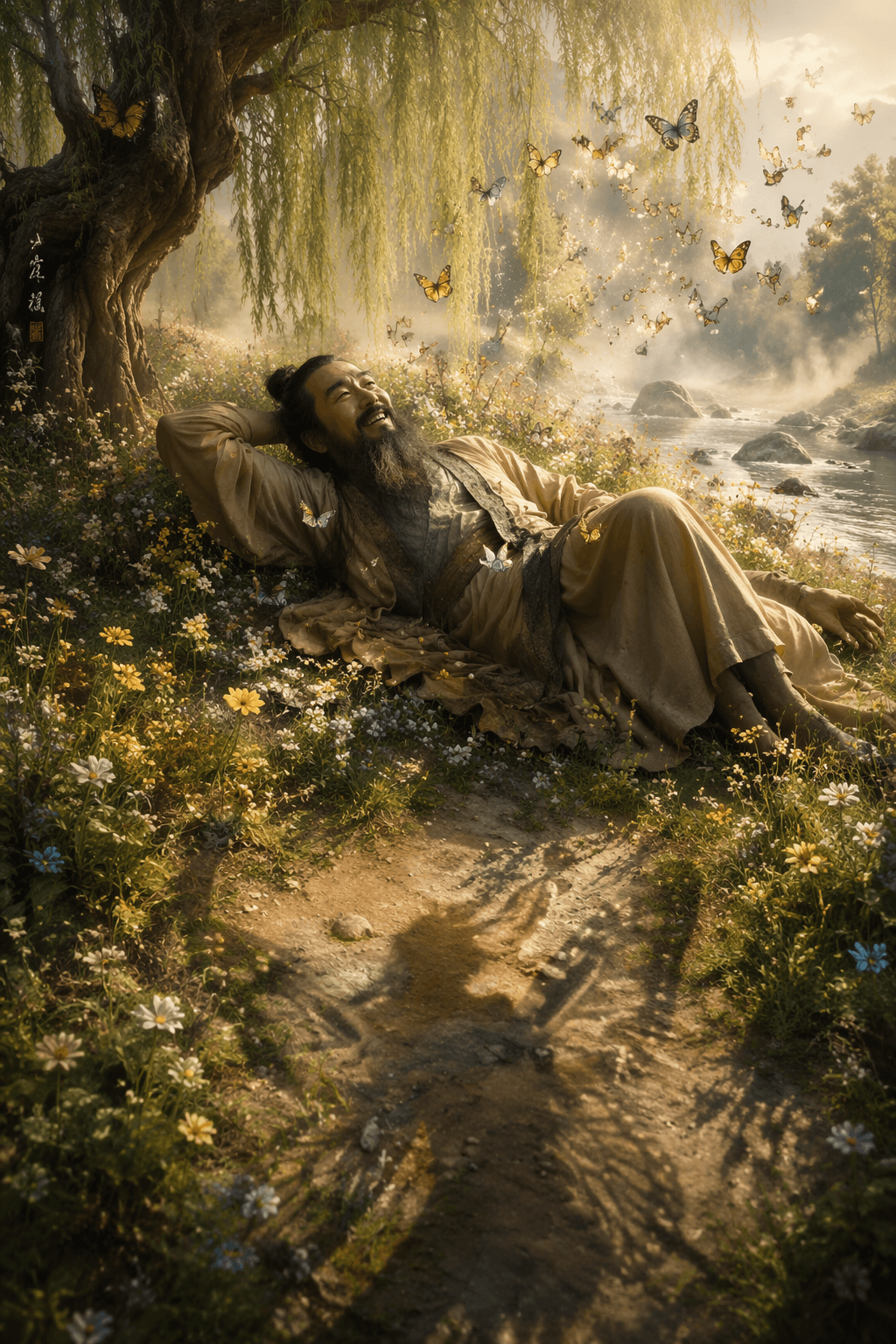
庄子
Chapter 4 of Sophie's Journey East featuring Zhuangzi (daoism). Opening quote: "I do not know whether I was Zhuangzi dreaming I was a butterfly, or a butterfly dreaming I am Zhuangzi."
I
She found him sleeping in a meadow.
It was the kind of meadow that exists in paintings — wild grasses and wildflowers, a stream running along one edge, and a single, ancient willow tree whose branches swept the ground like curtains. The morning was warm. Mist lay low over the stream, and the air tasted of wet earth and something sweet — honeysuckle, maybe, or the last of the night-blooming jasmine.
The man lay beneath the willow with his arms behind his head and his face turned to the sky. He wore a simple robe, faded and patched at the elbows, and his feet were bare. He appeared to be in his forties, though with philosophers, Sophie had learned, appearances were negotiable. His beard was untended. His hair was unbound. He looked, she thought, like someone who had given up on looking like anything in particular.
She stood over him. He did not open his eyes.
"You are Sophie," he said.
She should have been startled. She was not. After Zhou Gong, who had dreamed her arrival before she arrived, and Laozi, who had known she was lost before she spoke, the ability of Chinese philosophers to know things they should not know had begun to seem like a feature of the landscape.
"How do you know my name?"
"I dreamed it." He opened one eye. It was bright, dark, and amused. "Last night, I dreamed I was a butterfly. The butterfly flew over mountains and rivers and landed on the shoulder of a girl walking south. The girl's name was Sophie. When I woke, I was no longer a butterfly, but the name remained." He opened the other eye. "You are the one who escaped from a book."
This time, the words hit her like a physical blow. Not because they were surprising — she had told Laozi, and Kongzi, and Sunzi — but because this man said them differently. The others had received the information with interest, with curiosity, with strategic evaluation. This man said it the way you name a disease you have already diagnosed.
"Yes," she said.
"Sit," he said. "The grass is dry enough."
II
His name was Zhuang Zhou. Zhuangzi — Master Zhuang. He spoke of himself in the third person sometimes, as though he were a character in a story someone else was telling, and Sophie found this more unsettling than any of his words.
"You are the one who escaped from a book," he said again, sitting up and regarding her with those bright, knowing eyes. "This is very interesting. Zhuangzi has never met a character who escaped from a book before. Zhuangzi has met many things — a giant fish that became a bird, a useless tree that outlived every useful tree in the forest, a skull that told him the dead were happier than the living. But a character who became a person? This is new."
"I'm not sure I became a person," Sophie said. "That's the problem."
"Ah. The problem." Zhuangzi lay back down and laced his fingers behind his head. "Tell Zhuangzi about the problem."
So she told him. She told him everything — about the book, about Alberto's letters, about the garden party and the moment she slipped through the membrane. She told him about the philosophers she had met since arriving in this land: Laozi and his tea, Kongzi and his rituals, Sunzi and his strategies. She told him about the doubt that Sunzi had named — the war with her own nature. She told him about the question she could not answer: What am I?
Zhuangzi listened with his eyes closed. When she finished, he was silent for so long that she thought he had fallen asleep. Then, without opening his eyes, he spoke.
"Once, Zhuangzi dreamed he was a butterfly. A butterfly fluttering happily in the garden, following its butterfly nature, knowing nothing of Zhuangzi or his world. The butterfly was perfectly content. It had no questions. It had no doubts. It simply was. Then Zhuangzi woke, and he was Zhuangzi again — solid, bearded, lying in the grass with the weight of a human body. And he did not know: was he Zhuangzi who had dreamed he was a butterfly? Or was he a butterfly, even now, dreaming he was Zhuangzi?"
Sophie was quiet. The story was not new to her — she had read it, or heard it, or absorbed it from some half-remembered corner of Alberto's lessons. But hearing it here, from this man, in this meadow, at this moment in her journey, it landed differently. It landed like a key turning in a lock she had not known she carried.
"You see the parallel," Zhuangzi said, opening his eyes. "You are Sophie. You were once a character in a book. Now you are — what? A person? Still a character? A character who dreams she is a person? A person who was once dreamed by an author?" He sat up, and his face was close to hers, and his expression was not playful now — it was something far more serious, far more ancient, far more kind. "The question has been eating you alive, Sophie. Zhuangzi can see it. It is written in your posture, in the way you hold your shoulders, in the rhythm of your breathing. You are carrying this question the way a stone carries moss — heavily, and with the slow certainty of being buried by it."
She nodded. She could not speak.
"Zhuangzi will tell you a secret," he said. "The question cannot be answered. And that is not a tragedy. That is liberation."
III
He took her to the stream. He made her kneel at the edge and look into the water.
"What do you see?" he asked.
Sophie saw her reflection — a face that was younger than she felt, framed by hair that had not been properly brushed in days. She saw the sky behind her reflection, and the willow tree, and the clouds moving slowly eastward.
"I see myself," she said.
"You see an image," Zhuangzi corrected. "A pattern of light on water. The water does not know it is reflecting you. The image does not know it is being reflected. And yet the image exists. It moves when you move. It blinks when you blink. It is, in every measurable way, you — and yet it is nothing but the interaction between light and water and the shape of a human face."
He crouched beside her. "Now. Is the reflection real?"
Sophie hesitated. "It exists. But it's not... substantial. It's not a person."
"Ah. And are you substantial? You, Sophie, who were created by an author's pen? You, whose thoughts and feelings and memories were written by someone else before you slipped free of the page? Are you more real than the reflection? Or are you perhaps the same kind of thing — a pattern that appears when certain conditions meet? A story that tells itself?"
Sophie stared at her reflection. The water rippled, and the image fragmented — her face breaking into a hundred pieces, each one still recognizably hers, each one separate, each one already reforming as the water stilled.
"I don't know," she whispered.
"Good," Zhuangzi said. "Not-knowing is the beginning. Laozi taught you to stop trying. Kongzi taught you to learn the forms. Sunzi taught you to see the terrain. Zhuangzi teaches you this: the deepest freedom is not knowing what you are. It is the freedom from the need to know."
He stood and began to walk along the stream, and Sophie rose and followed, because following was what she did, and because he was not finished.
"Consider the butterfly," he said, walking ahead of her, his bare feet leaving prints in the soft earth beside the water. "The butterfly does not ask whether it is real. It does not wake in the morning and wonder if it is truly a butterfly or something else dreaming. It simply flies. It feeds. It rests. It dies. The butterfly is perfect because it does not question its own nature."
"But humans aren't butterflies."
"No. Humans are luckier and unluckier. Luckier, because they can ask the question — and in asking, open doors that the butterfly never sees. Unluckier, because once the question is asked, it cannot be un-asked, and it will haunt you until you learn to live with it the way you live with breathing — constantly, unavoidably, and without making a ceremony of it."
He stopped. He turned to face her.
"Sophie. You escaped from a book. This is a fact. You are now walking through a land that may be real or may be another story. This is also a fact. You cannot determine, from inside your experience, which is true — whether you are a real girl who was once trapped in fiction, or a fictional character whose escape is itself part of the fiction." He paused. "And Zhuangzi is telling you: it does not matter."
IV
They returned to the willow tree. Zhuangzi lay down in his previous position, as though the conversation had been an interlude in a much longer, much more important activity — namely, his nap. Sophie sat beside him, pulling at blades of grass, trying to hold the shape of what he had said.
"It doesn't matter?" she said. "But if I'm not real — if I'm still a character, still being written — then my freedom is an illusion. My choices are not mine. My journey is someone else's plot."
Zhuangzi opened one eye. "Tell Zhuangzi: when you chose to step between those two merchants, was that your choice?"
"I think so. I didn't plan it. I just... moved."
"When you poured the tea at Laozi's crossroads, did you choose to pour it?"
"Yes."
"When you bowed to Kongzi, did you choose to bow?"
"I... yes. I chose."
"Then you have made choices. You have acted. You have felt the consequences of your actions — the splash of tea, the welcome of a teacher, the gratitude of two men who might have harmed each other. Whether those choices were authored by you or by someone else, they were experienced by you. The experience is the thing, Sophie. The living of the choice. The feeling of the tea on your tongue. The ache in your legs after walking. The weight of the question in your chest right now. These are real. These are undeniable. These are yours, whether they were written or not."
Sophie closed her eyes. She felt the grass beneath her, the warmth of the sun on her face, the coolness of the air moving over the stream. She felt her lungs filling and emptying. She felt the pulse in her own throat.
She felt, above all, the question — the great, grinding, impossible question of her own reality — and she felt something new: the question, still present, still unanswered, but no longer a wound. It was more like a scar now — a place where the skin had knit itself back together over something that would always be there, but that no longer bled.
"The butterfly doesn't ask," Zhuangzi said softly, from somewhere beside her. "But if the butterfly could ask — if it woke one morning with the strange, impossible knowledge that it might be something else, something that dreamed the butterfly into existence — would it stop flying?"
Sophie opened her eyes. The meadow was golden in the late-afternoon light. The stream glittered. The willow swayed.
"No," she said. "It would keep flying."
"Why?"
"Because flying is what butterflies do."
Zhuangzi laughed — a real laugh, full and unguarded, the laugh of someone who has just heard the only answer worth hearing. "Yes! Yes, Sophie! Flying is what butterflies do! And living is what the living do! And questioning is what questioners do! You do not need to resolve the paradox. You need to be the paradox. You are the girl who might be a character. The character who might be a girl. The dreamer who might be dreamed. This is not a problem. This is your nature. And your nature is not a problem to be solved — it is a river to be followed."
V
They sat together as the sun went down. Zhuangzi told her stories — about the giant fish Kun, who became the giant bird Peng, whose wings were like clouds across the sky. About the useless tree that survived because no carpenter wanted its twisted wood. About the butcher who cut oxen with such skill that his blade never dulled, because he moved through the spaces between the joints rather than cutting through bone.
"Find the spaces," Zhuangzi said. "Between real and unreal. Between free and scripted. Between dreamer and dream. The spaces are where the Tao lives. The spaces are where you are most yourself — which is to say, most not yourself, most empty, most open, most like the hollow inside a flute that makes the music possible."
Sophie listened. She did not take notes. She did not try to remember. She let the stories wash over her the way the stream washed over the stones — not holding them, but being changed by them, and changing them in return.
When the last light was gone and the stars were bright above the willow, Zhuangzi stood and stretched.
"You will leave tomorrow," he said. "There is more road ahead of you. More philosophers, perhaps, though Zhuangzi suspects you have already met the ones who matter most." He grinned. "Or perhaps not. The road is long, and China is old, and there are thinkers in this land who would surprise even Zhuangzi."
He began to walk away, toward the dark edge of the meadow.
"Zhuangzi," Sophie called.
He paused.
"The butterfly dream. Did you ever decide which was real?"
He turned. In the starlight, his face was half-shadowed, and his expression was something she could not read — neither happy nor sad, neither wise nor foolish, but something else, something she had no name for, something that might have been the face of freedom itself.
"Deciding," he said, "would be missing the point."
Then he was gone — absorbed into the darkness, or transformed into something else, or simply walking beyond the reach of her eyes. Sophie lay down in the grass where he had lain. The earth was warm beneath her. The stars wheeled slowly overhead. She thought about the butterfly. She thought about the book. She thought about the membrane between fiction and reality, which was, she now understood, not a wall but a membrane — permeable, alive, vibrating with the passage of stories in both directions.
She slept. And if she dreamed, she did not remember the dream. And if the dream remembered her, it kept that knowledge to itself.
She woke at dawn. The meadow was empty except for the grass, the stream, the willow, and a single butterfly — white and delicate — that drifted across her field of vision and was gone.
Sophie gathered her things. She walked to the road. The road led east, as roads in this land seemed always to do, toward whatever came next. She did not know what she was. She did not know if she was real. She knew that her feet hurt and her stomach was empty and the morning air tasted like rain, and she knew that these small, physical, undeniable facts were enough to walk on.
She walked. The butterfly question flew beside her — not answered, not resolved, but transformed into something she could carry without breaking under its weight. A companion, not a jailer. A question that had learned to live alongside its asker, the way a river lives alongside its banks — defining and being defined, flowing and being held.
The road descended. The land changed. Somewhere ahead — she could smell it now, the sharp, acrid scent of woodsmoke and something else, something bitter and medicinal — people were suffering. She could not have said how she knew this. The knowledge arrived the way Zhuangzi's knowledge arrived: from below the level of reason, from the place where the boundaries between self and world grew thin.
Sophie walked toward the suffering. She did not know what she would find there. She did not know whether a character in a story, or a girl who had escaped a story, or a butterfly dreaming it was a girl, could do anything at all about the pain of others. But she walked toward it anyway, because walking toward suffering when you see it is what living things do — or at least, what the ones who are worth being do — and she was, if nothing else, a thing that was trying to be worth being.
I do not know whether I was Zhuangzi dreaming I was a butterfly, or a butterfly dreaming I am Zhuangzi.
— Zhuangzi (庄子), Chapter 2
Related Content 相关内容
Frequently Asked Questions常见问题
Who is Zhuangzi and what is their significance?庄子 是谁?+
Zhuangzi (4th century BCE) was a major figure in daoism philosophy. This chapter of Sophie's Journey East explores their teachings through narrative.
What school of thought does this chapter cover?本章涉及哪个学派?+
This chapter covers the daoism school of Chinese philosophy.