Knowing and Not Knowing
知己知彼
Sunzi 孙子 · 544–496 BCE · Wu (modern Jiangsu)
“Know yourself and know your enemy, and you will never be defeated.”— The Art of War (孙子兵法), Chapter 3
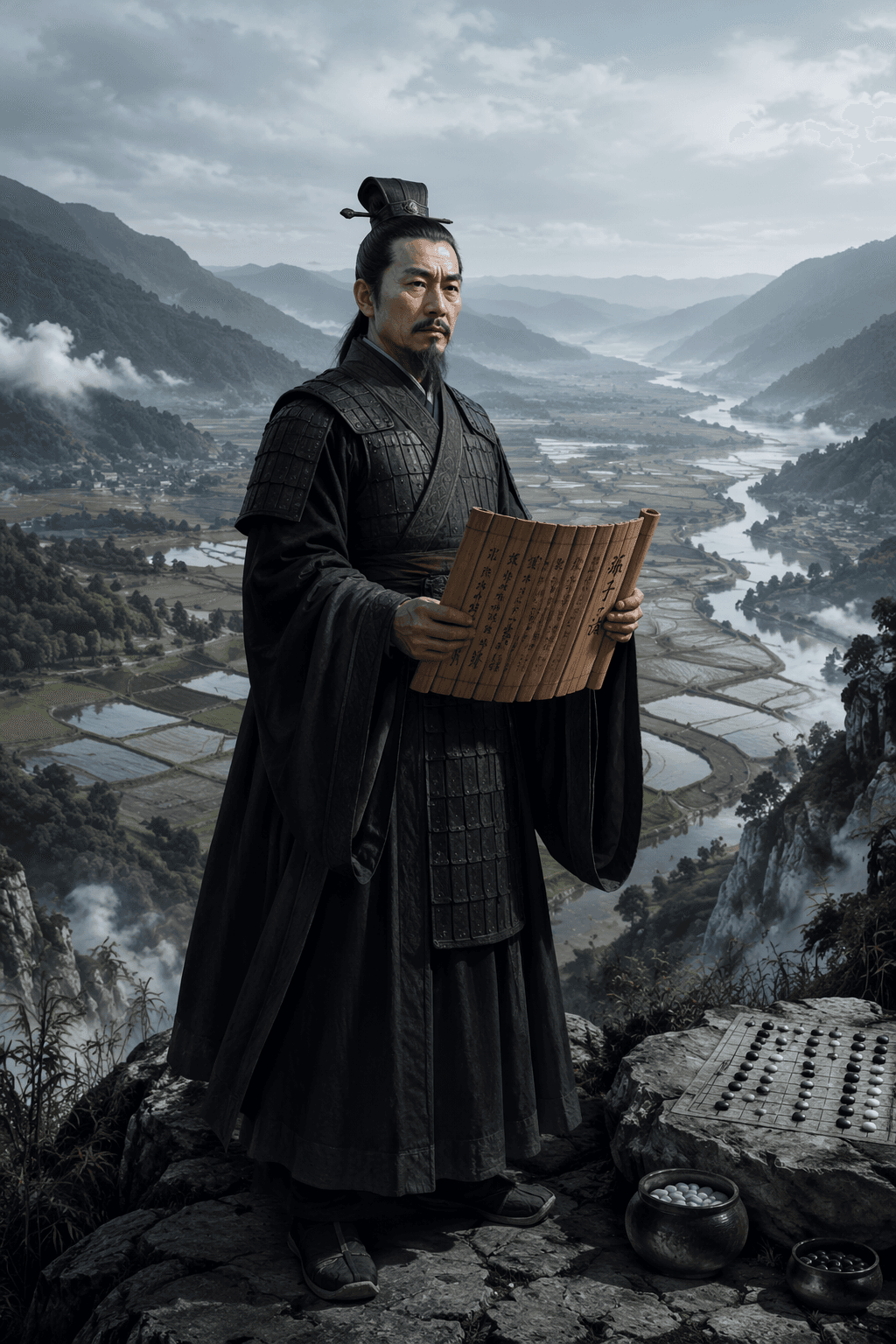
孙子
Chapter 3 of Sophie's Journey East featuring Sunzi (strategy). Opening quote: "Know yourself and know your enemy, and you will never be defeated."
I
Sophie left Qufu heading south, carrying with her a small bag of provisions that Kongzi's students had pressed upon her and a set of instructions so detailed they bordered on the absurd — how to greet a stranger on the road, how to accept an offering of tea, how to decline an invitation without causing offense. She had practiced each one until the movements felt less foreign, though they still sat on her body like borrowed clothes.
The landscape changed as she traveled. The dry plains of Lu gave way to wetter country — rice paddies carved into terraces, irrigation channels threading between fields like veins, the air thick with moisture and the smell of green growth. She passed through villages where the people watched her with open curiosity but, following the rituals she had learned, she greeted them properly, and their faces relaxed into something like welcome.
She was three days south of Qufu when she came upon the marketplace.
It sprawled along the bank of a wide, muddy river — a confusion of stalls and awnings and shouting vendors, bigger and wilder than anything in Qufu. The smell hit her first: fish and pepper and something sweet and fermented, all mingled with the mineral tang of river water. She moved through the crowd carefully, practicing her greetings, and had just purchased a bundle of steamed buns from an old man who smiled at her terrible accent when the shouting began.
Two merchants. One young, one old. They stood before a stall of silk bolts, and the space around them had opened up the way spaces do when violence is imminent — the crowd pulling back, forming an arena, watching with the grave attention people give to conflicts that are not yet theirs.
The young merchant was accusing the old one of selling him spoiled dye. His voice was loud, his gestures sharp and angular. The old merchant was quieter, but his stillness was not peace — it was the stillness of a man who has been wronged and knows it. Sophie could see, even from a distance, that both of them believed they were right, and that both of them were afraid.
The young merchant grabbed the old one's collar.
Sophie did not decide to step forward. Her body moved before her mind could object, the way it had moved when she escaped the book — not thoughtfully, but instinctively, driven by something below the level of reason.
"Stop!" she said, in the one word of Chinese she was certain of.
They both turned and looked at her. The young merchant's grip loosened in surprise. The old merchant used the moment to pull free. And then they were both staring at this foreign girl with her strange clothes and her single, inadequate word, and the situation, which had been on the edge of violence, tipped instead into confusion.
"Who are you?" the young merchant demanded.
Sophie had no idea how to answer.
II
The man who resolved the situation arrived the way resolution often does — not with drama but with the quiet certainty of someone who has assessed a problem and seen its shape before it fully emerges.
He was not old. Not young. He wore practical clothes — no silk, no finery, just the dark, close-fitted garments of someone who valued movement over appearance. His head was shaved close, and his eyes moved constantly, reading the crowd, the merchants, the girl, the stall, the silk, the dye, the river, the sky — absorbing everything, missing nothing.
He said something to the merchants in a low voice. Sophie could not hear the words, but she watched their effect. The young merchant's shoulders dropped. The old merchant's jaw unclenched. Something was being redistributed — not the silk, not the money, but the position of the two men relative to each other. The stranger was, Sophie realized, rearranging the battlefield.
After a few minutes, the young merchant produced a small pouch from his belt and placed it on the stall. The old merchant picked up one bolt of silk and handed it over. They bowed to each other — a perfunctory bow, not the deep, graceful bow of Kongzi's temple, but a bow that acknowledged a conclusion. Then they went their separate ways.
The crowd dispersed. The stranger turned to Sophie.
"You put yourself between two angry men," he said. His voice was flat, evaluative. "Do you know what that is called in my profession?"
"Brave?" Sophie offered.
"Foolish. The word is foolish." But there was a glint in his eye that softened the judgment. "My name is Sun Wu. Some call me Sunzi. I study the art of conflict. And you, foreign girl, are an interesting problem."
He walked toward the river. After a moment, Sophie followed.
III
They sat on the riverbank. Below them, the water moved in complex currents — eddies and counter-currents, places where the surface was smooth and places where it boiled around submerged rocks. Sunzi watched the water as he spoke, as though the river were illustrating his points in real time.
"Conflict is not a failure of peace," he said. "Conflict is a feature of the world. Two rivers meet. They do not politely merge. They struggle. They form whirlpools. Eventually, they become one stream, but the struggle was real, and it was necessary. The question is not how to avoid conflict. The question is how to engage with it skillfully."
Sophie pulled her knees up to her chest. "Those merchants — what did you say to them?"
"I told the young one that the dye was not spoiled but that he had stored it improperly, which was his fault, not the old one's. I told the old one that a merchant who sells dye without explaining its proper storage has not fulfilled his half of the transaction, which is his fault, not the young one's. Both were partially right. Both were partially wrong. The art is in helping each of them see the part they were wrong about without losing face."
"So you made them both lose a little."
"I made them both recognize a little. The young man paid for the dye he had wasted through neglect. The old man provided replacement silk to compensate for his failure to instruct. Both lost something. Both gained something more valuable: the knowledge that they had been seen accurately."
Sunzi picked up a flat stone and turned it in his fingers. "The supreme art of war is to subdue the enemy without fighting. Those men were enemies for a moment. If they had fought, one would have won and the other lost, and the loss would have festered into grudge. Instead, neither won. Neither lost. They simply... adjusted."
Sophie thought about the philosophers she had met so far. Laozi, who told her to stop trying. Kongzi, who told her to learn the patterns. And now this man, who told her that conflict could be managed — not avoided, not surrendered to, but shaped.
"What if you can't find a solution where nobody fights?" she asked.
"Then you fight. But you fight with full knowledge — of yourself, of your opponent, of the terrain, of the moment. Most conflicts are lost before they begin, because one side or both sides is fighting blind. They do not know what they want. They do not know what the other wants. They do not know where they stand. They swing their fists at shadows."
He threw the stone into the river. It skipped once, twice, three times, then sank.
"Know yourself and know your enemy, and you will never be defeated in a hundred battles. That is the first principle. But it applies to more than war. It applies to every moment where your will meets another will and the outcome is uncertain."
IV
The sun moved westward. Sunzi talked, and Sophie listened, and the river demonstrated everything he said.
He spoke of terrain — how the shape of the land determines the shape of the conflict. A battle fought in a valley is different from a battle fought on a plain. A marketplace dispute is different from a border war. The wise strategist does not impose his will on the terrain. He reads the terrain and lets it tell him what is possible.
He spoke of timing — how every conflict has a moment when the balance shifts, when one side is vulnerable and the other is poised. The art is not in being stronger but in being ready when the moment arrives. The merchant who demands satisfaction at the wrong moment loses even when he is right.
He spoke of deception — not dishonesty, but the strategic management of appearance. "All warfare is based on deception," he said. "When you are able, appear unable. When you are near, appear far. When you are weak, appear strong." He looked at Sophie directly. "You are a girl who escaped from a book. That is either the weakest position in the world — a character with no author, no story, no purpose — or the strongest — a being who is utterly unpredictable because she is answerable to no narrative. Which is it?"
Sophie felt something cold move through her. "I don't know."
"Good. Not knowing is honest. Not knowing and pretending to know — that is where defeat begins." He stood, brushing dust from his robes. "You have courage. I saw that in the marketplace. But courage without understanding is a fire without a hearth. It burns whatever it touches. Learn to see the shape of conflicts — not just the shouting, but the terrain beneath it, the needs behind it, the moment within it. Then your courage will have a direction."
He began to walk away along the riverbank. Sophie stood.
"Sunzi —"
He paused.
"When you look at me, what do you see? What is my terrain?"
He considered her for a long moment — not her face, not her clothes, but something behind and beneath both.
"I see a person who does not know whether she is real," he said. "That is the most dangerous terrain of all. A person who doubts her own existence cannot know herself, and a person who cannot know herself cannot read any conflict she enters. You are at war with your own nature, Sophie. And until that war is resolved — or dissolved — every other battle you fight will be a reflection of the one inside."
He turned and walked on, and the river swallowed his footsteps, and Sophie was alone.
V
The marketplace resumed its noise around her. The river resumed its current. The world resumed its indifference to the things she was feeling, which was, she thought, perhaps the most honest thing the world could do.
She sat on the riverbank until the light turned amber and the first mosquitoes rose from the water. She replayed the day in her mind — the merchants, the intervention, the stranger with his flat, precise voice and his eyes that saw everything. She thought about terrain and timing and the art of winning without fighting. She thought about his last words to her, and how they had found the exact place where she was most afraid.
You are at war with your own nature.
Was she? Was the doubt — the endless, grinding uncertainty about whether she was real or fictional, free or scripted, a person or a character — was that a war? Or was it something else? A question that could not be answered by strategy because it was not, in Sunzi's terms, a conflict at all? It was something more like a dream — a state in which the usual rules of engagement did not apply because the combatants were not on the same plane of existence.
She thought about Alberto's letters. She thought about Laozi's tea. She thought about Kongzi's careful, precise bows. Each philosopher had given her something — a way of seeing, a way of moving, a way of being with others. But none of them had answered the question that sat at the center of her like a stone in a river, around which all the currents of her new life had to flow.
What am I?
The mosquitoes bit. The light faded. Sophie stood, shouldered her bag, and walked away from the river, following a road that led inland through darkening fields. She did not know where she was going, but she had stopped expecting to know. The not-knowing was becoming familiar — a landscape she inhabited rather than a problem she needed to solve.
Somewhere ahead, she was sure, another philosopher was waiting. Another question she had not yet thought to ask. Another piece of the vast, ancient, incomprehensible civilization that had been asking questions for three thousand years before she was even a character in someone's imagination.
She walked. The stars came out. The road wound through farmland and forest, and the night sounds of the Chinese countryside rose around her — crickets, frogs, the distant bark of a dog, the rustle of something small moving through the rice paddies. She was not afraid. She was not brave. She was simply walking, one foot after another, through a world that was either real or a dream, and for the first time, the difference between those two things seemed to matter less than the walking itself.
Know yourself and know your enemy, and you will never be defeated.
— The Art of War (孙子兵法), Chapter 3
Related Content 相关内容
Frequently Asked Questions常见问题
Who is Sunzi and what is their significance?孙子 是谁?+
Sunzi (544–496 BCE) was a major figure in strategy philosophy. This chapter of Sophie's Journey East explores their teachings through narrative.
What school of thought does this chapter cover?本章涉及哪个学派?+
This chapter covers the strategy school of Chinese philosophy.